

You've used eleven pages of a new sketchbook, you've got thirty photos on your phone that you meant to draw from, and the course page in front of you asks you to choose a level from a dropdown. Maybe you're the parent at the kitchen table instead, or the tutor being asked for the fourth time whether a drawing qualification leads anywhere. The stuck point is rarely the drawing. It's the routes: which level to enter, how long it runs, what an assessor wants to see, and whether the work will still count as yours by the time it reaches an admissions tutor.
Many learners arrive one step further along than they think. The expensive mistakes come from picking a course name first and checking the level and the evidence later. Here's the ladder, the skills it builds, the assessment rules that decide whether work counts, and the questions Level 2 and Level 3 students ask most about university entry.
Table of Contents
- Drawing Course Routes by Level and Duration
- Core Skills a Drawing Course Builds
- How Drawing Work Is Assessed in Practice
- How Tutor-Led Online Study Builds Progression
- Who a Drawing Course Suits
- Adapting Drawing Study for SEND Learners
- Using Digital Tools and AI Without Losing Authorship
- Level 2 and Level 3 Questions About University Entry
- Choose Your Route and Confirm Your Next Step
Drawing Course Routes by Level and Duration
A course in drawing isn't one product. It's a ladder, and the right rung depends on your current level, your age and your goal.
| Route | Level | Typical duration | Leads to |
|---|---|---|---|
| Recreational taster or skills course | Non-accredited | Short, weeks rather than years | Confidence and a first drawing portfolio |
| Key Stage 3 Art | Key Stage 3 | Follows the school key stage, usually Years 7 to 9 | Foundation for GCSE-age study |
| Level 1 pathway | Level 1 | A year or less | Entry into formal study in art, music, photography or design |
| Level 2 Certificate in Art and Design | Level 2 (GCSE equivalent) | Standard 2 years or intensive 1 year | GCSE-equivalent progression |
| International GCSE Art and Design | Level 2 | Standard 2 years or intensive 1 year | iGCSE progression, in the UK or outside it |
| A Level Art, Design or Music | Level 3 | Typically 2 years | Degree applications |
| Level 3 Foundation Diploma in Art and Design | Level 3 | Usually one year of specialist study | Specialist portfolios such as fine art, photography, graphic design and fashion |
Read the duration column as a commitment check, not a ranking. Accredited routes are tied to an awarding body's assessment calendar, so the timetable doesn't move for a busy month. Recreational study bends around your week and produces no certificate, which is exactly right when confidence is the goal and wrong when a university application is.
Length on an unregulated course is set by whoever runs it. On accredited routes, two patterns matter. The Level 2 Certificate in Art and Design runs as a standard two-year course or an intensive one-year course, and International GCSE Art and Design follows the same two-year or one-year pattern, written for study in the UK or outside it.
If you're unsure which rung you're standing on, which course level is right for you sets out the entry evidence each level expects.
Then choose the row that satisfies your current level, your target qualification and the hours you can give each week. Two out of three won't hold.
Core Skills a Drawing Course Builds
Drawing is a set of seeing skills that stack. Each one makes the next possible, which is why a course that jumps straight to finished pictures leaves learners stuck at the same level for years.
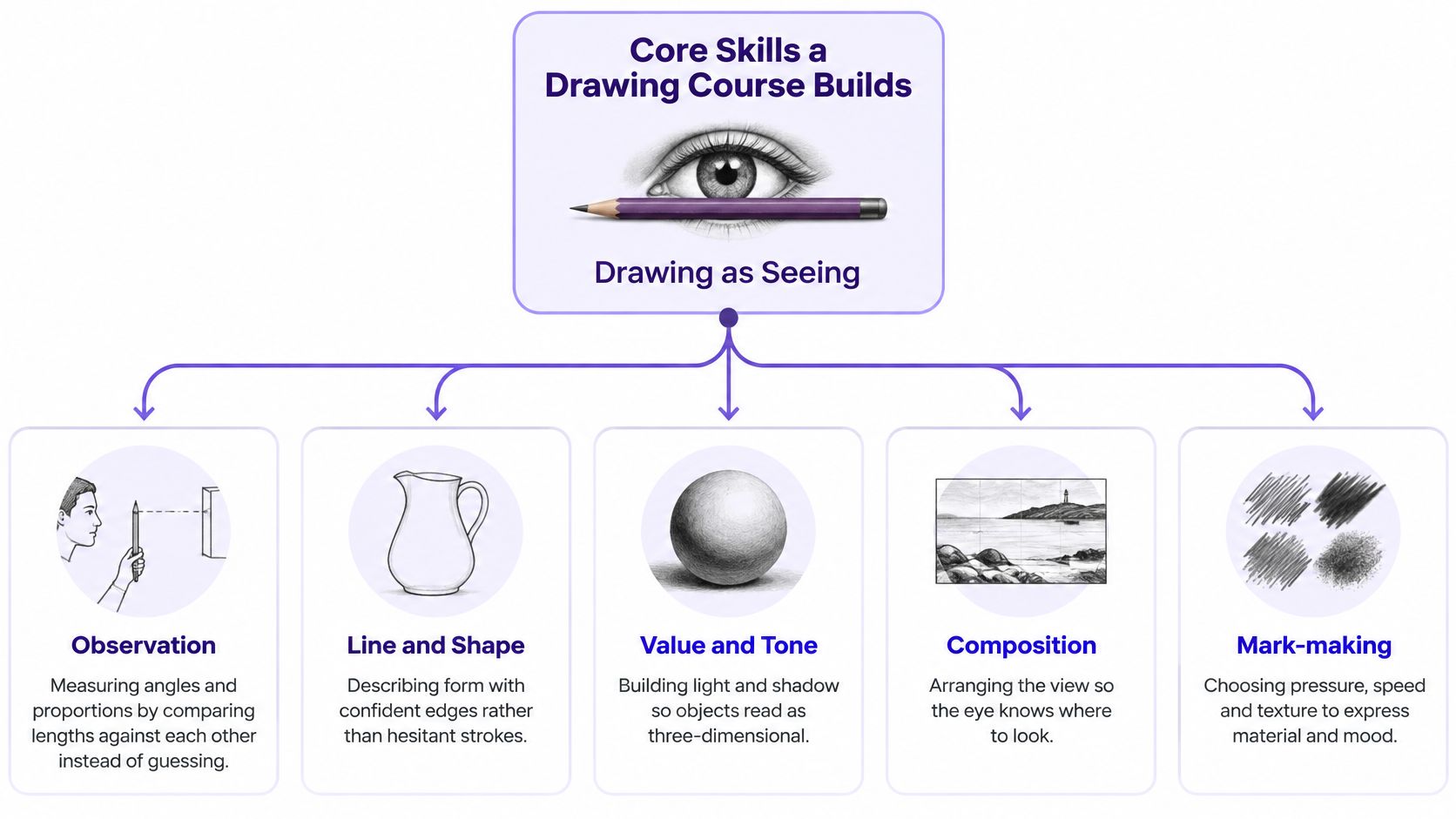
Observation comes first. You measure angles and proportions by comparing one length against another instead of guessing: the width of a mug's handle against the width of the mug, the tilt of a roof edge against the vertical edge of the page. Hold a pencil at arm's length, line it up with the shape, then bring it back to the paper along the same path your arm travelled.
Perspective places those shapes in space. One-point construction gives you a single vanishing point on the eye level line; two-point gives you two. The difference is how you're standing in relation to the object. Put the eye level line and the vanishing points in first and the rest of the drawing has somewhere to go.
Here is the same reasoning worked through at the easel.
Volume and form come next. A cube, a cylinder and a sphere teach how light wraps around a shape, and once you can shade those three convincingly, most objects become variations on them. Tonal study follows: plot light, mid-tone and shadow on a value scale, decide where the light source sits, and the form starts defining itself.
Mark-making turns control into expression. Test pencil, charcoal, ink and mixed media on the same subject and notice how pressure, speed and texture change the reading. Composition arranges shapes, edges and focal points so the eye knows where to land. Colour harmony comes later, applied to observed subjects rather than learnt as swatches on a chart.
The rule to keep: draw to find out, not only to finish.
Drawing also changes form with purpose. AQA's GCSE Art and Design scheme of assessment states that drawing may take different forms according to purpose and need, including planning, analytical observation, experimentation and expressive development. A good course therefore sequences short, function-specific studies before it asks for a sustained project.
Practice step: make one ten-minute value study this week, from life, and label where the light falls. Mark the darkest point, the lightest point and the direction the shadow travels. Keep the sheet.
How Drawing Work Is Assessed in Practice
Assessment judges a portfolio of process, not a single polished sheet. Ofqual's GCSE subject level conditions and requirements for Art and Design allocate 25% of assessment to each of four equally weighted objectives. That means a beautiful final drawing with no working pages behind it scores no better than a plainer set of studies showing every decision.
| Assessment objective | Weighting | What tutors look for |
|---|---|---|
| AO1 Develop ideas through source investigation | 25% | Research pages, original sources and clear starting points |
| AO2 Refine ideas through experimentation | 25% | Tests in two or three media, with visible revisions |
| AO3 Record observations and insights | 25% | Annotated studies that show what was seen and why it mattered |
| AO4 Present a meaningful final response | 25% | A coherent outcome that communicates visual intent |
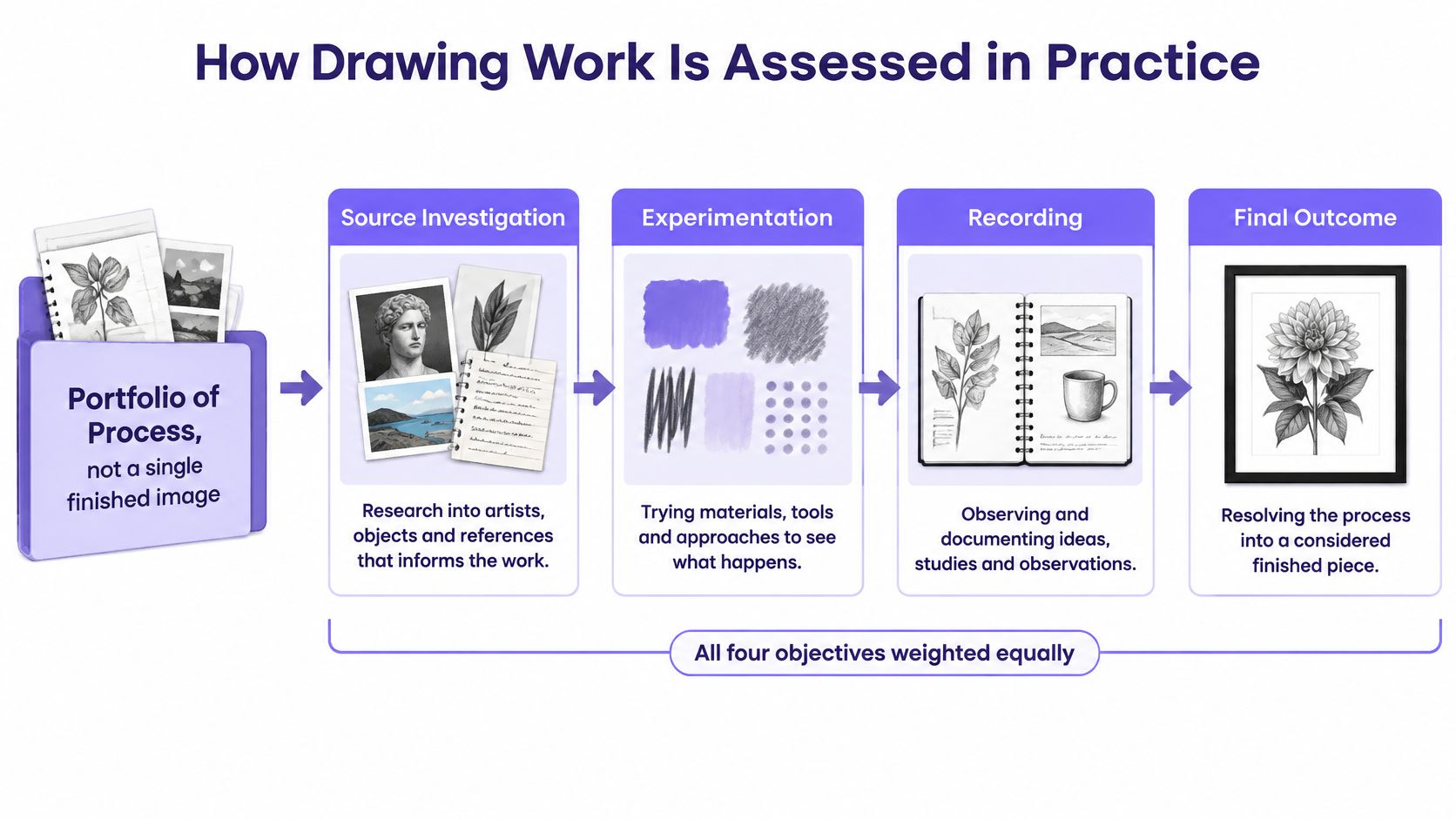
Keep the preparatory studies, the annotation, the revisions and the experiments. Technical progress becomes assessable when it's attached to deliberate decisions, and those are the pages learners throw away first.
A project cycle that matches the weightings:
- Choose a starting source and write one line on why it interests you.
- Investigate it with sketches, measured studies and photographs.
- Experiment with two or three media on the same subject.
- Record and annotate each decision as you make it, not afterwards.
- Present a final response with a short written rationale.
Photograph each sheet on the day you make it and upload it for feedback. That habit builds a dated timeline an assessor can follow, and it stops a term's work vanishing into a lost folder.
The common mistake is polishing one drawing for three weeks and discarding the thinking pages. A strong annotation covers four things: the visual problem you set yourself, the medium you chose, the adjustment you made, and the effect it had. GCSE art assessment objectives shows how the four weightings interact across a full project.
How Tutor-Led Online Study Builds Progression
A drawing course can be a ladder: each rung links the learner's current level to a clear next step. Tutor feedback helps make that movement visible by showing how a drawing changes in response to a specific decision.
For example, a learner might begin with a measured study of a cup, then adjust its proportions after feedback. In a later study, they could use tonal contrast to describe its rounded form. The sequence matters because it shows both developing skill and the learner's reasoning.
OCAD offers courses where students can choose one-to-one tutorials or group lessons. One-to-one discussion can focus on an individual drawing; group lessons let students learn from a live teacher and peers. See what working online with OCAD involves for more about the online learning experience.
A useful progression record connects each piece of work to the next. Uploading photographs of completed work and assignments allows students to receive feedback and build an art portfolio. An annotation can name the issue, such as an uncertain contour, explain the change made, and describe its effect. Over time, these notes make it easier to see whether observation is becoming more accurate and whether choices of media are deliberate.
Set dates for lessons, uploads and revisions, then use practical goal planning for college students to keep tasks manageable. Before enrolling, check how tutor feedback is provided and how students can choose between individual tutorials and group lessons.
Who a Drawing Course Suits
Most adult evening classes are full of people starting again rather than starting from nothing.
In England, drawing is taught and assessed inside the wider Art and Design qualification rather than as a standalone GCSE. Government statistics on provisional entries for GCSE, AS and A level recorded 194,040 entries in Art and Design subjects in summer 2022 and 191,160 in summer 2023, a decrease of 2,880 entries, or approximately 1.5%, while total GCSE entries rose 3.6% over the same period. Drawing sits in a large, recognised pathway, one competing for timetable space.
The longer trend is starker. Parliament's library briefing on arts education reports that, since 2010, the share of GCSE entries in arts subjects declined by 47%, citing research by the Campaign for the Arts (House of Lords Library, arts education in England). Flexible provision exists partly because squeezed options leave gaps.
- Complete beginners: structure matters more than inspiration, so a recreational or taster course comes first.
- Returning adults: you want to rebuild confidence and finish a first set of sketches, not chase a certificate.
- Career changers: illustration, graphic design and photography all need a portfolio, so pick a portfolio-focused route. Students who already hold an art degree and want to move into graphic design are accepted onto our courses on that basis.
- Home-educated learners: you need an accredited route with clear assessment points and a named qualification at the end.
- Practising artists: outside eyes on your work, especially after years away from painting, is the whole point.
International learners usually need the same thing in a form that fits around other commitments, which is where tutor-led online study earns its place.
Three questions decide enrolment: what level am I working at, what qualification do I need, and how many hours a week can I give? If you hold no formal art qualification, start with a Level 2 Certificate or a taster rather than committing to Level 3, because A Level entry usually assumes an equivalent qualification.
Adapting Drawing Study for SEND Learners
638,700 children and young people in England had an active Education, Health and Care plan in January 2025 (Explore Education Statistics, education, health and care plans). For a learner, the practical question is how to make drawing tasks accessible while keeping the learning objectives clear.
- Sensory load: softer lighting, a neutral background behind the subject, or a quieter session format can reduce distractions. Cameras can be off if the learner prefers.
- Visual instructions: step cards, numbered demonstrations and captioned video give learners ways to follow a task without relying only on spoken explanations.
- Alternative mark-making tools: thicker grips, tactile charcoal, large-format paper, a stylus or a drawing tablet can provide different ways to make marks.
- Predictable feedback: using the same written format on the same day each week makes feedback easier to anticipate. Share the schedule in advance.
- Flexible pacing: self-paced units and live sessions booked around the learner's preferred hours can make study fit their needs.
Screen and camera fatigue can make long sessions difficult. Shorter sessions with breaks may be more manageable, and a parent or carer can join if the learner wants support in the room.
Course level and support needs are separate choices. The Online College of Art & Design offers online SEND art and design courses with fully accredited qualifications at Level 2, equivalent to GCSE/BTEC, and Level 3, equivalent to A-Level/Foundation Diploma. Its Level 2 Certificate in Art & Design with SEND Support Package is studied online in the learner's own time, with no exam or written essay. A course route should fit the learner's goal and support needs, not just its title.
An adaptation changes access to the task, not the assessment criteria. For example, a learner with motor-coordination needs may use a stylus on enlarged sketchbook pages; the drawing can still be assessed for observation and proportion.
Tutor review: does the plan change access only, is progress evidenced against the same objectives, and has the learner been asked which adjustments actually help?
Using Digital Tools and AI Without Losing Authorship
The useful question isn't whether digital tools belong in drawing practice. It's whether you can prove which marks are yours when an assessor asks.
A study of 32 mainly UK art, design and media instructors at the University for the Creative Arts found that educators valued digital tools for accessibility and iterative experimentation, but raised concerns about over-reliance, authentic assessment and the loss of tactile studio practice (UCA research on art and design education). That's a fair summary of the tension in most portfolios.
Five workflows get muddled together, and they carry different rules:
- Reference gathering: collecting images to study from. Fine, with credit and a note on what you took from each.
- Tracing for study: useful for learning proportion. Disclose it and never submit it as finished drawing.
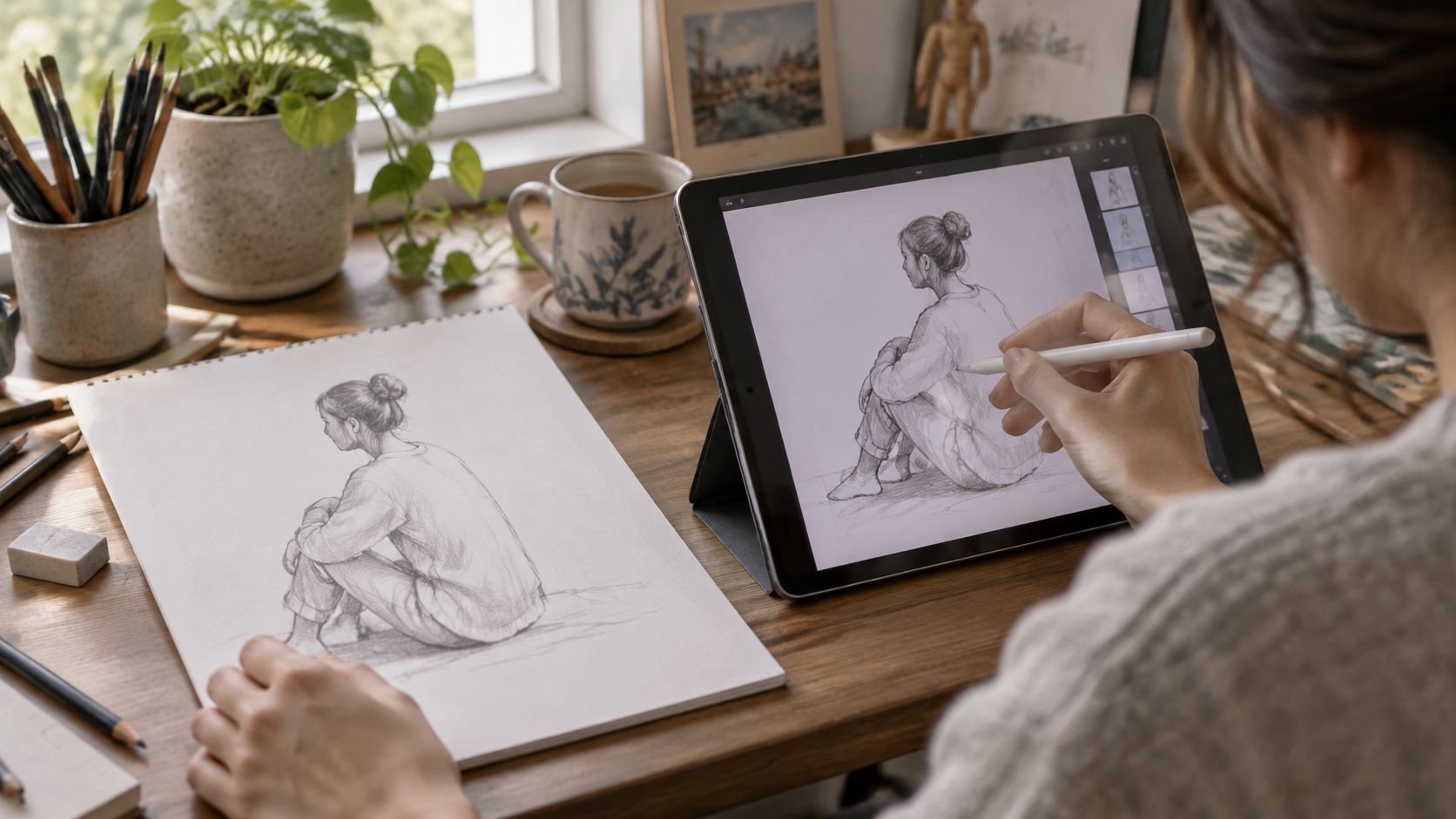
- Digital rendering: drawing on a tablet with your own marks. Treat it exactly like a pencil drawing.
- Photo manipulation: editing a photograph. Disclose it and assess it separately from drawing.
- Generative image production: prompting a model. That isn't your drawing, and presenting it as one breaks the deal.
Process evidence is what carries all five. Keep the source images, the sketches, the failed attempts, the edits, the tool disclosure and a short note on the decisions you personally made. An assessor can follow a paper trail; nobody can follow a single unexplained image.
Hybrid tasks test the skills directly. Set a timed observational drawing from life, then a digital study that must match it, then a paragraph explaining which marks are your own and which tools produced them. When claims about new tools sound too good, it pays to test big AI claims yourself rather than take a demo at face value.
Ask yourself one question before submitting: if an assessor asked you to explain each choice, could you?
Level 2 and Level 3 Questions About University Entry
Does a Level 3 creative qualification count toward university entry? It depends on the qualification and the course page. Related creative-arts degrees commonly require at least two A levels, with published entry requirements ranging from CDD to ABB and BBC the most frequent requirement, according to UCAS guidance on creative arts subjects. Universities may also accept a BTEC Level 3 National Extended Diploma in Art and Design or an SVQ Creative and Cultural Skills qualification at SCQF Level 6, and acceptance is provider-specific, so match the qualification title, awarding body and grades against every course page you're considering.
Can you start A Level art without a GCSE in art? Yes, if you hold an equivalent formal qualification such as a Level 2 Certificate, a BTEC, high school art or an Arts Award. We accept students onto A Level art or design on exactly that basis.
Can an adult get university funding? There's no age limit for Tuition Fee Loan eligibility when you're studying for a first undergraduate degree. For Student Finance England, applicants generally need to be a UK national or have settled status, normally live in England, and have lived in the UK, Channel Islands or Isle of Man for the three years before the course starts (UCAS guidance on tuition fee loans for full-time students).
| Qualification | Typical use for university entry | What to check |
|---|---|---|
| A levels (at least two) | Commonly required for related creative-arts degrees | Published grades from CDD to ABB, with BBC the most frequent |
| BTEC Level 3 National Extended Diploma in Art and Design | Accepted by some universities | Acceptance is provider-specific; check each course page |
| SVQ Creative and Cultural Skills at SCQF Level 6 | Accepted by some universities | Acceptance is provider-specific; check each course page |
| Level 2 Certificate, BTEC, high school art or Arts Award | Equivalent qualification for starting A Level art without GCSE art | Confirm equivalence with the provider |
Three checks settle it: the entry requirement printed on the course page, your residency and immigration status, and whether the specific course is eligible for funding.
Choose Your Route and Confirm Your Next Step
Work through this in order and you'll have a route by the end of the evening.
- Name your current level and any GCSE or Level 2 art evidence you hold.
- Pick your target: recreational skill, a GCSE equivalent, A Level, a Foundation Diploma or a university portfolio.
- Match the target to the route table and confirm the duration you can commit to.
- Check entry requirements, residency and funding eligibility using the three checks above.
- Ask how tutor support works, whether one-to-one or group tuition suits you better, how portfolio feedback is given, and whether that feedback is written against the assessment objectives.
The Online College of Art & Design is one option among several. We run online courses in art, photography, music and design, including online A Level Art, A Level Design and A Level Music, so the ladder from a Level 2 equivalent to a Level 3 portfolio sits with one provider.
Ask us how a course assesses observation and process before you enrol. That answer tells you whether feedback will build the portfolio you need or just praise the drawings.
Compare the routes, then speak to a tutor before you commit. One conversation about your level and your target saves a term.
At The Online College of Art & Design (OCAD), students build drawing, tonal and light studies, perspective and composition through tutor-led online courses, uploading photographs of finished work for feedback as they go, with one-to-one or group tuition available through Microsoft Teams for Education. If you're assembling evidence for a Level 3 application or a university portfolio, the coursework is structured around the process an assessor will read. Visit The Online College of Art & Design (OCAD) to compare the routes and find the rung that matches where you are now.