

You may be sitting at a kitchen table with a Level 2 project beside you, wondering whether textiles means sewing clothes, drawing outfits, or something more technical. Perhaps you enjoy colour and fabric but aren't sure which qualification leads to university. Perhaps you're home educated, returning to study, or need a course that can fit around SEND support and other commitments.
A useful course in textiles should answer those practical questions. It should help you understand materials, make and test textile outcomes, develop a portfolio, and explain where your skills could lead. The strongest route combines creative decision-making with construction, repair, sustainability, digital processes, and evidence of how things work.
Table of Contents
- Course in textiles and what it actually means today
- How UK textile history shaped modern courses
- Main textile specialisms you can study
- What a Level 3 foundation diploma in textiles actually covers
- Technical and circular skills most courses under-teach
- Online delivery and SEND access for textile learners
- Using a Level 3 textile course to reach university
- Choosing your next textiles step
Course in textiles and what it actually means today
A course in textiles isn't a sewing class, and it isn't fashion illustration with fabric added later. It studies how fibres become yarns, how yarns become fabrics, how fabrics behave, and how designers use, alter, repair, print, construct, and evaluate them.
At Level 2, you might begin by identifying natural and manufactured fibres, recording texture and colour, experimenting with stitch, and producing small samples. The purpose isn't to make a perfect final garment immediately. You're learning to observe materials and make controlled choices.
At Level 3, the work becomes more independent. You could research a visual theme, test woven or knitted structures, create printed surfaces, develop a garment or interior textile, and document your decisions in a sketchbook or digital portfolio. A Level 3 Foundation Diploma usually asks you to move from broad experimentation towards a defined pathway and a substantial final project.
The subject is wider than fashion
Modern textile study can connect with:
- Fashion and costume, through garment construction, drape, pattern cutting, fitting, and surface detail.
- Surface pattern and print, through repeat design, screen printing, digital print, dyeing, and colour systems.
- Interiors, through upholstery, curtains, wall coverings, rugs, cushions, and spatial materials.
- Technical textiles, through performance fabrics, testing, durability, medical products, and industrial applications.
- Circular design, through repair, alteration, reuse, remanufacture, and designing products that last.
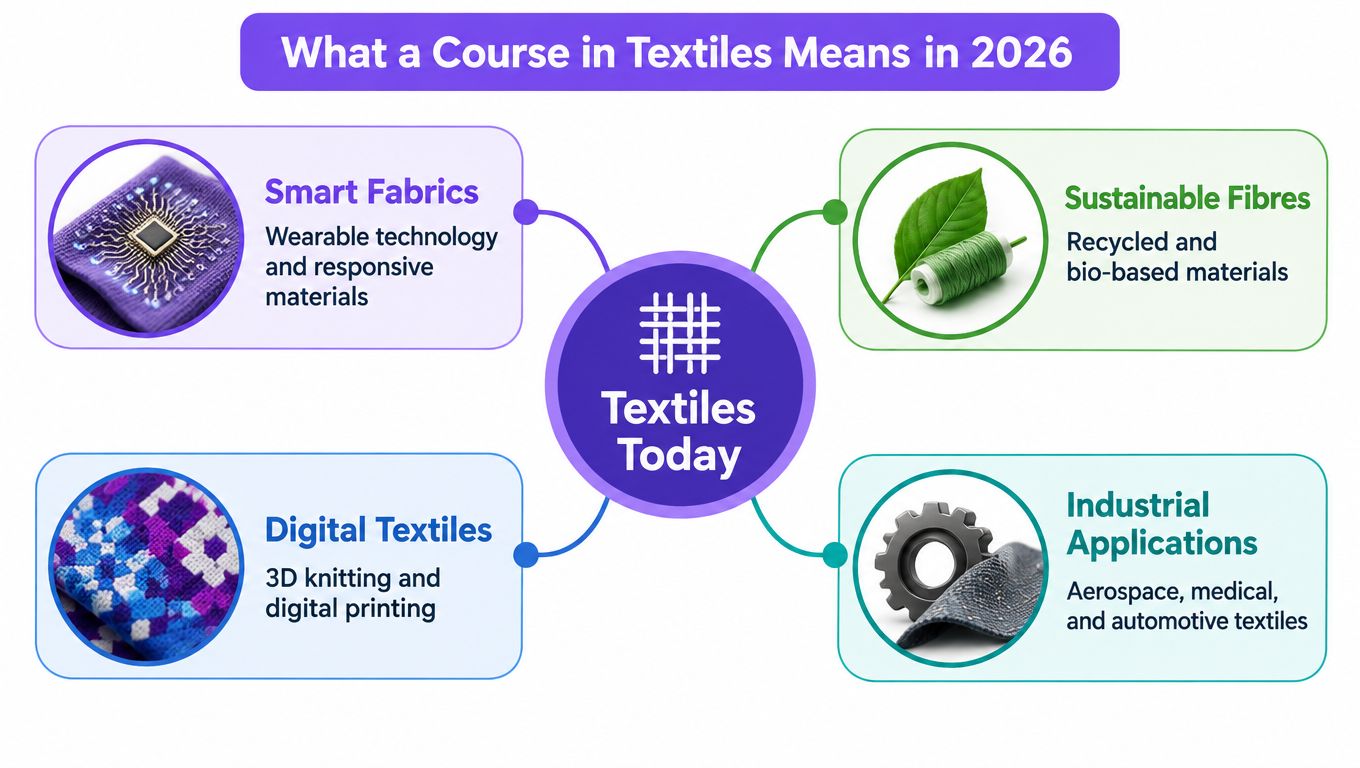
The infographic's central idea is useful when comparing providers. Ask whether a course gives you opportunities to work with physical samples and digital tools, rather than relying on one type of making. You might use hand stitch and a loom in one project, then scan a sample, manipulate it digitally, and prepare a repeat pattern in another.
If you want a gentle practical introduction to patchwork and fabric construction outside formal study, you could sign up for quilting lessons as an additional skills resource. Keep your formal course focused on assessed outcomes, research, reflection, and progression.
Practical rule: Choose a textiles course by asking what you'll make, test, record, and improve, not by judging the course title alone.
How UK textile history shaped modern courses
Textiles once operated on a scale that is difficult to imagine from a contemporary studio. A 1975 parliamentary debate reported approximately 900,000 people employed in the UK textile industries, around 9.5% of total UK industrial employment, with textiles described as the country's third-largest manufacturing industry. The same debate recorded around 150,000 workers on short-time working, showing that the sector's size existed alongside serious economic pressure. Historic Hansard records provide the parliamentary context.
The regional story is just as important. In 1921, approximately 259,000 people worked in the woollen and worsted industries, including 206,000 in the West Riding of Yorkshire. By 1930, insured employment in those industries had fallen from 274,870 in June 1921 to 239,030. Cotton-textile employment also fell from about 250,000 to 80,000 by 1975, according to the same parliamentary record.
The later contraction changed what learners need to study. UK textiles and apparel employment stood at more than 750,000 in 1978, then fell to 376,000 by 1998 and 97,000 by 2014, an estimated decline of about 87%. The number of enterprises decreased from 16,554 in 1995 to 7,868 in 2014. Research on the UK textile sector also records that microbusinesses represented approximately 80% of the sector, while average employment per firm fell from 25 workers in 1998 to 13 in 2015.
Why this history matters to your portfolio
The old image is a large mill with specialised workers performing one industrial task. The contemporary learner is more likely to encounter small studios, specialist manufacturers, repair services, independent designers, museums, community workshops, and digital production.
That shift explains why providers combine design development, technical sampling, sustainable production, digital processes, business awareness, and portfolio practice. A university applicant needs to show more than attractive drawings. They need to demonstrate curiosity about materials, an ability to test ideas, and an understanding of how textile decisions affect use and longevity.
Main textile specialisms you can study
Most providers blend specialisms, but four pathways appear frequently. The right choice depends on what you enjoy doing repeatedly, because a portfolio develops through sustained investigation rather than a single attractive outcome.
| Specialism | Typical portfolio output | Common progression |
|---|---|---|
| Fashion textiles | Fabric samples, garment experiments, draping studies, constructed pieces, technical drawings, and styling or photography | Fashion textiles, fashion design, costume, garment construction, studio practice |
| Surface pattern and print | Motif development, colour trials, repeat patterns, screen prints, dyed samples, digital compositions, and product mock-ups | Printed textiles, surface pattern, wallpaper, homeware, fashion print, licensing |
| Technical and constructed textiles | Weaving, knitting, stitch structures, fabric tests, prototypes, repair studies, and performance-led material investigations | Textile technology, production, materials, technical design, manufacturing support |
| Textile design for interiors | Larger-scale patterns, upholstery or furnishing samples, mood boards, spatial proposals, and coordinated colour plans | Interior textiles, soft furnishings, homeware, hospitality, interior design |
Match the specialism to your working habits
Choose fashion textiles if you like the relationship between body, movement, fit, and fabric. You'll need patience for construction, because an idea only becomes convincing when seams, fastenings, hems, and fabric behaviour support it.
Choose surface pattern and print if you enjoy repetition, colour relationships, drawing, and controlled variation. A successful print portfolio should show how a motif changes when you rotate, mirror, scale, or recolour it. It shouldn't consist only of isolated illustrations.
Technical and constructed textiles suit students who ask, “What is this material doing?” You might enjoy testing a weave, comparing structures, analysing a defect, or working out why a fabric stretches, frays, pills, or fails. This route can support progression beyond conventional fashion design.
Interior textiles are a strong match if you think at room scale. You'll consider how pattern, texture, light, durability, and use work together across curtains, cushions, upholstery, rugs, and wall treatments.
Your specialism should describe the questions you want to investigate, not trap you in one job title.
Before enrolling, inspect completed student portfolios if the provider makes them available. Look for process pages, material tests, written evaluation, construction evidence, and resolved outcomes. A portfolio with varied experiments usually tells an admissions tutor more than a gallery of unrelated finished images.
What a Level 3 foundation diploma in textiles actually covers
A Level 3 Foundation Diploma in Art, Design and Media is usually a transition between earlier creative study and higher education. It isn't the same as every qualification called a Level 3 Diploma. Providers may use similar wording for different programmes, so check the exact qualification title, awarding arrangements, assessment method, and progression advice.
A textile specialist route commonly develops through three broad movements. You start by exploring materials and ideas, then select a pathway, and finally confirm a personal direction through a major project.
From exploration to a resolved project
Early work might include:
- Fibre and fabric identification
- Drawing from textile samples
- Colour and composition studies
- Stitch, print, dye, weaving, or knitting experiments
- Research into artists, designers, cultures, materials, and processes
- Basic construction and surface manipulation
- Digital documentation and image development
The point of these exercises is to create evidence of decision-making. If a printed sample fails, photograph it, explain why, alter the process, and test it again. Tutors and admissions teams need to see how you respond to a problem.
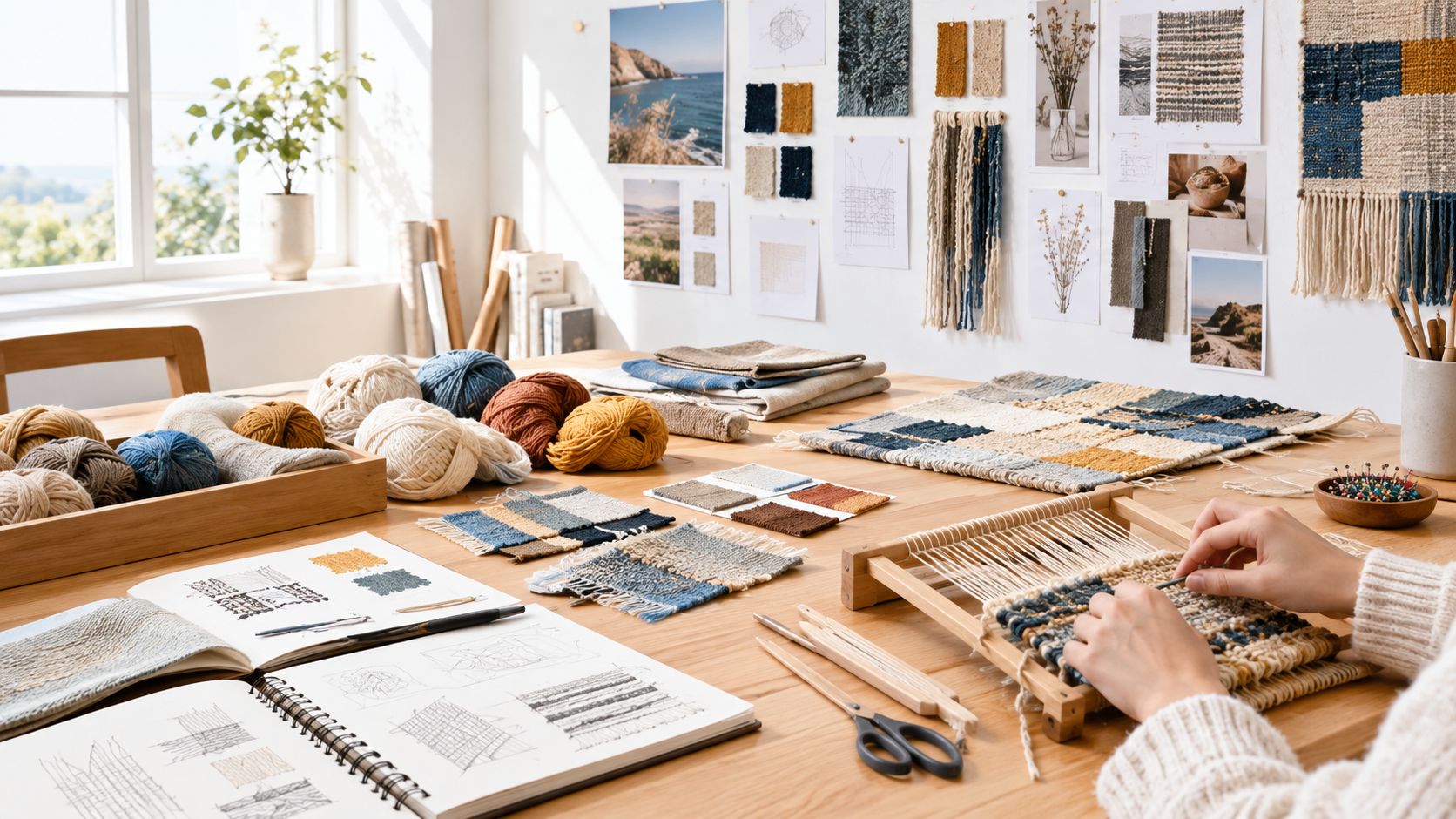
Your portfolio is built as you work
A strong foundation portfolio could contain a material library, annotated sketches, mood and research pages, fabric samples, construction tests, digital developments, and photographs of final outcomes. It might include a wearable piece, a printed collection, a woven panel, or an interior proposal, depending on your chosen pathway.
Use this foundation textile course resource to compare how a specialist programme describes its projects and portfolio expectations. The important question isn't whether the course promises a particular aesthetic. Ask whether it gives you structured feedback, time to revise, and clear evidence of assessment.
Foundation Diploma or Level 3 Diploma
A foundation diploma is often designed specifically to prepare students for degree-level art and design. It may place strong emphasis on independent project development, critical reflection, portfolio curation, and applications.
A Level 3 Diploma can also support progression, but universities may assess it according to the qualification, subject, grade profile, and their own entry criteria. Don't assume that the word “foundation” is interchangeable with “Level 3”. Request the course specification and ask the university admissions team how it treats the exact award.
Technical and circular skills most courses under-teach
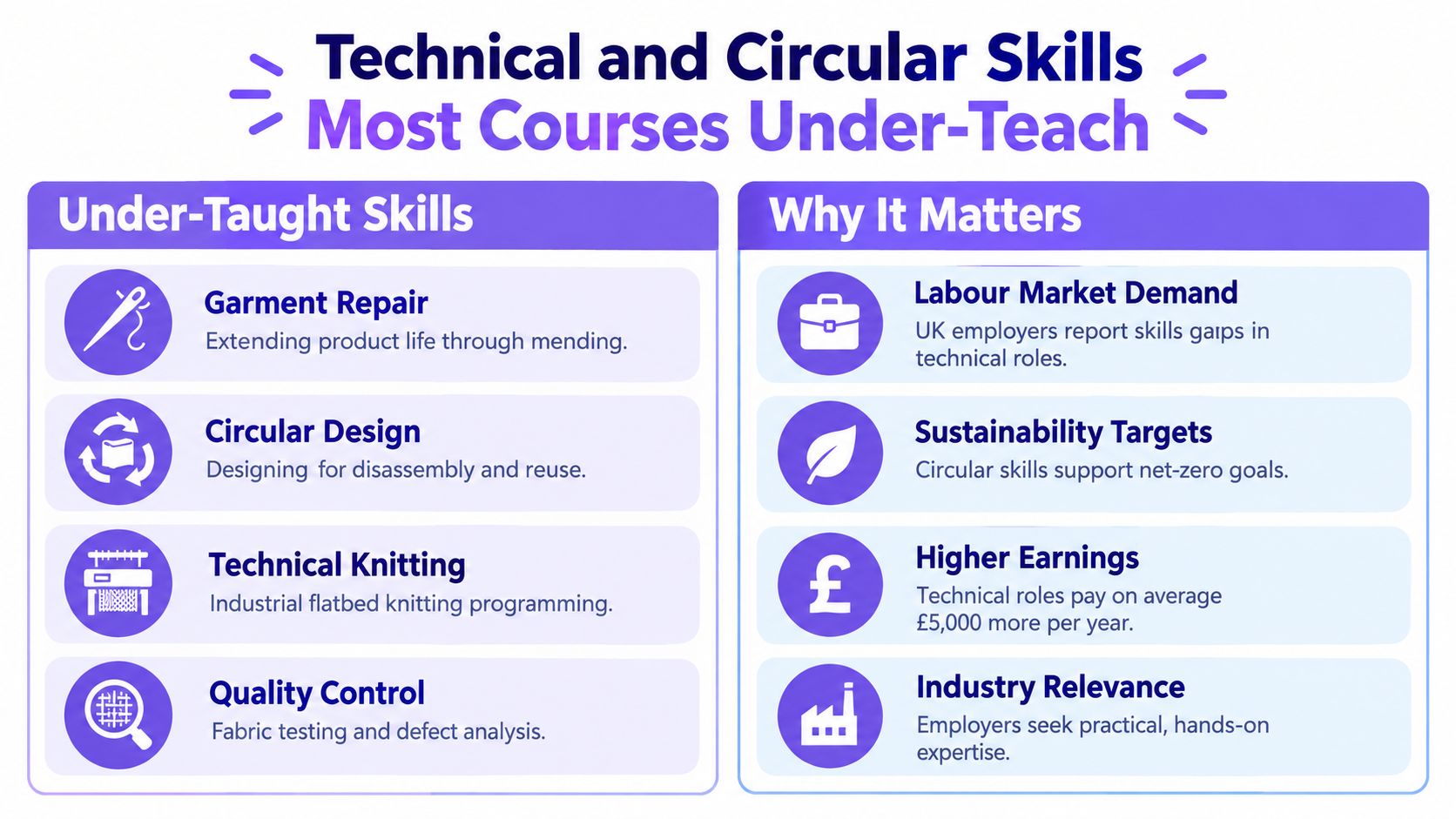
Fashion imagery can make textiles look like a sequence of sketches. Employers and progression tutors also need students who understand fibres, yarns, dyeing, finishing, construction, compliance, testing, repair, and sustainability evidence.
UK research on textile skills identifies technical and specialist capabilities as critical shortages, alongside engineering and eco-credential data management. In 2025, manufacturing had a 42% skills-shortage vacancy density, described as the third-highest among industries. The same research recorded 2,369 UK postings for textile process operatives, 288 for clothing, fashion and accessories designers, 165 for tailors and dressmakers, and 171 for sewing machinists in January 2025. Relevant textile and clothing postings had fallen from nearly 6,000 in mid-2023 to the mid-3,000s in 2025. The textile skills research points towards a smaller, more specialised market, not an absence of opportunity.
Repair is a design skill
A useful course should teach you to diagnose a garment before deciding what to do. Is the failure caused by abrasion, poor seam construction, fibre weakness, incorrect care, or unsuitable use? Can you mend it visibly, invisibly, decoratively, or structurally?
WRAP research published in 2025 found that four out of every five repaired textile items displaced a new purchase, an 82.2% displacement rate. Repairing a cotton T-shirt can avoid more than 7.5 kg CO2e, while repairing a wool jumper can avoid over 16 kg CO2e, and repairing a waterproof jacket can avoid over 45 kg CO2e. The WRAP repair findings show why garment extension deserves practical assessment rather than a brief sustainability paragraph.
A strong student project might compare repair with replacement, record the original condition, select a technique, document the intervention, and evaluate durability. For fabric testing, learning how to compare Martindale rub counts can introduce the relationship between abrasion resistance and intended use.
Build evidence employers can read
Include samples that show:
- Construction: Seams, hems, fastenings, lining, fitting, or structural assembly.
- Material knowledge: Fibre identification, fabric behaviour, care labels, and finish.
- Circular thinking: Repair, alteration, reuse, disassembly, and responsible material selection.
- Quality control: Defect analysis, testing notes, tolerances, and improvements.
- Communication: Clear production records, measurements, process photographs, and concise evaluation.
These skills can support applications to studios, manufacturers, museums, apprenticeships, and community repair projects. They also make your creative ideas more credible because you can explain what a textile does, not just how it looks.
Online delivery and SEND access for textile learners
Online study can work well for textiles when the provider treats the course as a studio practice rather than a collection of downloadable worksheets. You need demonstrations, clear assignment briefs, material guidance, regular critique, and a reliable way to photograph or scan work.
For a home-educated student, online delivery can provide an organised route towards an accredited qualification without requiring daily travel. An adult learner might need part-time pacing around work or family responsibilities. A student with dyslexia, ADHD, autism, or anxiety may need instructions broken into manageable stages, predictable feedback, and a slower or more flexible rhythm.
What accessible delivery looks like
Ask a provider how it handles the following:
- Tutor contact: Can you speak to a tutor individually, or are you left to interpret written feedback alone?
- Assignment structure: Are large projects divided into smaller actions with clear deadlines?
- Material access: Can the course suggest affordable alternatives when specialist equipment isn't available?
- Portfolio evidence: Can you submit photographs, scans, process notes, and video demonstrations where appropriate?
- Support planning: Can the provider discuss reasonable adjustments before enrolment?
The Online College of Art & Design (OCAD) uses online studio spaces containing units, assignments, video tutorials, and portfolio workspaces, with one-to-one or group tuition delivered through Microsoft Teams for Education. Its dedicated SEND pathways include Level 2 and Level 3 foundation options, with adapted pacing and individualised support.
A student should still expect to make decisions independently. Accessibility doesn't mean lowering the standard of textile work. It means presenting the learning in a form that allows you to demonstrate your actual ability.
Ask to see how feedback is delivered before you enrol. A supportive course should be able to explain the weekly rhythm, communication method, assessment process, and adjustment options clearly.
If you need a specialist route, review the SEND foundation textile course and compare its support model with other providers. Also ask how physical samples are assessed when you study from home, how tutors judge scale and finish, and whether you'll receive advice about photographing textured work accurately.
Using a Level 3 textile course to reach university
A Level 3 qualification can be a bridge to an undergraduate degree, but it isn't an automatic offer. The UK Government lists A levels, Access to Higher Education Diplomas, advanced apprenticeships, applied general qualifications, International Baccalaureate Diplomas, T Levels, and Level 3 certificates and diplomas as Level 3 qualifications. The government qualification-level guidance makes the level clear, but universities still decide how they interpret a particular award.
Check the chosen degree before you enrol. A university may specify subjects, grades, portfolio standards, interview requirements, or an equivalent qualification. A textile student should ask whether the course accepts their exact Level 3 award, whether a textile specialism is preferred, and whether the portfolio must include constructed work, sketchbooks, digital development, or written research.
Separate admission from funding
Student Finance England states that eligible undergraduate funding can include a first degree such as a BA or BSc, a foundation degree, a Certificate or Diploma of Higher Education, an HNC, an HND, and certain approved Level 4 or Level 5 higher technical qualifications. The course must be eligible, and course intensity generally needs to be at least 25%. Student Finance England's eligibility guidance explains why the exact course and institution matter.
For eligible full-time students in England, the maximum tuition-fee loan is £9,535 for 2025–26 and £9,790 for 2026–27. Accelerated degrees have published maximums of £11,440 and £11,750 for those academic years. These are tuition-fee loan limits, not a guarantee that every student receives those amounts or a complete estimate of living costs. The current full-time student finance guidance lists the relevant limits and eligibility factors.
Use this checklist before applying:
- Qualification: Confirm the exact Level 3 award and its assessment structure.
- Entry criteria: Check required subjects, grades, portfolio, and interview conditions.
- Provider: Verify that the university and course are recognised for the intended funding route.
- Intensity: Ask whether the mode and study load meet finance requirements.
- Portfolio: Find out whether the university wants a digital submission, physical samples, or both.
For a clearer explanation of how a foundation route can sit between school-level study and degree applications, read what an art foundation diploma is and whether you should study one.
Choosing your next textiles step
Start with your actual position, not the image of the student you think you should be. A home-educated learner in Year 10 may need a Level 2 foundation in materials and visual development. A Level 3 student with a strong portfolio may need a specialist foundation route. An adult returner may prioritise flexible pacing, while a SEND learner may need adapted assignments and one-to-one support.
Avoid choosing solely because a provider shows fashionable garments. Check the technical content, repair work, assessment method, portfolio expectations, tutor access, and progression record. If you're considering university, contact admissions before enrolling and ask whether they accept the qualification you're researching.
Your next actions are simple:
- Identify your current level.
- Choose a specialism to investigate.
- List your flexibility or SEND requirements.
- Ask what physical and digital work you'll produce.
- Verify university and funding routes in writing.
If you're marking a personal milestone after completing creative study, resources about education degree celebration stoles can help you think about how academic achievement is recognised, even though your next textile decision should remain focused on skills and progression.
The Online College of Art & Design (OCAD) offers flexible, tutor-led creative study from entry level through Level 3, including foundation diploma routes with textile specialisms, online studio work, portfolio development, and SEND pathways. Visit The Online College of Art & Design (OCAD) to review the available textile options and discuss which route matches your current qualification, portfolio, and progression goal.