

What makes a university-ready art portfolio convincing, the polished final image, or the evidence showing how the idea developed?
That question exposes the central misunderstanding about foundation courses in art. Many Level 2 and Level 3 students assume that university admissions depend mainly on finished pieces. In practice, a strong application usually depends on a much wider record of curiosity, research, experimentation, decision-making, reflection, and direction.
A foundation course can provide the structured space to develop that record. It can also help you decide whether fine art, graphic design, fashion, textiles, photography, interior design, animation, or another specialist area is the right next step. The qualification isn't just an extra year of making work. It is a transition into more independent creative study.
Table of Contents
- Defining the Art Foundation Qualification
- Comparing Foundation Routes to Direct Degree Entry
- Navigating Specialist Pathways and Exploration
- Understanding the Workload and Study Commitment
- Mastering Portfolio Assessment and Evidence
- Adapting the Foundation Model for Diverse Learners
- Choosing the Right Provider and Preparing to Apply
Defining the Art Foundation Qualification
A UK Diploma in Foundation Studies Art and Design, commonly called an art foundation, is normally a one-year Level 3 qualification designed to prepare students for degree-level study. UCAS describes it as a widely recognised route into art and design degrees, allowing students to explore a subject before committing to a narrower undergraduate specialism. You can read a further explanation of what an art foundation diploma involves before comparing individual providers.
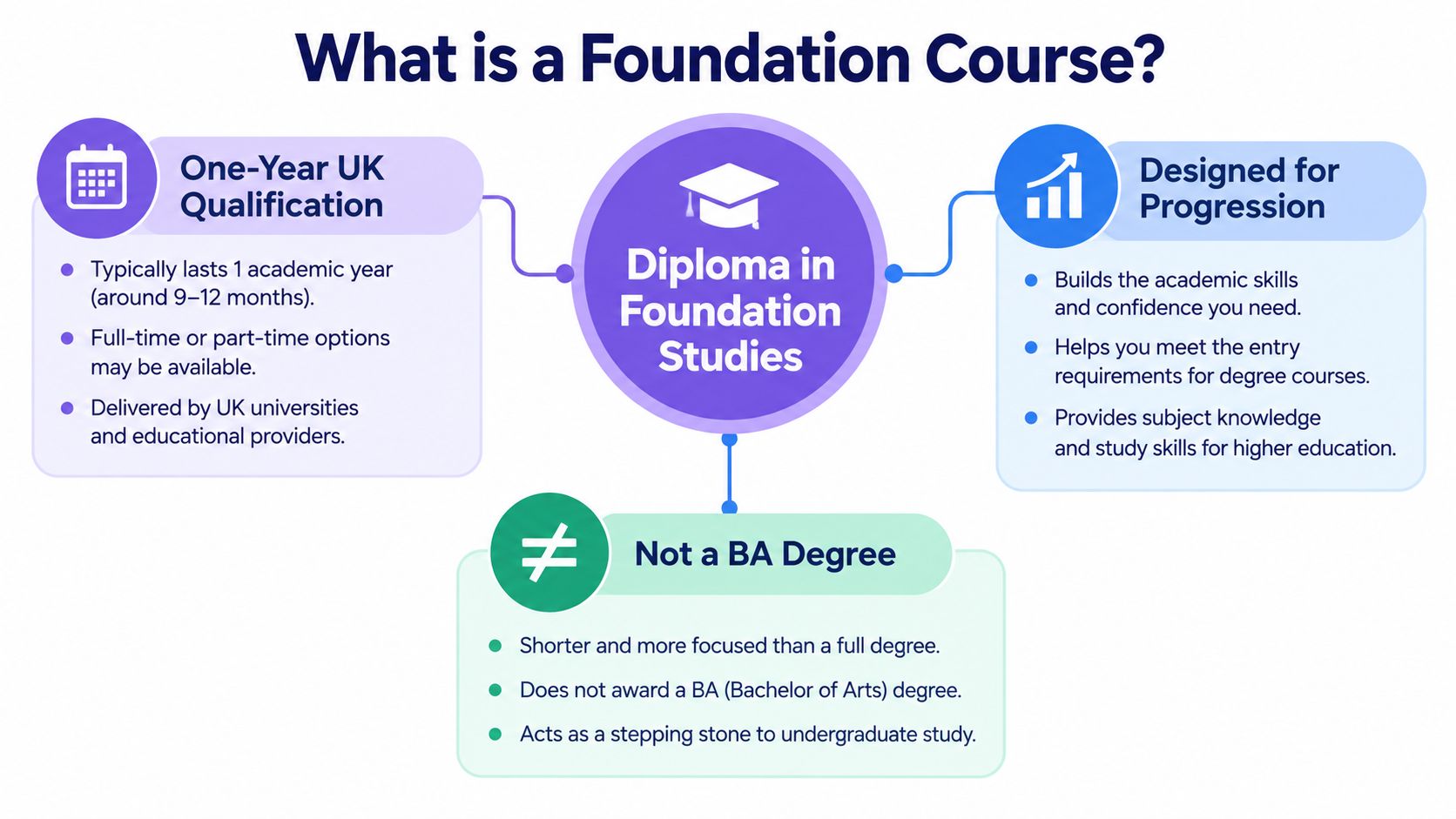
The word foundation causes confusion because it describes more than one type of programme. An art foundation is not a BA degree, and it isn't the same as a foundation degree. UCAS describes a foundation degree as normally a two-year higher-education qualification equivalent to the first two years of an undergraduate degree. An art foundation sits at Level 3 and acts as a bridge between school or further-education study and university.
The distinction matters when you're checking entry requirements, funding, and progression. A student who completes a Diploma in Foundation Studies hasn't completed undergraduate study. They have developed the specialist knowledge, portfolio, and working habits needed to apply for it.
A recognised qualification, not an informal portfolio class
The UK Department for Education's Register of Regulated Qualifications lists the Pearson BTEC Level 3 National Foundation Diploma in Art and Design as approved for learners aged 16 to 19 from 1 June 2016, with Advanced Learner Loan funding approved from 1 August 2016. The same register records the University of the Arts London Level 3 Foundation Diploma in Art and Design as a Level 3 qualification, with funding approval for 16 to 19-year-olds beginning on 1 August 2018 and continuing through 31 July 2027. These details appear in the official qualification listing.
That regulatory history shows why a foundation course shouldn't be dismissed as an unstructured gap year. It can sit within a recognised post-16 qualification and funding framework, although students must always confirm the exact awarding body, provider approval, and current eligibility.
Practical rule: Check the qualification title and awarding organisation, not just the word “foundation” in a course name.
A good course should give you an organised route through exploration, portfolio development, assessment, and progression. Resources such as art and design curriculum support can also help families and educators understand how creative learning develops across stages.
Comparing Foundation Routes to Direct Degree Entry
Should you apply directly to university after A Levels, a Level 3 Diploma, or another Level 3 creative qualification? Or would an art foundation give you a more realistic chance of entering the course you want?
Neither route is automatically correct. Direct entry may suit a student who already has a focused practice, understands the demands of their chosen degree, and can produce a portfolio that demonstrates sustained development. A foundation route may suit someone whose work is promising but broad, inconsistent, under-researched, or not yet aligned with a particular subject.
| Direct degree application | Foundation route first |
|---|---|
| Moves straight from Level 3 study into undergraduate education | Adds a dedicated transition year before degree study |
| Works well when portfolio direction is already clear | Creates space to test several disciplines |
| Limits the time available to rebuild weak project evidence | Allows sustained development and portfolio curation |
| May be efficient for a prepared applicant | May be valuable for a student who needs greater maturity or specialisation |
The extra year can be strategically useful for selective courses, but it carries an opportunity cost. You should consider tuition or living arrangements, the time spent studying before a degree, and whether the foundation curriculum will add something genuinely new rather than repeat your existing work.
Oxford's Ruskin School of Art provides unusually specific admissions evidence for 2026 entry. Among 184 UK applicants, 54 were shortlisted and 28 received offers. A foundation diploma or equivalent was completed or underway for 35% of applicants, 48% of shortlisted candidates, and 57% of offer-holders, as recorded in the school's fine art admissions feedback. These figures describe an association, not proof that foundation study causes admission. Applicants with stronger portfolios may also be more likely to choose a foundation course.
Still, the pattern challenges the idea that foundation is merely a fallback. At a highly selective fine-art institution, foundation experience appears more common among shortlisted applicants and offer-holders than among the full applicant group. That may reflect the value of focused portfolio development, independent practice, and experience with degree-style critique.
Ask whether the year solves a real problem
A foundation course is more likely to be worthwhile if you can answer yes to one or more of these questions:
- Direction: Do you need to choose between fine art, fashion, graphic design, or another pathway?
- Evidence: Does your portfolio show outcomes but not enough research, experimentation, or reflection?
- Specialisation: Have you studied creative subjects broadly but not yet developed a coherent body of work?
- Confidence: Do you need practice discussing choices, responding to critique, and presenting work to admissions tutors?
Some universities recommend or favour foundation experience, while others accept direct applicants with suitable Level 3 qualifications and portfolios. Always read the requirements for the exact degree, because a foundation diploma doesn't replace every academic, portfolio, or subject condition.
Navigating Specialist Pathways and Exploration
A student may begin a foundation course convinced they want graphic design and discover that their strongest work involves constructed objects, photography, or moving image. Another may arrive interested in fashion but find that material research leads towards textiles, costume, or sculpture.
That change isn't failure. It is one of the reasons foundation courses exist.
Start broad enough to find the right question
Early projects commonly ask students to work across materials, processes, and visual problems. You might draw from observation, manipulate photographs, investigate colour, build a three-dimensional form, design a visual identity, or respond to a social or environmental theme. The purpose isn't to produce a random collection of tasks. Each experiment gives you evidence about how you think and make.
Suppose you begin with an interest in portraiture. Drawing can reveal an interest in structure and anatomy, photography can develop your approach to lighting and framing, and installation can show that you respond to the relationship between a person and a space. By comparing those outcomes, you can identify a more precise direction instead of choosing a degree based only on its title.
Contextual research plays an important role here. Looking at artists, designers, makers, photographers, architects, and cultural movements helps you understand the decisions behind your own work. The useful question isn't “Which famous artist should I copy?” It is “What can I learn from this person's use of material, composition, process, audience, or subject matter?”
Narrow through evidence, not guesswork
As the course develops, tutors usually expect you to make increasingly informed choices. You may select a pathway such as:
- Fine art: Painting, drawing, sculpture, installation, performance, or lens-based work.
- Graphic design: Typography, communication, branding, editorial design, or digital image-making.
- Fashion and textiles: Garment construction, surface design, material investigation, print, or styling.
- Three-dimensional design: Product, spatial, furniture, model-making, or object-based practice.
- Film and animation: Storyboarding, character, sequence, editing, sound, or moving-image communication.
The final portfolio shouldn't look like unrelated samples from every pathway. It should show how exploration led to a considered practice. A university admissions tutor needs to see both range and judgement. Range demonstrates that you've tested possibilities. Judgement demonstrates that you know which possibilities deserve further development.
A specialist pathway isn't a permanent identity. It's a reasoned decision about what you want to investigate next.
Keep records while you explore. Photograph work in progress, save unsuccessful tests, annotate changes, and explain why you rejected or developed an idea. Those records will help you build a coherent application and give you material to discuss during interviews.
Understanding the Workload and Study Commitment
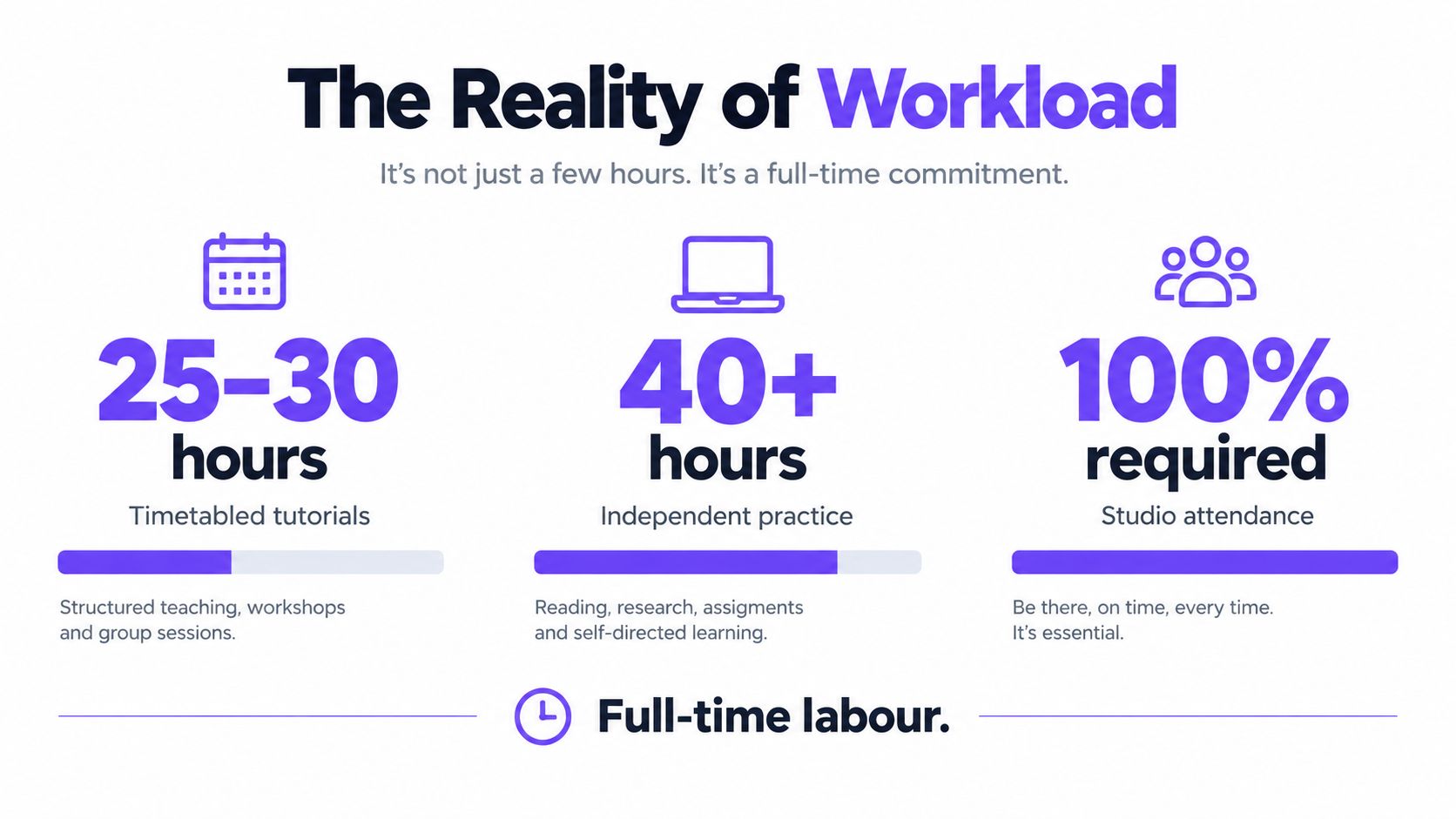
Could a foundation course fit around work, caring responsibilities, or home education? It can, but it still demands sustained practice. A UK Level 3 Foundation Diploma in Art and Design is typically structured as a one-year qualification with approximately 1,200 total qualification hours, including 680 guided learning hours, according to the UAL Foundation Diploma information.
The distinction between total qualification time and guided learning matters. About 680 hours may cover scheduled teaching, tutorials, demonstrations, critique, and supervised activity. The rest can include independent practice, research, experiments, documentation, and project development. Provider timetables differ, yet the expectation remains similar: studio learning continues beyond contact hours.
What the work involves day to day
A project often develops through connected decisions rather than one straight burst of production. You might begin by interpreting the brief, identifying its subject, limits, audience, and possible questions. Contextual research then connects your ideas with artists, designers, places, materials, and relevant concepts.
Testing follows. Try processes before deciding which deserve sustained making, and accept that failed experiments can reveal useful information. Tutor or peer critique adds another viewpoint. Record the feedback, revise the work in response to evidence, then curate the strongest outcomes by selecting, sequencing, photographing, and explaining them.
This process is closer to editing a draft than decorating a finished object. University admissions tutors can learn from the choices behind a portfolio, including changes that improved an idea and tests that showed what to avoid.
Firm milestones keep that exploration manageable. Flexible scheduling may suit students with employment, caring responsibilities, or home education, but it still needs the expected depth and volume of learning.
For online study, ask whether the provider offers scheduled live tutorials, documented independent-study hours, milestone reviews, and a digital portfolio showing development. It should also explain how participation and feedback are monitored when students do not share a physical studio.
Planning question: If your study times vary, where will you protect regular periods for making, reflection, and tutor review?
Before enrolling, compare your available time with the qualification's units and deadlines. A part-time arrangement may support steady progress more effectively than compressing intensive studio work into occasional bursts.
Mastering Portfolio Assessment and Evidence
How do assessors distinguish a promising portfolio from a collection of polished images? A foundation portfolio records creative thinking in action, rather than presenting only flawless final pieces. In the cited UK model, assessment is predominantly coursework-driven. Units are internally assessed, with final grading supported by external quality assurance. Earlier units receive a pass-only outcome, while the final unit is graded Pass, Merit, or Distinction, as described in the UAL Foundation Studies Centre Handbook.
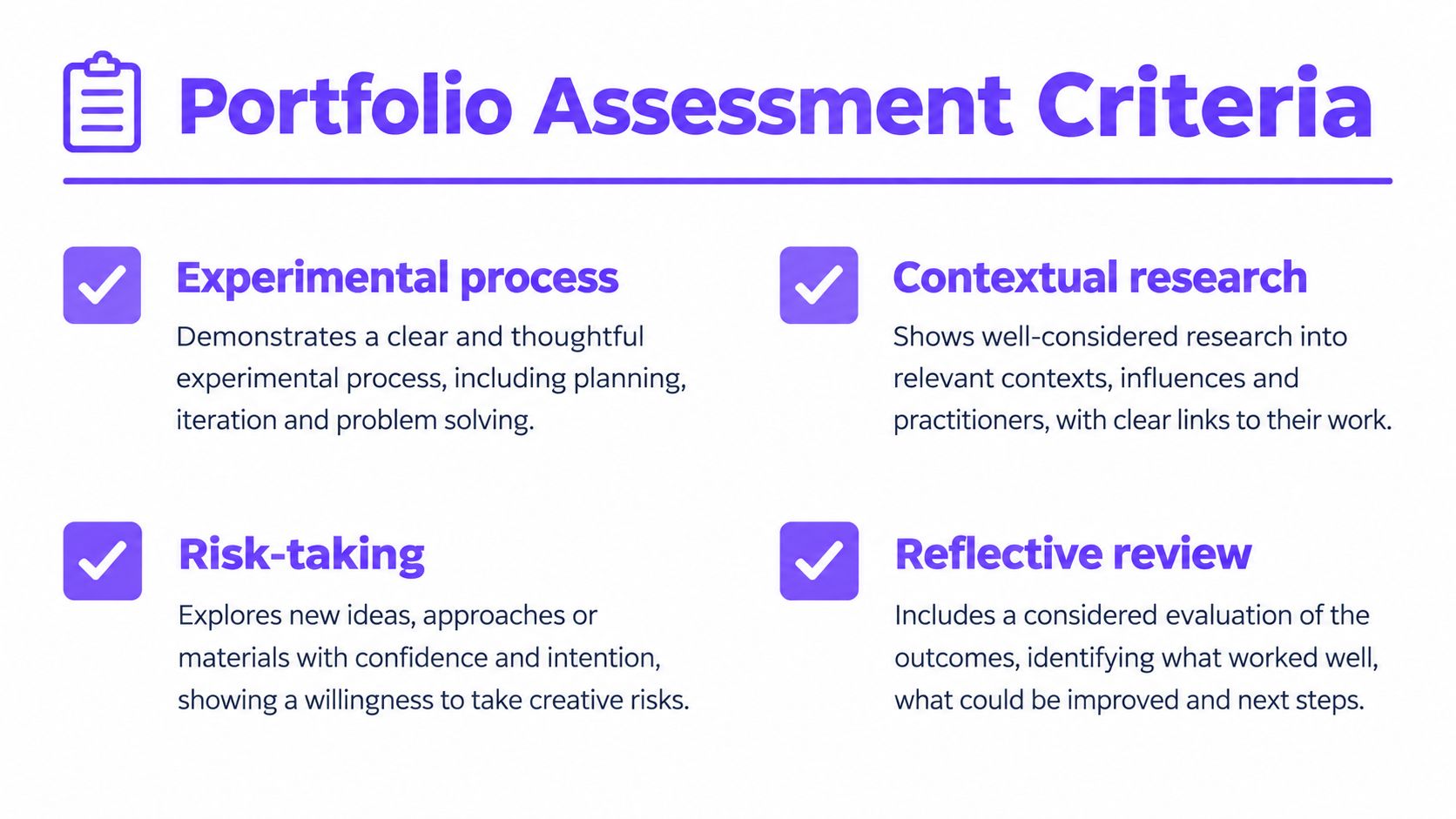
Across the required units, you must meet the relevant assessment criteria. A higher grade includes the lower-grade criteria plus further Merit or Distinction requirements. A striking final artefact therefore cannot replace evidence of research, experimentation, problem-solving, contextual understanding, and reflective development. Assessors examine the route as well as the destination.
Build evidence as you work
Treat each project like a chain of decisions, similar to showing every draft behind a finished essay. Keep:
- Initial proposals: What did you intend to investigate, and why?
- Visual research: Which artists, designers, sources, or observations influenced the work?
- Experiments: Which materials, techniques, compositions, or processes did you test?
- Critique records: What feedback did you receive, and how did you respond?
- Revisions: What changed between the first attempt and the resolved outcome?
- Reflective reviews: What worked, what failed, and what would you pursue next?
UAL portfolio guidance identifies observational drawing, work in progress, annotations, diverse media experimentation, and research explaining creative influences as useful evidence for progression applications. Mistakes do not need to disappear. A failed test can demonstrate risk-taking and learning when you explain what it revealed.
For practical advice on arranging digital evidence, consult this guide to how to make an online art portfolio. In Display Guru's portfolio inspiration, study how development work supports the final presentation instead of copying its visual style.
Use dated folders or versioned files. Name uploads clearly, photograph work in consistent light, and annotate decisions while they remain fresh. Admissions tutors should be able to follow the reasoning between images without guessing what changed.
Watch how a development page and a resolved outcome sit side to side, and note how the annotations carry the argument:
Adapting the Foundation Model for Diverse Learners
Who gets to study art foundation, and what should a suitable course provide? The familiar picture is an 18-year-old working in a campus studio each day. In practice, adults changing careers, home-educated learners, students returning to education, and disabled learners may all need the same intellectual challenge through a different structure.
The Cultural Learning Alliance's 2026 analysis reports that 8.2% of Art and Design A-level students had identified SEND in 2024/25, compared with 4.8% across all A-level students. It also reports SEND representation of 13.7% in Crafts, Creative Arts and Design Level 3 vocational qualifications. Pupils with SEND remain under-represented in most arts GCSE subjects, though not in Art and Design. These figures appear in the analysis of the status of the arts in schools.
Those findings show participation, not automatic inclusion. A creative subject may attract disabled learners while still creating barriers through assessment methods, communication, sensory conditions, executive-function demands, or portfolio presentation.
Ask how the course is designed
A provider should explain how its teaching works in practice. Can deadlines or study sequences change while required learning outcomes remain in place? Are instructions, critiques, and feedback available in formats the student can process? Can learners use suitable software, captions, recording tools, or alternative presentation methods?
Clarify the support structure too. Is tutor contact limited to group sessions, or can students receive individual guidance? How are noise, travel, lighting, screen use, and physical studio demands addressed? What assessment adjustments are available within the awarding body's rules?
Online study may reduce travel and sensory barriers, yet it can increase isolation and self-management demands. One student may work well with recorded resources and flexible access. Another may need regular live contact, clear weekly targets, and help dividing a large project into manageable actions.
Home-educated students and adults returning to education should ask the same questions. Flexibility should change when and how support is delivered. It should still include meaningful critique and the evidence expected at Level 3.
Accessibility is a teaching model rather than a tick box. Ask how the provider will help you investigate, make, review, and present work. That answer reveals more about the course than a general statement about access.
Choosing the Right Provider and Preparing to Apply
The right foundation provider should be judged by its qualification, teaching model, assessment process, and progression support. A course page may promise portfolio development, but you need to know how that promise becomes weekly practice.
Start with the awarding body. Confirm whether the course leads to the exact Level 3 qualification required by your intended universities, and check the current specification. The government listing for the UAL Level 3 Foundation Diploma in Art and Design, qualification number 60331380, records approved status and funding approval for eligible learners aged 16 to 19 from 1 August 2018 to 31 July 2027, as well as approval under Advanced Learner Loans over the same period. The official funding and qualification record also advises providers to check availability with the awarding organisation. Funding isn't automatic for every learner, provider, or delivery format.
Use a practical provider checklist
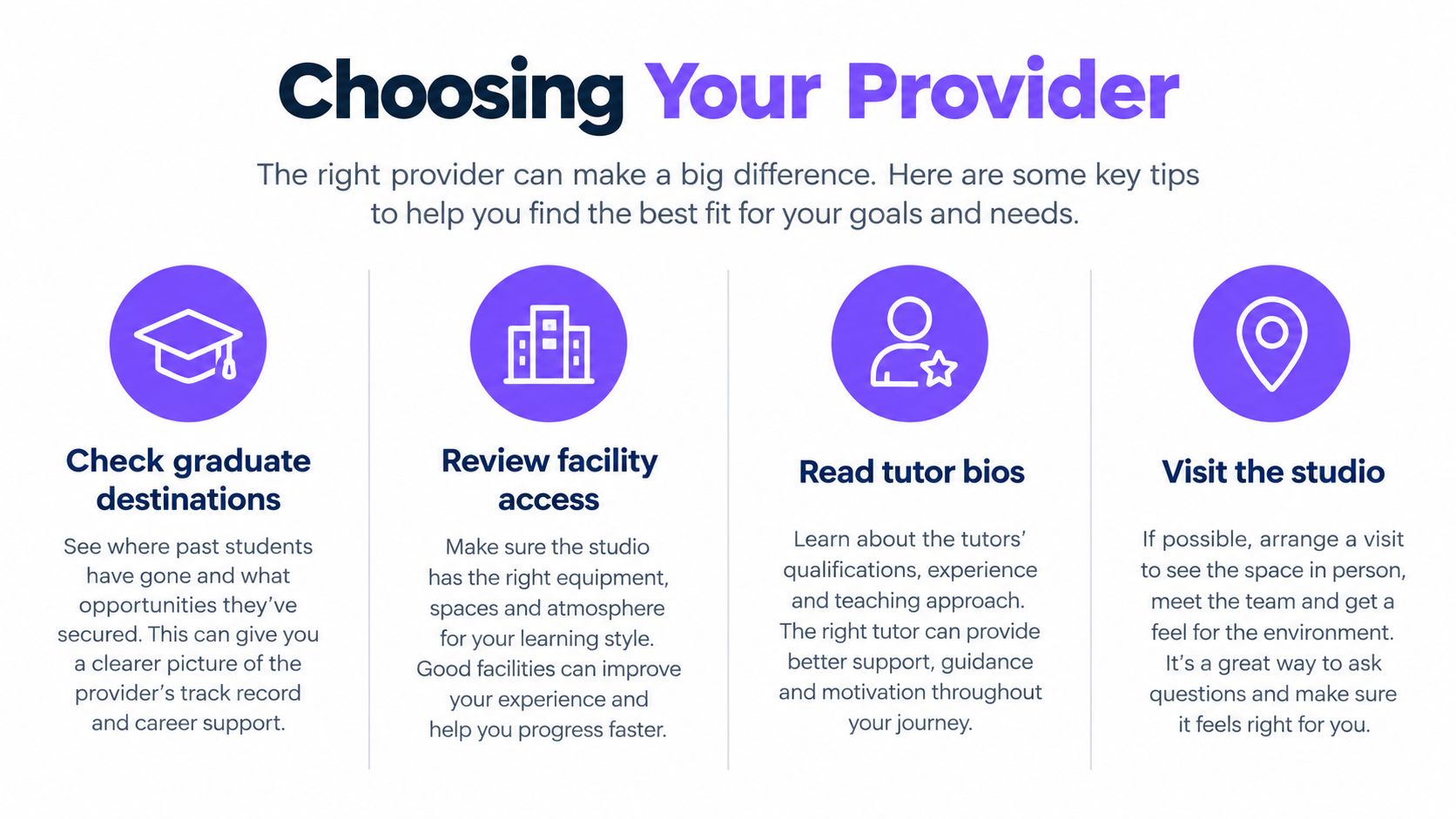
Ask these questions before applying:
- Assessment: How are units assessed, moderated, and graded?
- Feedback: How often will a tutor review work, and will feedback be written, live, or both?
- Portfolio: Will the course assess development pages as well as resolved outcomes?
- Progression: How does the provider support university choices, applications, interviews, and portfolio curation?
- Facilities: What materials, software, equipment, or studio access will you need to supply?
- Flexibility: Can the timetable accommodate employment, caring responsibilities, home education, or access requirements?
- Student examples: Can you review anonymised portfolios showing different pathways and levels of experience?
For an online option, check whether the provider offers a genuine digital studio rather than a folder of worksheets. Look for live tutor contact, structured assignments, recorded demonstrations, critique checkpoints, and a portfolio workspace that preserves the creative process.
The Online College of Art & Design (OCAD) offers online Level 3 Foundation Diplomas in Art, Design and Media, including specialist routes such as Fine Art, Fashion, Textile, Interior, Architectural, Film and Animation, Graphic Design, and Photography. Its model includes one-to-one or group tuition through Microsoft Teams for Education, an online studio with assignments and portfolio workspace, flexible scheduling, degree pathway guidance, and dedicated SEND versions of Level 2 and Level 3 foundation pathways. If you are applying, prepare a concise personal statement that explains your interests, current experience, preferred pathway, and reasons for further study. Guidance on writing a personal statement for a foundation art course can help you organise those points.
Your application doesn't need to present a finished artist. It should show that you're ready to investigate seriously, respond to feedback, document decisions, and sustain a project beyond the first attractive idea.
The Online College of Art & Design (OCAD) offers flexible, tutor-led Level 3 Foundation Diplomas with specialist art and design pathways, online portfolio workspaces, live Microsoft Teams tuition, and progression guidance for university applications. Visit The Online College of Art & Design (OCAD) to compare foundation routes and find a study structure that fits your creative goals and circumstances.