

Can you name the exam centre where you'll sit your art paper next June? Most learners weighing up GCSE vs iGCSE can't, and that blank answer shapes their options more than any debate about which qualification is harder.
The comparison that matters runs end to end: the awarding body and specification behind the title, the grade scale your next institution reads, and whether a registered centre near you will enter you as a private candidate for that exact syllabus. Get those three right and the label on the certificate stops being the deciding factor.
Table of Contents
- GCSE and iGCSE at a Glance
- Who Takes Each Qualification and Why It Matters
- How Grades Compare on the 9–1 Scale
- How Assessment Differs for Creative Subjects
- Exam Access for Home-Educated and Adult Learners
- Answers to Common Questions From Level 2 and Level 3 Creative Students
- Match Your Route and Confirm Entry Rules
GCSE and iGCSE at a Glance
| Feature | GCSE (England) | iGCSE |
|---|---|---|
| Typical awarding bodies | AQA, Edexcel (Pearson), OCR, WJEC Eduqas | Cambridge Assessment International Education, Pearson Edexcel International GCSE |
| Regulation | Regulated by Ofqual in England | Set by the awarding body and its specification, not Ofqual |
| Grading scale | 9–1, with U for ungraded | A*–G or 9–1, depending on the board |
| Assessment mix | Mainly examination; non-exam assessment only where the subject requires it | Set by the board and subject, as exams, coursework or practical work |
| Usual audience | Most pupils aged 14–16 in state and independent schools | Mostly independent and international schools, plus private and adult candidates |
| Art and Design example | GCSE Art and Design | iGCSE Art and Design |
| Recognition for progression | Standard route into UK sixth forms and colleges | Accepted by many UK universities and employers, so confirm the exact entry wording |
Each row answers a question that will eventually land on an admissions tutor's desk. Awarding bodies split along national lines, with AQA, Edexcel, OCR and WJEC Eduqas on one side and Cambridge Assessment International Education plus Pearson Edexcel International GCSE on the other. Regulation is the deepest structural difference, because a GCSE is bound by Ofqual's conditions while an iGCSE follows the rules of the board that writes it.
Grading means 9–1 with U for a GCSE, and A*–G or 9–1 for an iGCSE depending on the board and subject. Assessment mix puts exams at the centre of GCSE design, with non-exam assessment only where a subject requires it, while an iGCSE's blend of exams, coursework and practical work is set by the specification. Usual audience follows school type rather than ability, with iGCSEs concentrated in independent and international schools and among private and adult candidates.
Recognition is the row readers care about most. GCSE is the standard route into a UK sixth form or college, and iGCSE results are accepted by many universities and employers once the exact entry wording is matched. GCSE also remains the reference point for the whole system, with 5.7 million GCSE results issued in England in the 2025–26 academic year, 1.0% more than in 2024–25, from just over 15.5 million component entries, as the Department for Education's entries background information reports.
The real differentiator: the title on the certificate tells you less than the specification behind it. Two courses both called Art and Design can sit on different boards, use different grade scales and split marks differently between an externally set assignment and a portfolio.
One board might place more of the grade on an externally set task than another places on two years of sketchbook work, so the same course title can hide very different weekly workloads and very different risks in June.
If you're choosing a course, The Online College of Art & Design (OCAD) offers International GCSE Art and Design as a standard two-year option or an intensive one-year option, for learners in the UK or outside it, at £1,999 to £4,000 depending on the option chosen. Teachers and tutors adapting schemes of work rather than sitting the exam will find Kuraplan's GCSE teaching resources a useful starting point.
Before you read further, pick the two or three rows that match your next destination, whether that's a sixth form, a college or a university, and keep them beside you. Those rows do more work than any general claim about which qualification is better.
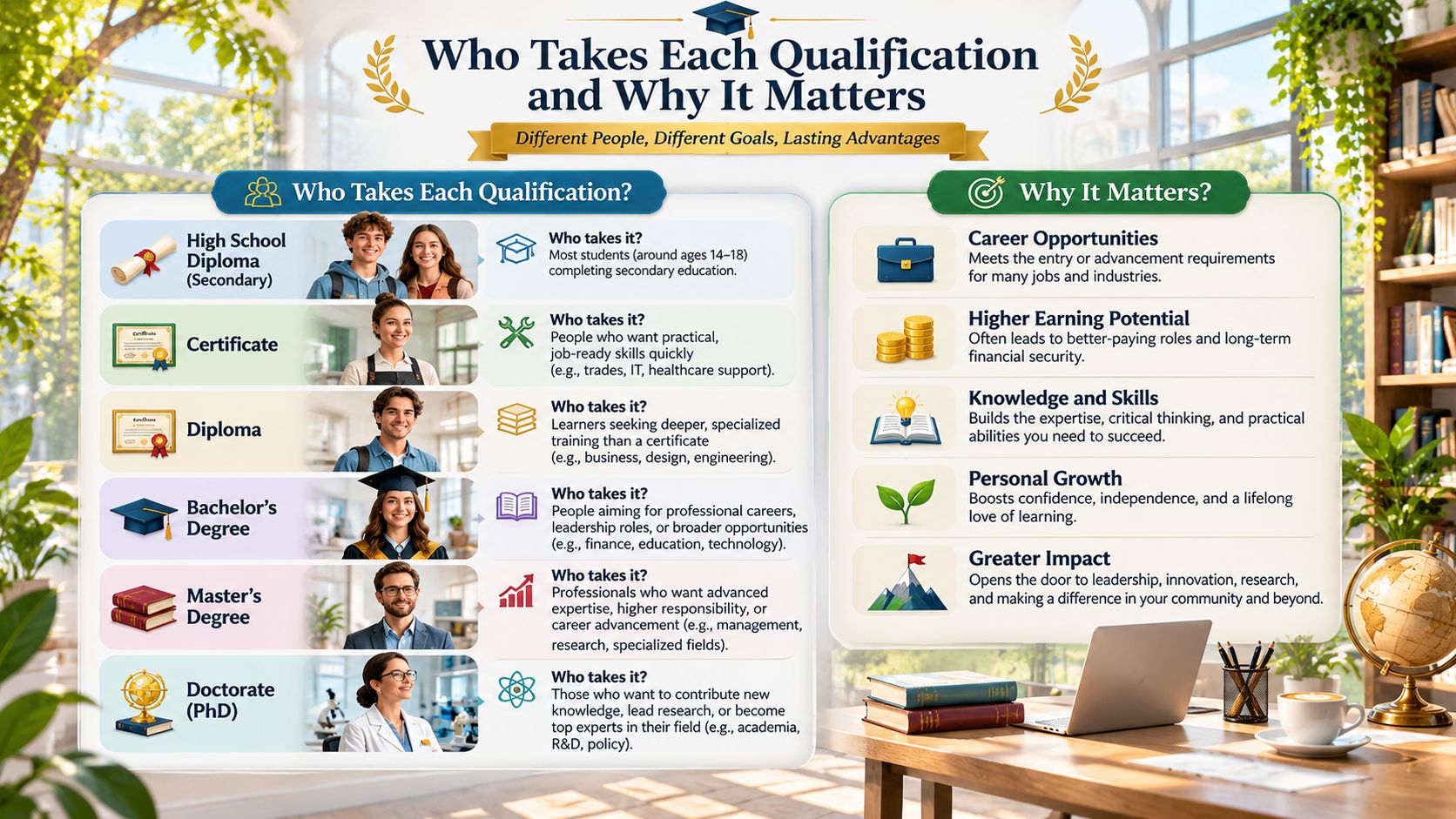
Who Takes Each Qualification and Why It Matters
GCSEs are the mainstream Key Stage 4 qualification in England, taken by pupils typically aged 14 to 16. International GCSEs are alternative qualifications from awarding organisations such as Cambridge Assessment International Education and Pearson, and in England they've become a marker of school type as much as of academic ambition.
A UK government comparison published in 2018 found that international GCSEs had become especially concentrated in the independent-school sector after reformed GCSEs began counting in school performance tables from 2017, subject by subject. In that analysis, independent-school pupils accounted for 94% of international GCSE entries in England, 163,971 entries in total, and international GCSEs made up 45% of the 361,581 combined GCSE and international GCSE entries across independent schools, as the Department for Education's Key Stage 4 performance statistics record.
The figures say more about where the qualification is used than about how good it is.
Pupils taking at least one international GCSE also tended to score higher in their other GCSEs: among pupils with prior attainment at level 4C or above, the gap was approximately 0.3 to 0.6 grades, the same analysis found. That's an association, not evidence that the qualification lifts achievement, because those pupils were already in schools with different intakes and different exam entry patterns.
What the history does tell you is that the label carries context. A school may choose an iGCSE because a subject's GCSE content or assessment changed in a way its teaching didn't suit, because performance tables treat a qualification differently, or because the board offers an exam session that fits an international calendar. None of those reasons says anything about the standard of the qualification itself.
That's why it pays to judge the specification rather than the badge. Our students study Ofqual regulated qualifications, including GCSEs, A Levels and Vocational Level 2, 3 and 4 courses, and our Level 2 courses lead to a nationally recognised college certificate equivalent to GCSE, Level 2 Certificate or BTEC.
The name on the certificate signals school context, accountability rules and exam design. The specification tells you the standard, the workload and whether your next institution will accept it.
How Grades Compare on the 9–1 Scale
The numbered GCSE scale replaced A* to G, and the mapping still confuses people. Grade 9 sits above the old A*, grade 4 is the standard pass, and U means no grade was awarded.
| GCSE grade (9–1) | Approximate former grade | What it signals |
|---|---|---|
| 9 | Above A* | Highest reported grade |
| 8 | A* | Very high pass |
| 7 | A | Strong pass |
| 6 | B | Good pass |
| 5 | Higher C | Strong pass, often a sixth form or college threshold |
| 4 | Standard C | Standard pass, widely used as the minimum requirement |
| 3 | D | Below standard pass |
| 2 | E or F | Low pass |
| 1 | G | Lowest reported grade |
| U | Ungraded | No grade awarded |
Two things make the scale harder to use than it looks. The first is that grades are awarded on standards rather than percentages: Ofqual requires awarding organisations to hold standards steady across years by analysing candidate performance data, reviewing scripts near provisional boundaries and applying examiner judgement, as the Ofqual guide to the 9 to 1 grade scale sets out.
The second is that boundaries are set after marking, and the marks behind them move. The key boundaries sit at 1/U, 4/3, 7/6 and 9/8, as Ofqual's message to headteachers on GCSE and A Level grading explains, but the raw mark needed to reach any of them depends on the subject, the paper and the exam series.
Practical rule: read "grade 4 or above" as a GCSE 9–1 requirement, where grade 4 is the standard pass, and get the grade scale of any iGCSE confirmed in writing before you compare results.
Informal conversions go wrong at this point. An iGCSE may report A* to G or 9 to 1 depending on the board and specification, so turning an iGCSE B into a GCSE 5 by feel is guesswork. Raw marks are worse still: 72% on one art paper and 72% on another can sit either side of a boundary, because the papers differ in difficulty.
Ask the receiving institution which scale it reads, and ask in writing rather than by phone. If you're combining a portfolio-based course with an English or maths requirement, check that requirement separately, because a strong creative portfolio doesn't answer a grade threshold in a different subject.
How Assessment Differs for Creative Subjects
Reformed GCSEs are assessed mainly by examination, with non-exam assessment used only where a subject needs it, and controlled assessment is coursework or other non-exam assessment governed by specific rules, as Ofqual's GCSE controlled assessment regulations describe.
For a creative student, that shifts the question from "is there coursework?" to "which component carries the marks?". The specification decides whether work is externally examined, internally assessed and moderated, or completed under controlled conditions, so the title Art and Design tells you very little on its own.
Say a learner spends two years building a studio portfolio and assumes the finished body of work will carry most of the grade. Before enrolling, they total the component weights from the official specification. If the externally set assignment holds more of the marks than the portfolio does, the grade rests far more heavily on a short supervised task than on two years of sketchbooks and experiments.
The same planning applies to where and how those components are sat.
iGCSE art specifications mix external papers, coursework and practical work in different proportions depending on the board and subject. Some lean on timed papers, others include a portfolio component, and the moderation route for internally marked work differs too.
What to check in the specification
- Component weights: the percentage each part carries, added up to 100 so nothing is left unaccounted for.
- External deadlines: which work is submitted to the board rather than marked inside the centre, and when.
- What is assessed: preparatory studies, sketchbooks, a final piece or a written study, because these are not the same task.
- Moderation: how centre marks are checked before they become grades, which affects how closely you should follow the mark scheme.
- Portfolio evidence: what you'll need to photograph and curate for a university application later.
If you want the assessment objectives mapped before you start, our breakdown of GCSE art assessment objectives sets out what examiners reward at each stage.
Total the component percentages from the official specification before you choose. Two courses that look identical on a website can hand most of the marks to a completely different task.
Exam Access for Home-Educated and Adult Learners
Teaching and exam entry are two separate arrangements, and only one of them comes with an online course.
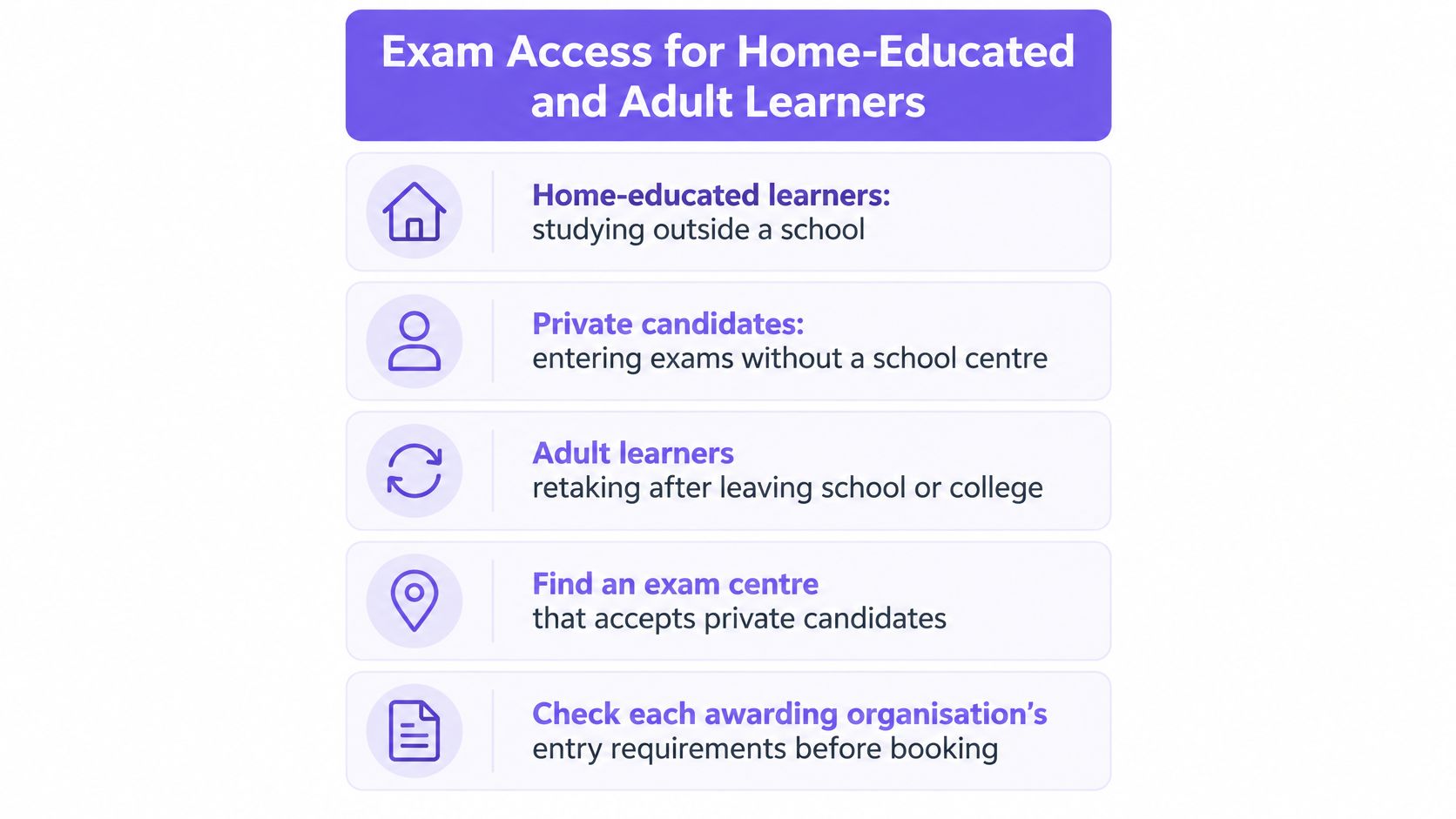
Ofqual states that private candidates, including home-educated learners and people retaking after leaving school or college, must register with a school or college to sit exams, as the Ofqual student guide to exams and assessments in 2026 sets out. That single requirement decides more enrolment decisions than curriculum content does.
The exam entry checklist
- Name the awarding body. Board and specification, not just "GCSE art", because centres enter candidates by syllabus code.
- Find a registered centre. One that will take private candidates, ideally within travelling distance for practical sessions.
- Ask about that exact specification. A centre can accept private candidates for one syllabus and refuse another.
- Confirm practical components. Can the centre run the practical, oral or controlled-assessment work your subject needs?
- Check entry deadlines. Each series has its own cut-off, and art practical work often needs earlier arrangement than written papers.
- Ask about resits. Whether a summer or November resit is available at the same centre, and what it costs to re-enter.
Creative subjects are the harder case. A centre that happily enters private candidates for English may not be able to administer a board-specific practical component, so the question isn't only "will you take me?" but "can you run this paper?".
The exam centre, not the course provider, decides whether you can sit the paper.
Ofqual's student guide for 2026 lists private candidates explicitly, which tells you this is a mainstream pathway rather than a niche exception. Home-educated learners and adult returners use it every year, and the process is administrative rather than exceptional.
We offer both recreational and exam-board accredited courses, and the two lead to different outcomes, so confirm which type leads to the qualification you need before you enrol. The registration itself usually sits with the centre, which is why the exam question should be settled before the course question.
Answers to Common Questions From Level 2 and Level 3 Creative Students
These are the questions creative students ask most often, answered briefly so you can move on to the checks that matter.
Recognition and equivalence
Is an iGCSE accepted for UK university entry? In most cases, yes. The deciding question isn't whether the qualification is recognised but whether the exact board, subject and grade satisfies the stated entry requirement, so ask admissions to confirm in writing before you rely on it.
Does a GCSE-equivalent Level 2 certificate replace a GCSE? Only if the receiving institution says so. A provider's equivalence claim doesn't transfer automatically to a sixth form, college or university, and our Level 2 Certificate in Art and Design sits on the GCSE course pathway for that reason: comparable level, destination decides.
Do I need GCSE art to start a Level 3 course? No, not if the college accepts an equivalent formal qualification. What matters is the published entry requirement of the institution you're moving to, not the title of your Level 2 course.
Difficulty and access
Is an iGCSE harder than a GCSE? There's no universal ranking. Compare the specification, the board and the assessment structure, because a course weighted towards exams and a course weighted towards portfolio work demand different things from you. If you're planning a portfolio-heavy route, read our guide to how many iGCSEs to take alongside the specification.
Can a home-educated learner sit a GCSE in art? Yes, as a private candidate entered through a registered centre. Online teaching doesn't create exam access on its own, so settle the centre first.
Where do creative qualifications lead outside teaching? Design skills travel into retail, exhibition and display work, and routes into visual merchandising work show how a portfolio converts into commercial roles.
Match Your Route and Confirm Entry Rules
Route fit usually settles the question before any comparison of standards does. A pupil in a state school in England takes GCSE because that's what the school enters them for; a pupil in an international school takes iGCSE because it's the benchmark qualification in that system.
| Situation | Usually the better fit | What to confirm first |
|---|---|---|
| State school pupil in England | GCSE | Whether the school offers the subject on a board you can take |
| Independent or international school pupil | Either, often iGCSE | The sixth form's accepted syllabus and grade wording |
| Home-educated learner | Either, depending on destination | A registered centre that will take you as a private candidate |
| Adult career changer | Accredited GCSE or Level 2 route, or A Level art without GCSE | Whether the destination accepts an equivalent formal qualification |
| Learner with SEND | SEND-supported Level 2 certificate, if the destination accepts it | Equivalence wording and assessment format |
| International learner outside the UK | iGCSE often the default | UK entry rules if you plan to study here |
| Creative degree applicant | Whichever route meets the GCSE English and maths requirement, plus a strong portfolio | The separate academic threshold and portfolio requirements |
What changes between rows isn't the standard of the qualification, it's the confirmation step. That's why the name of the route matters less than the sentence in the prospectus.
Three entry checks in order
- Read the wording. "GCSE grade 4" and "grade 5" aren't interchangeable, and a named subject specification means exactly that subject rather than a neighbouring one.
- Ask in writing. Email admissions with the board, syllabus title, grade scale and your predicted or achieved grade, so the reply covers all four.
- Keep the evidence. Certificate, awarding body details and syllabus title, which let an admissions team verify equivalence quickly instead of corresponding for weeks.
Cambridge states that its iGCSE A*–G and 9–1 grading scales are understood and accepted by universities and employers, while noting that universities may differ over whether a grade 4 or a grade 5 is treated as equivalent to the former grade C for English and mathematics requirements, as its iGCSE 9 to 1 grading factsheet explains.
Broad recognition and administrative friction coexist. A university can accept iGCSEs in principle and still run a course page that names a GCSE grade, so the useful question is never "are iGCSEs recognised?" but "does this board, subject and grade satisfy this course's stated requirement?".
For creative degrees, treat the academic threshold and the portfolio as two separate applications. Admissions may assess portfolio, interview and motivation separately from minimum qualifications, and a stated English or maths requirement still has to be met in the form the institution accepts. Retain the official certificate and syllabus title if you applied from home education or outside a conventional school, because those documents are what an admissions team checks.
Art school routes don't always require GCSE art. Students can study A Level art or design with us without a GCSE in art if they hold an equivalent formal qualification such as a Level 2 Certificate, BTEC, high school art or Arts Award. The Level 2 Certificate in Art & Design with SEND support is equivalent to GCSE or BTEC in good schools, has no exam and no written essay, and is studied fully online in the student's own time.
International learners comparing routes from outside the UK often meet different terminology for the same qualifications, and GCA's guide to exams for parents is a helpful translation layer before you approach a UK admissions office. Our online International GCSE Art and Design course follows the route described here, so its component weighting can be checked against your destination's requirements before you commit.
Email the admissions team with the syllabus title before you enrol. One reply settles the grade scale, the subject match and the equivalence question at once.
The Online College of Art & Design (OCAD) teaches GCSE, iGCSE, A Level and Level 2 and 3 creative courses online, with tutor feedback built into portfolio work from the first unit rather than bolted on at the end. If you're still deciding between routes, our tutors will talk through the specification, the component weights and the exam centre question with you before you commit a year to either. Visit The Online College of Art & Design (OCAD) to see the courses and start that conversation.