

A Level 2 or Level 3 creative student choosing a beginner graphic design course may think the first decision is which software to learn. If university is the goal, that's only part of the problem. You also need structured projects, regular feedback, evidence of development and a portfolio that shows how you think, not just a collection of polished images.
This roundup compares graphic design courses for beginners by their next useful outcome: an assessed qualification, an intensive portfolio, design theory, software confidence, flexible study or a focused skill. Formats range from tutor-led online pathways and live bootcamps to university short courses, Adobe training and self-paced learning. Course fees, schedules and availability can change, so check the provider's current booking page before enrolling.
The best beginner course is the one that produces clear evidence of progress towards your actual goal.
Table of Contents
- 1. The Online College of Art & Design for an assessed university-ready pathway
- 2. Shillington Education for an intensive portfolio sprint
- 3. UAL Short Courses for conceptual design foundations
- 4. City Lit for practical Adobe software confidence
- 5. British Academy of Graphic Design for staged study
- 6. Coursera and CalArts for self-paced design theory
- 7. FutureLearn for a focused typography skill
- 7-Program Comparison: Beginner Graphic Design Courses
- Build Your Route from Beginner Skills to University
1. The Online College of Art & Design for an assessed university-ready pathway
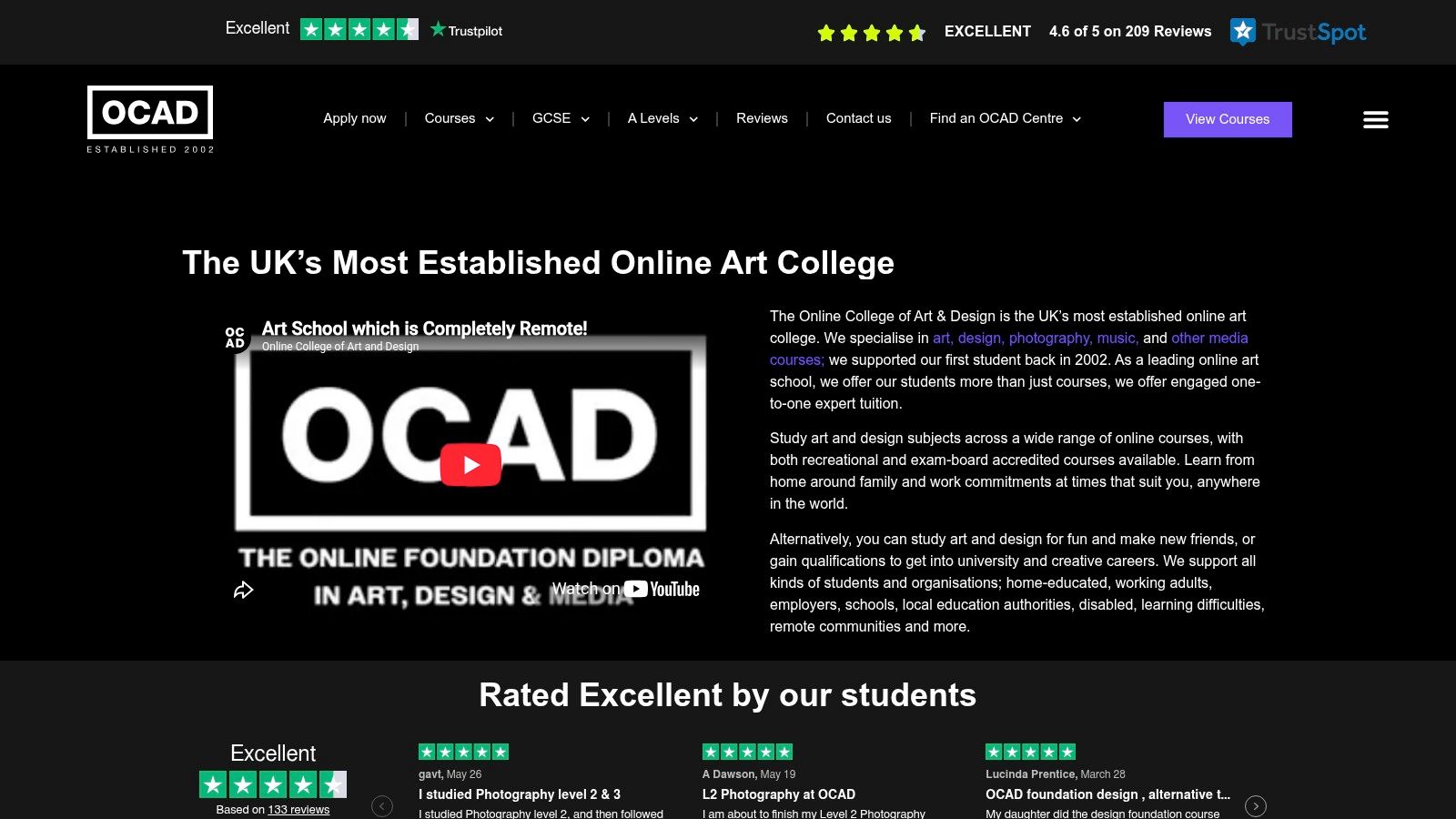
The Online College of Art & Design is the strongest choice when “beginner” means you need a supported route into formal creative study rather than a few isolated tutorials. OCAD offers tutor-led online learning across art and design, with routes that can progress from entry-level study towards GCSE or iGCSE, A Level and Level 3 or foundation-level work. Its graphic design pathway is particularly relevant to learners who need time to build a substantial body of assessed work.
The delivery combines a self-paced online studio with live Microsoft Teams tutorials, either individually or in groups. That mix suits home-educated students, adults changing direction and learners balancing study with work or family commitments. You can work through units and assignments independently, then use tutor feedback to revise ideas, strengthen layouts and develop a more coherent portfolio.
OCAD also publishes guidance around progression towards BA applications and provides dedicated SEND course options. That matters for learners who need adapted pacing, clearer structure or support that a large, self-directed platform may not provide.
What you'll produce
The main advantage is continuity. Instead of completing one branding exercise and moving on, you can build a sequence of projects that demonstrates research, experimentation, technical development and final outcomes. That evidence aligns with what UK creative admissions teams commonly ask to see. The University of Portsmouth, for example, asks applicants to submit five pieces of work that showcase their creative interests, experience and skills, while also recommending evidence of development in the portfolio (University of Portsmouth portfolio guidance).
OCAD's online format does mean you won't get the same everyday campus studio atmosphere as an in-person college. Optional centres may help, but learners who want constant physical studio access should compare the delivery model carefully. Public pricing isn't listed as a simple standard fee, so contact OCAD for the course-specific cost and schedule before applying.
For a closer look at the learning experience, read what it's like to be a student at OCAD.
Best for: a recognised, tutor-supported progression route, portfolio development, flexible study and learners who need structured support.
2. Shillington Education for an intensive portfolio sprint
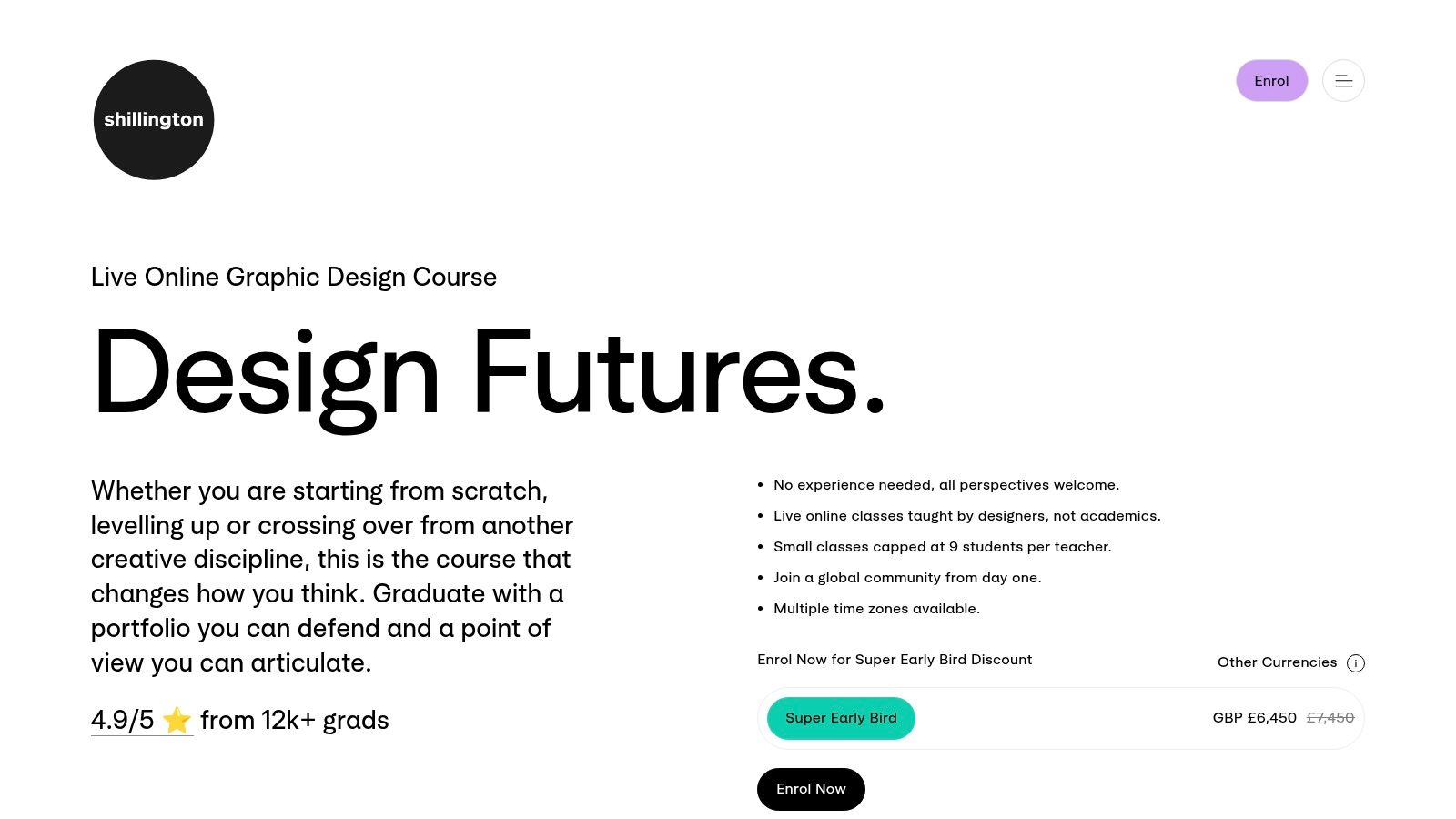
Shillington Education's live online graphic design course is built for beginners who want a concentrated, project-heavy experience. Rather than leaving you to decide what to practise next, it uses structured briefs, live demonstrations, tutor critiques and a cohort environment to keep momentum high.
The curriculum covers typography, layout, branding and digital production workflows. Those areas give a beginner a useful foundation because they connect visual decisions to communication. You're not only learning how to make an attractive image. You're learning how to organise information, establish hierarchy and develop a visual identity across related outputs.
A course for visible momentum
The strongest reason to choose Shillington is accountability. Live classes create a fixed rhythm, while peer critique exposes you to alternative solutions and different levels of progress. That can be valuable if you tend to watch tutorials without finishing projects. Career support adds a practical layer for learners who want to present their work professionally after the course.
The trade-off is equally clear. A premium live course costs more than a self-paced platform, and fixed sessions can be difficult around employment, caring responsibilities or unpredictable timetables. It also isn't the same as a qualification-led pathway. If your university application depends on a particular Level 2, Level 3 or foundation credential, check the course outcome before treating the bootcamp as a substitute.
You'll also need to understand the difference between making digital artwork and solving a communication problem. This comparison of graphic design and digital art is useful before you commit, especially if your portfolio currently contains illustrations but few typography, branding or layout projects.
Best for: a learner who can commit to live teaching and wants an intensive push towards a portfolio.
3. UAL Short Courses for conceptual design foundations
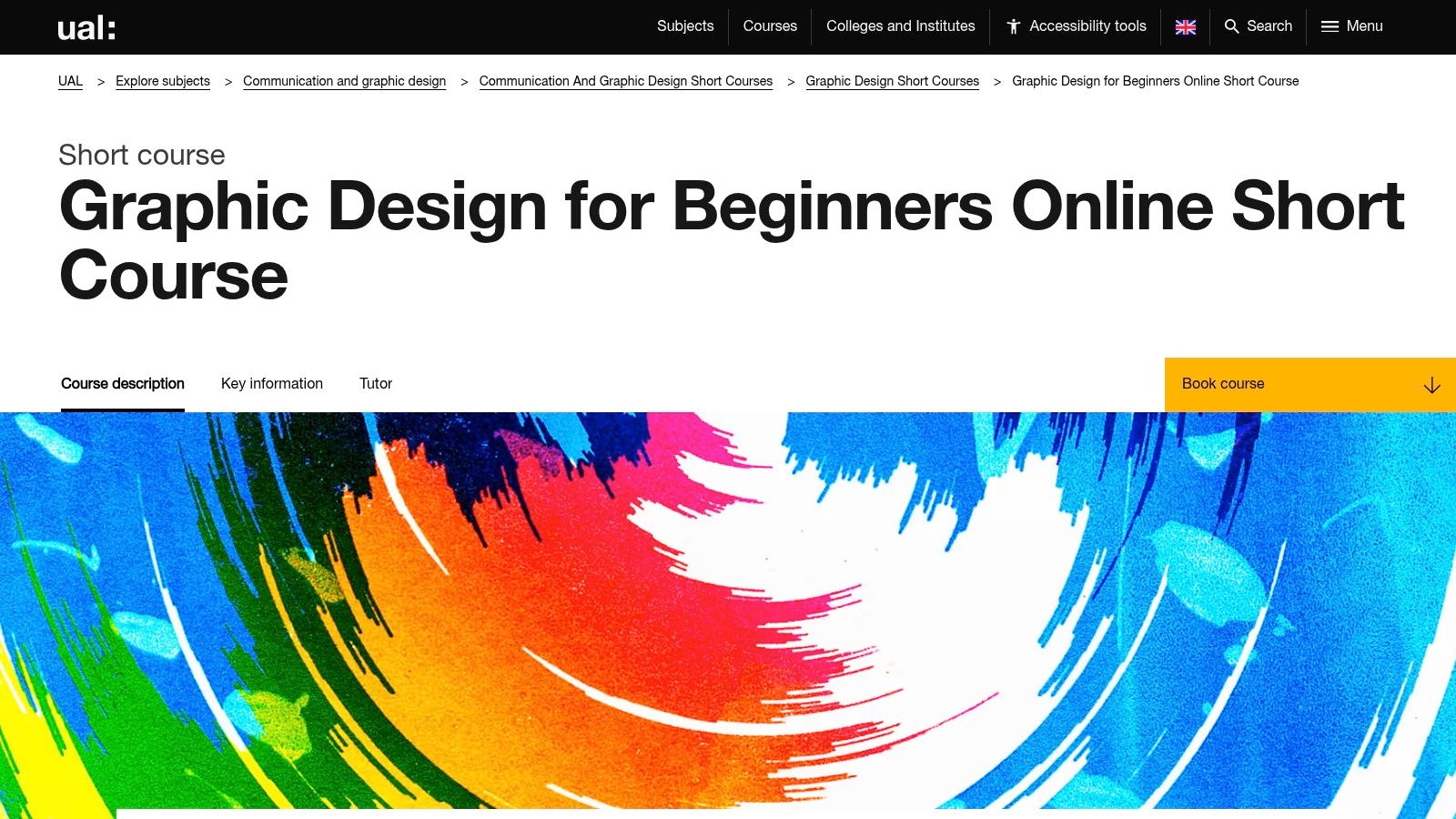
UAL's Graphic Design for Beginners online short course is the right choice if you need to understand how designers think before specialising in software. Delivered through UAL's communication and graphic design provision, it focuses on visual communication, typography, layout and image-making through practical projects and tutor review.
You can approach the work with analogue materials such as paper and scissors or use your preferred software. That flexibility makes the course accessible to students who are still developing digital confidence. It also stops beginners from confusing software operation with design judgement. A programme can teach you where to find a tool, but you still need to decide what the page should communicate and how the viewer should read it.
Where UAL fits in a university plan
Weekly critique is the feature to prioritise. Beginners often need an experienced person to explain why a composition feels unclear, why type hierarchy is weak or why an image competes with the message. Regular review helps you revise rather than treating the first version as finished.
The course awards a certificate or digital badge of attendance, but it isn't primarily an Adobe training course and shouldn't be your only choice if software confidence is the immediate barrier. Booking-stage pricing can vary by intake, so check the current cost before enrolling. If you're comparing it with a longer pathway, ask whether the resulting work will be enough for your intended university portfolio or whether you'll need additional projects.
University of Brighton's portfolio guidance asks for 15 to 20 images, with sketchbook work and idea development making up roughly three-quarters of the portfolio (University of Brighton portfolio advice). Use UAL projects as development evidence, not just final screenshots.
Best for: conceptual foundations, visual communication and learners who want critique without committing to a full qualification.
4. City Lit for practical Adobe software confidence
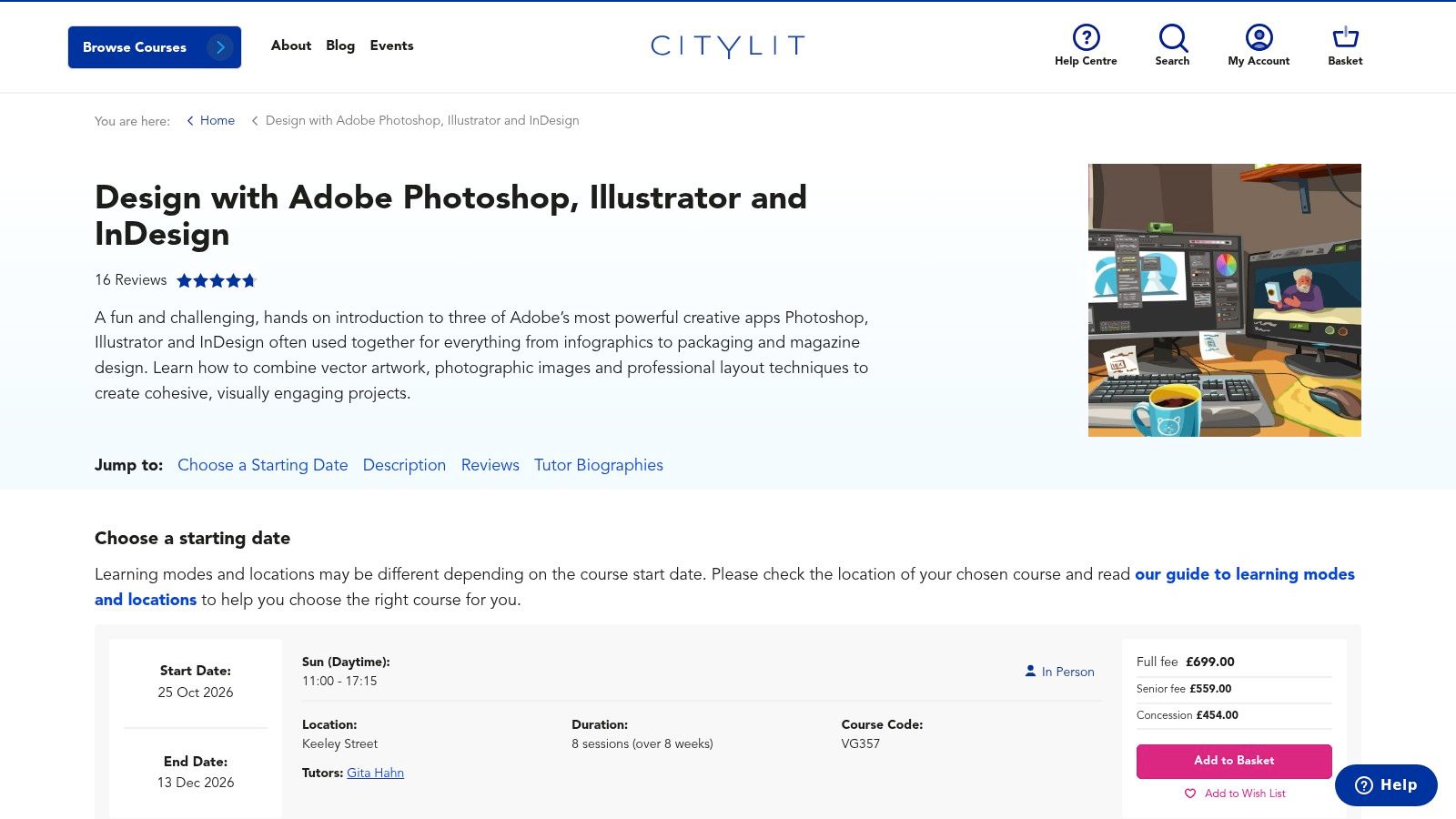
City Lit's beginner course in Adobe Photoshop, Illustrator and InDesign is the most direct recommendation for learners who understand basic design ideas but freeze when faced with professional software. The course focuses on hands-on work across the three Adobe applications most associated with everyday graphic design production.
Photoshop is useful for image editing and compositing. Illustrator is suited to vector artwork, marks and scalable graphics. InDesign handles page layouts and longer documents. Learning how the applications work together is more useful than mastering isolated buttons, because a real project may move from image preparation to vector artwork and then into a print or digital layout.
Flexible delivery, narrow scope
City Lit offers online and London-based options with different timetable patterns. That makes it easier to fit software training around work or other study. In-person delivery is also useful if you learn faster when you can ask a tutor to watch your process and correct it immediately.
This is a software course, not a complete foundation in design theory or a full university preparation route. You'll need to create your own broader portfolio by applying the tools to purposeful briefs. You'll also need access to an Adobe subscription for practice outside class, so include that ongoing requirement in your total cost.
The UK creative sector continues to report shortages in specialist IT skills connected to areas such as graphic design and multimedia production. The latest creative industries sector skills assessment also identifies digital capability as an important curriculum priority. City Lit is a sensible add-on when your next step is producing cleaner, more reliable digital work.
Best for: Adobe confidence, practical file production and learners who need flexible software training rather than a complete qualification.
5. British Academy of Graphic Design for staged study
British Academy of Graphic Design's course pathways suit learners who want to begin with a manageable commitment and progress through increasingly advanced study. Its options include home study, live online learning and classroom delivery, with Certificate and Diploma routes leading towards higher professional levels.
The staged structure is useful when you're not ready to choose a full-time course. You can start by testing whether graphic design suits your interests, then continue into more demanding briefs and portfolio work. Tutor support gives the route more direction than a completely independent course, while selected higher tiers may include optional work-placement opportunities.
Choose this route for progression by stages
This provider is a better match for a learner who wants flexibility but still needs a defined sequence. Home study offers control over your timetable. Live online or classroom study adds more immediate contact and routine. Compare the teaching mode, assessment process and portfolio expectations before selecting a tier, because the experience can differ between pathways.
The main caution is that a private-provider route shouldn't automatically be treated as equivalent to a school, college or university qualification. Ask what certificate you'll receive, how work is assessed and whether the outcome supports your intended next application. Longer pathways also cost more than a single short course, so calculate the full route rather than judging only the entry-level fee.
For university applicants, a portfolio needs more than attractive final pieces. Arts University Bournemouth states that most of its courses require a digital portfolio and that applicants should include finished work and work in progress (Arts University Bournemouth portfolio guidance). Choose briefs that let you show research, drafts, testing and refinement.
Best for: flexible staged progression, tutor-supported portfolio briefs and learners comparing home study with live or classroom options.
6. Coursera and CalArts for self-paced design theory
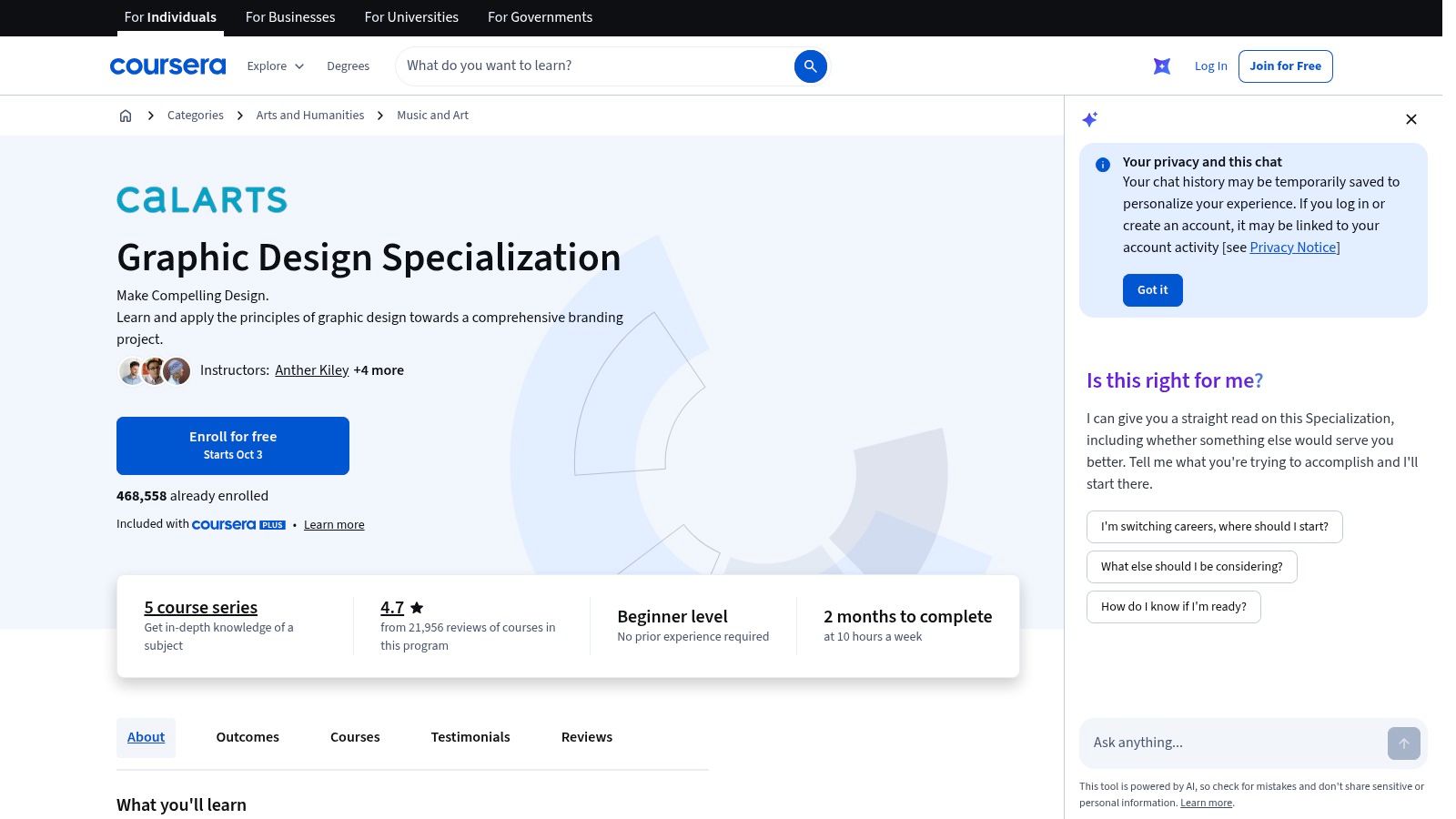
The CalArts Graphic Design Specialization on Coursera is a strong choice for a beginner who needs flexible access to design principles and can manage their own study schedule. The linked course sequence covers typography, colour, composition and image-making, then brings those ideas together in a branding capstone project.
It's especially useful for learners who are still asking what makes a design effective. You'll spend more time thinking about form, hierarchy and visual language than clicking through software tutorials. That conceptual grounding can pair well with City Lit or another Adobe-focused course.
Build discipline into self-paced study
The freedom is also the weakness. Without fixed live sessions, you must create your own deadlines and finish the assignments rather than collecting videos. Feedback is mainly peer-based unless you join a format that provides more direct support, so it won't replace sustained tutor critique when you're preparing a high-stakes university portfolio.
Coursera's subscription and financial-aid arrangements can vary by country and may only become clear during enrolment. Check the current terms before starting. You should also save your own project files, sketches and revisions rather than relying only on the platform record. A portfolio is stronger when it shows how a concept developed.
Use this guide to making an online art portfolio to organise your work as you progress. Keep a project page for each brief with the objective, research, experiments, selected outcome and a short reflection.
Best for: flexible theory-led study, independent learners and beginners who want a branding project to anchor their first portfolio.
7. FutureLearn for a focused typography skill
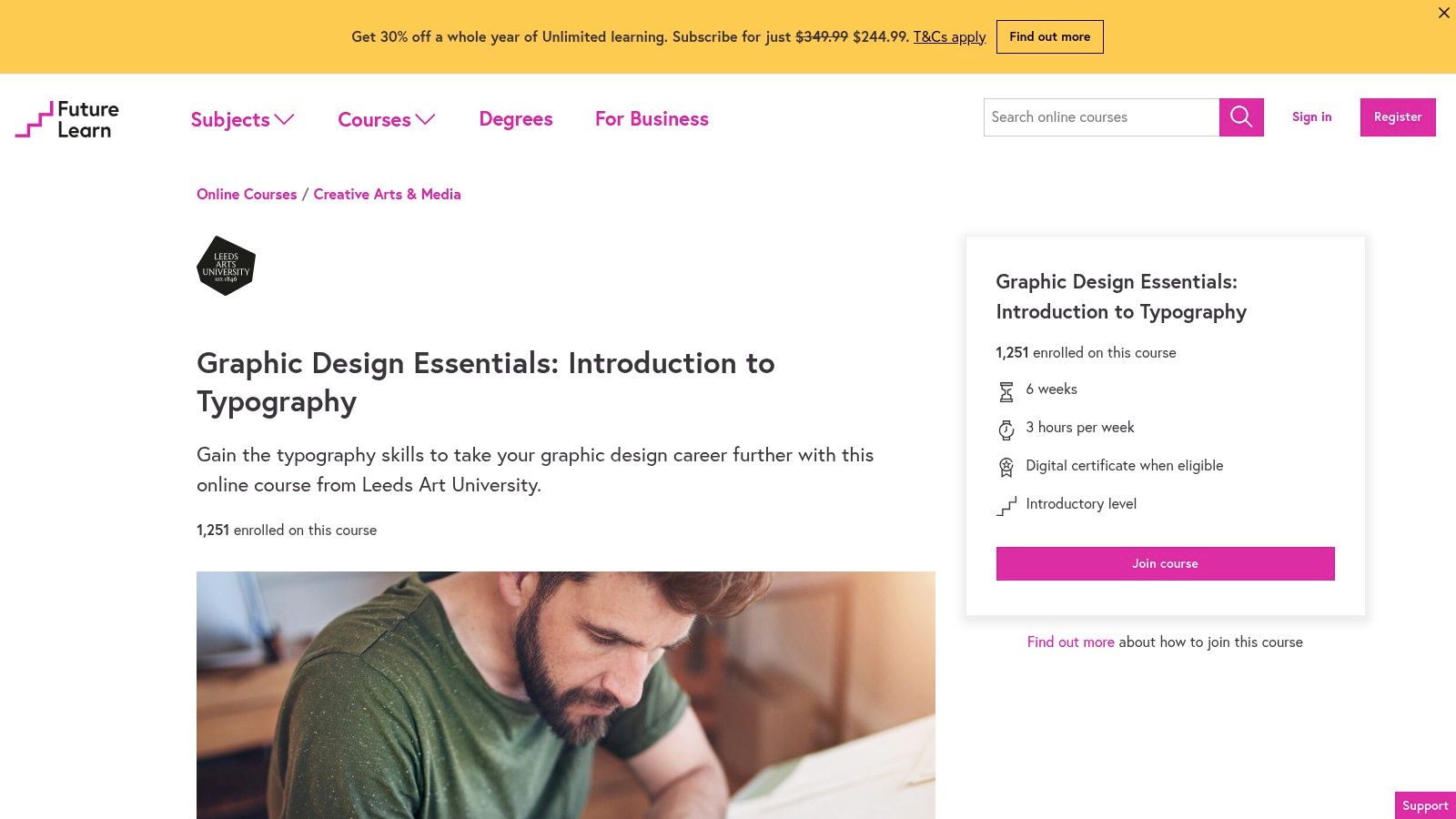
FutureLearn's Graphic Design Essentials course from Leeds Arts University is the most focused option in this list. It concentrates on typography fundamentals such as type classification, letter anatomy, grids, custom type and layout. That narrow scope is a benefit if you already know that text handling is the weak point in your work.
Typography affects how quickly people understand a page and how a design feels. A beginner who improves spacing, hierarchy, alignment and type pairing can make progress across posters, editorial pages, branding and digital layouts without needing a new creative concept for every exercise.
Use a narrow course deliberately
The course includes discussion-based learning, project elements and portfolio guidance, with certificate options available through the platform. Its manageable weekly workload makes it suitable for people studying around work or family commitments. It won't cover the full range of branding, image-making, software production or university portfolio preparation, so treat it as a targeted module rather than a complete pathway.
Start with a clear output. You might create a typographic poster, a small editorial spread or a simple identity system. Save the rejected type choices and layout tests as well as the final version. A font pairing guide for creators can support exploration, but your finished work should explain why the chosen type serves the message.
Certificate and extended-access pricing varies on the course page. Check what's included before paying, particularly if you only need the learning materials and portfolio exercises.
Best for: typography confidence, a compact study commitment and learners who need to strengthen one visible design skill.
7-Program Comparison: Beginner Graphic Design Courses
| Program | Complexity 🔄 | Resources & Speed ⚡ | Expected outcomes ⭐ / 📊 | Ideal use cases 💡 | Key advantages ⭐ |
|---|---|---|---|---|---|
| The Online College of Art & Design (OCAD) | Moderate, blended tutor‑led + self‑paced 🔄🔄 | Flexible pacing; needs reliable internet, MS Teams, art materials; fees on request ⚡ | Accredited routes (GCSE/A Level → Level 3/Foundation), strong portfolio & exam success 📊⭐ | Home‑educated learners, SEND students, adults upskilling, international learners 💡 | Accredited pathways, iterative tutor feedback, SEND support, long track record ⭐ |
| Shillington Education, Live Online Graphic Design Course | High, intensive live bootcamp (full‑time or part‑time) 🔄🔄🔄 | Time‑boxed (≈3 months full‑time / ≈9 months part‑time); cohort schedule; premium cost ⚡⚡ | Portfolio‑ready projects, practical skill acceleration, career support 📊⭐ | Career changers or fast‑track portfolio builders who can commit to fixed schedule 💡 | Cohort critique culture, live demos, strong career services ⭐ |
| UAL Short Courses, Graphic Design for Beginners (Online) | Moderate, weekly tutor reviews, project‑based 🔄🔄 | Short, structured timetable; certificate/badge on completion; moderate time commitment ⚡ | Conceptual foundations (typography, layout, image‑making); certificate of attendance 📊 | Beginners seeking institution‑led conceptual grounding (Central Saint Martins/UAL) 💡 | Reputable faculty, conceptual emphasis over tool training ⭐ |
| City Lit, Design with Photoshop, Illustrator & InDesign (Beginners) | Low–Moderate, software‑focused, practical classes 🔄🔄 | Multiple schedule options (online/in‑person); requires Adobe subscription for practice ⚡⚡ | Practical tool proficiency across Adobe suite; hands‑on project outcomes 📊 | Learners needing Adobe skills to complement theory or portfolio work 💡 | Tool‑specific training, in‑person facilities, flexible timetables ⭐ |
| British Academy of Graphic Design, Certificate/Diploma Pathways | Variable, progressive modular routes (Certificate → Diploma → Professional) 🔄🔄 | Multiple study modes (home‑study, live online, classroom); longer timelines for higher tiers ⚡ | Tiered qualifications, portfolio briefs, optional placements at higher levels 📊 | Those seeking clear progression, validated diplomas and optional workplace placements 💡 | Transparent module lengths/pricing, portfolio focus, placement options ⭐ |
| Coursera, CalArts "Graphic Design" Specialization | Low, self‑paced university courses with capstone 🔄 | Flexible pacing via Coursera; subscription or financial aid; peer feedback common ⚡⚡ | Strong conceptual grounding and capstone portfolio; recognised credential for CV/LinkedIn 📊⭐ | Self‑motivated learners who want university‑led theory at own pace 💡 | University‑authored curriculum, flexible access, widely recognised credential ⭐ |
| FutureLearn, Graphic Design Essentials: Intro to Typography (Leeds Arts University) | Low, focused short course (6 weeks, ~3 hrs/week) 🔄 | Short weekly commitment; discussion‑based; certificate option; low time overhead ⚡⚡⚡ | Typography fundamentals, small portfolio elements, practical layout skills 📊 | Beginners wanting a focused introduction to typography with modest weekly time 💡 | University‑authored content, manageable workload, clear typography focus ⭐ |
Build Your Route from Beginner Skills to University
The right course depends on what must exist at the end of your study. Choose OCAD or another structured qualification pathway when you need sustained tutor feedback, assessed work and a university-ready portfolio. Choose Shillington when you can commit to an intensive live experience and want a concentrated portfolio sprint.
Choose UAL or Coursera's CalArts Specialization for conceptual foundations. UAL gives you tutor review and a project-based institutional setting, while Coursera gives you greater control over pace and study time. Choose City Lit when software is the immediate barrier and you need practical experience with Photoshop, Illustrator and InDesign. Choose FutureLearn when typography is the specific skill holding back your layouts. Consider the British Academy of Graphic Design when you want staged study options across different delivery modes.
Before you enrol, check:
- Target qualification: Is the outcome a certificate of attendance, a private-provider award, a regulated qualification or a foundation-level progression route?
- Portfolio output: Will you finish several connected projects, or only isolated exercises? Can you keep sketches, research, drafts and final outcomes?
- Feedback model: Will a tutor review your work live, provide written assessment, facilitate peer critique or leave you to self-assess?
- Timetable: Do you need self-paced access, flexible live sessions, classroom teaching or a fixed intensive schedule?
- Software access: Does the course teach Adobe tools from scratch, allow analogue methods or expect you to arrange software independently?
- Total cost: Include tuition, subscriptions, materials, equipment and any travel. Course fees can change, so confirm the current figure with the provider.
- Progression support: Does the provider help you prepare for further study, portfolio submission or a degree application?
For Level 2 and Level 3 creative students, map every project against the requirements of the degrees you're considering. University admissions teams want to see creative thinking and development, not only finished images. De Montfort University's Art and Design Foundation Diploma, for example, combines academic entry requirements with a good portfolio or recent art and design experience (De Montfort University foundation diploma requirements).
Keep your research, sketchbook pages, experiments, discarded ideas, feedback and final outcomes in an organised digital portfolio. Brighton's guidance asks applicants to submit a single website link, so practise presenting your work as a clear sequence rather than sending a folder of unrelated files. If you're moving from Level 2 or Level 3 study towards university, that process evidence may be as important as the final composition.
The UK design economy is highly qualified, with 80% of graphic design workers holding a degree in 2020 and 69% of surveyed designers reporting a design GCSE or equivalent, according to the Design Council's UK design economy report. A beginner course should therefore be judged by how well it helps you take the next credible step, not by how impressive its course title sounds.
The Online College of Art & Design (OCAD) offers flexible, tutor-led routes in art and design, including beginner study, Level 2 and Level 3 progression, foundation pathways and portfolio support. If you need graphic design courses for beginners that can fit around home education, work, family commitments or SEND requirements, visit The Online College of Art & Design (OCAD) and explore the pathway that matches your university goal.