

You've built a portfolio you're proud of. Your sketchbook is full, your project work is strong, and your personal statement finally sounds like you. Then you check a university application and find a condition you didn't expect: a recognised maths qualification.
For a Level 2 or Level 3 student in art, design, photography, fashion, music, or media, that moment can feel unfair. You may have chosen a creative route precisely because traditional maths didn't reflect how you think. Yet a missing qualification can still delay an application or limit your choices.
Online Functional Skills Maths can offer a practical route forward. It's designed around usable numeracy, flexible study, and problem-solving rather than a broad academic syllabus. It won't replace the need to check each university's requirements, but it may give you the recognised maths pathway your creative progression needs. You can also explore broader degree pathways for creative students while deciding how maths fits into your plans.
Table of Contents
- Your Creative Talent Is Not Enough for University
- What Exactly Is Functional Skills Maths
- The Level 2 Maths Your University Wants
- How Online Courses Make Maths Manageable
- Functional Skills vs GCSE Maths Which Is Right for You
- Tips for Success in Your Online Maths Course
- University Entry FAQs for Creative Students
Your Creative Talent Is Not Enough for University
Maya has spent two years building a fashion portfolio. She can explain fabric choices, justify a colour palette, and present a clear collection. Her tutors see strong potential, and she has shortlisted courses that fit her goals. Then one university asks for a maths qualification at a specific level.
That can feel frustrating, but the issue is simple. The university is asking for proof of a foundation skill, not judging her creative work.
A maths requirement does not measure whether you can draw, compose, photograph, design, or think visually. It shows that the course wants a recognised level of numeracy before you start higher study. The practical move is to check the exact entry condition, see which qualifications the university accepts, and choose the route that fits your current commitments.
A missing maths qualification is an admin hurdle, not a comment on your creative potential.
For many creative applicants, online study fits better than returning to a full-time classroom. You may already be doing a Level 3 course, finishing a portfolio, working part-time, or managing responsibilities at home. A tutor-led online course lets you study in planned sessions without pulling you away from your creative practice. It works a bit like a studio timetable, with focused blocks you can return to instead of one long, fixed lesson.
The qualification also has a clear purpose. Government guidance describes Functional Skills Mathematics as a foundation for progression into employment and further technical education, while supporting confidence and everyday numeracy through a defined national framework official Functional Skills Mathematics guidance.
You do not need to become a mathematician. You need to understand what the qualification checks, choose the right level, and build enough confidence to show what you know. For a creative student, that makes maths less like a barrier and more like one more practical step on the path to university.
What Exactly Is Functional Skills Maths
Think of Functional Skills Maths as a practical workshop. You're not sitting in a lecture about mathematical theory for its own sake. You're learning which tool to choose when a real problem appears, how to use it accurately, and how to explain the result.
That practical emphasis is built into the official subject content. Functional Skills Mathematics in England is nationally defined, with government-set content covering Entry Levels 1 to 3 and Levels 1 to 2. The framework focuses on number, measures and shape, statistics, and problem solving, rather than treating maths as a collection of disconnected exercises the government's Functional Skills Mathematics subject content.
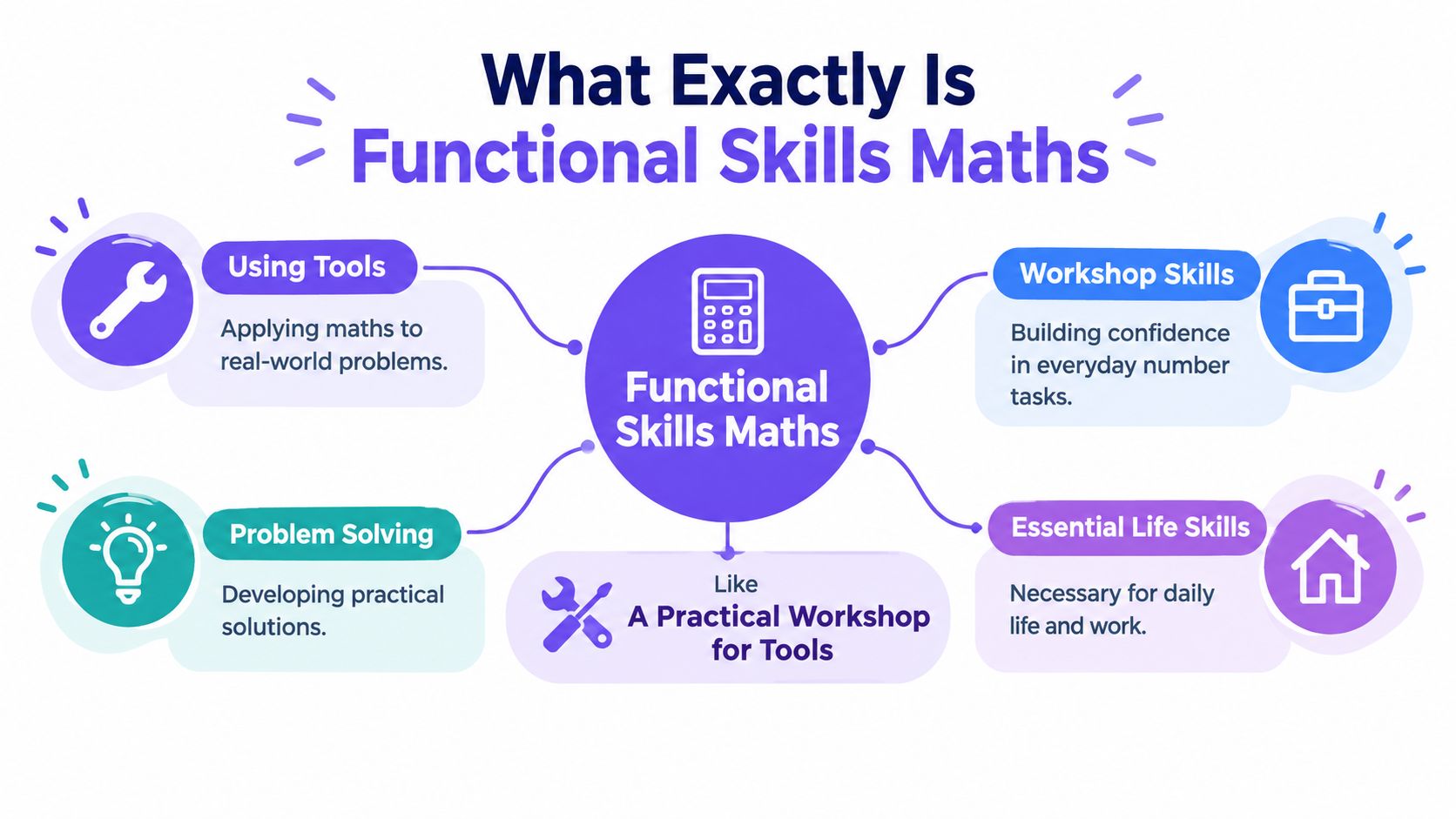
The four practical areas
Number covers the calculations you use to understand quantities, prices, fractions, decimals, percentages, ratios, and proportions. A graphic designer might use these ideas when resizing artwork, checking print quantities, or dividing a project budget.
Measures and shape connects maths to space, size, distance, area, volume, scale, and geometry. Those ideas appear naturally in interior layouts, garment construction, photography composition, set design, architecture, and product work.
Statistics means reading and interpreting information. You might work with charts, tables, averages, or comparisons. In a creative context, that could mean understanding audience feedback, comparing engagement categories, or making sense of survey results.
Problem solving brings the strands together. Instead of receiving a calculation with every operation already identified, you must decide what information matters, choose a method, and check whether the answer makes sense.
A digital diagnostic can help a provider identify which areas need attention first. If your number skills are secure but data interpretation is weaker, you can spend more time on charts and tables instead of repeating material you already understand. That approach makes online learning feel less like moving through a fixed textbook and more like following a personalised workshop plan.
The levels also have a clear progression. At Level 1, learners work with skills such as calculating a mean and range, interpreting charts, and expressing probability on a scale from 0 to 1. At Level 2, the demands increase to estimating means from grouped frequency distributions, comparing data sets, and expressing probabilities as percentages, as set out in the government subject content linked above.
The qualification is practical, but it isn't trivial. It asks you to use maths purposefully, which is exactly why it can suit students who learn best through context.
The Level 2 Maths Your University Wants
For a creative student preparing a portfolio, Level 2 Functional Skills Maths can feel like an entry ticket rather than part of the creative process. It is often the qualification learners investigate when a university or course asks for a recognised maths result. National Numeracy's explanation of Functional Skills describes Level 2 as broadly benchmarked against GCSE grade 4/C standard, with acceptance across many jobs and further-study settings. Treat that comparison as a guide, then check the exact entry requirements for your chosen university and course.
Level 2 expects you to make decisions, not to repeat arithmetic. Learners solve complex, multi-step problems, usually involving at least two connected steps or processes. You must identify relevant information, interpret the situation, choose a method, and check whether the result is sensible. The official Level 2 Functional Skills Mathematics guidance sets out this expectation.

Translating the syllabus into creative work
Ratio is useful when you mix materials, scale a pattern, adjust a colour mixture, or resize an image for a different format. The numbers describe relationships, much like a recipe describes how separate ingredients work together.
Percentages support everyday creative decisions. You might calculate an equipment discount, compare supplier costs, review a project budget, or alter a design's dimensions. Connecting the question to a decision you already understand can make the calculation feel more manageable.
Geometry and measures relate directly to visual work. Perspective depends on spatial relationships. Layouts require proportion and measurement. Photography involves distance, framing, and scale. Planning an exhibition may involve dimensions, area, and how visitors move through a space.
Data interpretation gives creative judgement a firmer base. If you collect portfolio feedback in a table, Functional Skills Maths helps you compare categories, notice patterns, and question whether a small set of responses supports a confident conclusion. It does not decide what your art should be. It helps you assess the information around your work.
Level 2 tests whether you can choose and connect methods, not whether you can memorise isolated formulas.
The qualification also has a clear outcome. Functional Skills Mathematics uses one specified attainment level, Pass, rather than a range of grades within the qualification, according to Ofqual's Functional Skills Mathematics conditions and requirements. A clear pass condition can simplify your planning when maths is one requirement among portfolio, interview, and subject-specific applications.
Maths may also connect with education support or specialist academic work alongside a creative career. The National Heritage Academies specialist role illustrates responsibilities associated with maths-focused work.
For course planning, review the NCFE Level 2 Functional Skills Mathematics option and compare its requirements with the university conditions you need to meet.
How Online Courses Make Maths Manageable
Online learning works best when it combines flexibility with accountability. Watching a few videos alone may not be enough if you're unsure why an answer is wrong. A structured course with tutor feedback, practice tasks, and a clear assessment route gives you somewhere to ask questions before confusion becomes a habit.
For a creative student, the schedule is often the deciding factor. You might study after a studio session, before work, or during a quieter part of the week. The useful flexibility isn't just being able to log in whenever you want. It's being able to organise maths around portfolio deadlines without losing contact with a tutor.
What assessment can look like online
UK Functional Skills Mathematics rules allow awarding organisations to define whether assessments are available online, on paper, or through both formats. They may also use on-demand or session-based delivery, with arrangements that consider how learners can retake assessments NCFE's online practice-assessment support.
That flexibility can reduce the pressure created by a single fixed exam window. Your provider should explain the assessment platform, identity checks, equipment requirements, invigilation process, and options for resitting if you don't pass at the first attempt. Ask these questions before enrolling, especially if you have limited device access or need reasonable adjustments.
Online assessment can suit learners who feel more comfortable working on screen. NCFE's 2024–25 pass-rate summary reports a 50% overall pass rate for Level 2 maths and 47% for Level 1 maths, and states that online assessments consistently produce higher pass rates than paper-based assessments across Level 2 English and maths NCFE's 2024–25 Functional Skills pass-rate summary. The same report records 56% overall for digital Level 1 maths, compared with the 47% total average in the comparison described by NCFE.
Those figures are useful, but they don't prove that online delivery alone causes better results. Learner selection, centre support, digital familiarity, and preparation may all affect outcomes. If you find screens distracting, struggle to type, or need paper for working, an online course can still support you while you practise in the format that helps you think clearly.
Support matters more than the platform
Look for a provider that offers direct tutor contact, marked practice, clear feedback, and guidance on booking or preparing for the assessment. The online Functional Skills course options should be judged by the support around the content, not just the fact that the lessons are delivered digitally.
A short diagnostic at the beginning can identify your starting point. From there, you can work through number, measures and shape, statistics, and problem solving in a deliberate order. The aim is to make each session manageable enough that you can keep returning to it.
Functional Skills vs GCSE Maths Which Is Right for You
GCSE Maths and Functional Skills Mathematics can both be meaningful qualifications, but they serve different purposes. GCSE Maths offers a wider academic syllabus and usually forms part of a traditional school or college programme. Functional Skills focuses more tightly on practical numeracy and applied problem solving.
For a creative student, the right choice depends on the exact university requirement, your previous study, your available time, and the kind of qualification you may need later. Don't assume that a university will accept one qualification because another institution does. Contact admissions before you enrol and ask for the answer in writing if the requirement is central to your application.
| Decision point | Functional Skills Maths | GCSE Maths |
|---|---|---|
| Main purpose | Practical number use, measures, statistics, and problem solving | Broader academic mathematical study |
| Best fit | A learner targeting a defined maths requirement or practical progression route | A learner who needs the traditional GCSE pathway or broader academic coverage |
| Assessment style | A regulated assessment with a single Pass attainment outcome | GCSE grading across a wider grade scale |
| Study pattern | Can be suitable for flexible, tutor-led online study | Often follows a more structured classroom timetable |
| Creative relevance | Applied contexts such as budgets, scale, measurement, data, and comparison | Wider theory that may support later academic mathematics |
| Entry requirements | National Numeracy notes no formal pre-entry requirements for Functional Skills Level 2 | Entry arrangements vary by centre and programme |
| University suitability | May be accepted, but each course sets its own conditions | Commonly recognised as a traditional academic qualification |
When Functional Skills may be the efficient route
Functional Skills can make sense when you already have strong creative qualifications and need to add a specific maths credential. You may not need a broad return to school-style study if your goal is to demonstrate practical numeracy at the required level.
The qualification also has a clear progression ladder from Entry Levels 1 to 3 through Level 1 and Level 2. Level 2 is the highest level in the mainstream Functional Skills Mathematics structure. That makes it important to confirm whether your course asks for Level 2, GCSE grade 4/C, or a qualification with particular wording.
When GCSE may still be preferable
GCSE Maths may be the safer choice if a university explicitly requires GCSE and doesn't list Functional Skills as an alternative. It may also suit you if you're considering a route where broader academic maths is expected, or if you want to preserve more traditional progression options.
Neither qualification is automatically easier for every learner. Functional Skills is often more directly connected to daily life and work, while GCSE covers a broader academic field. Your previous experience matters, as does the assessment format in which you perform best.
Choose the qualification that matches the written entry requirement, not the one that sounds more familiar.
The practical decision is simple. Find the exact wording from your university, ask whether Functional Skills Level 2 is accepted for your course, and then compare study support, assessment arrangements, and your own confidence with each route.
Tips for Success in Your Online Maths Course
Creative learners often remember ideas more effectively when they can see relationships. Turn a topic into a visual map, colour-code the steps in a method, or connect a calculation to a design task you already understand.
For example, you could represent fractions as sections of a composition, use scale drawings to explore measurement, or create a small chart from portfolio feedback. Symmetry, perspective, proportion, and the golden ratio can make mathematical language feel less detached from visual practice, although the exam will still require you to follow its own question wording.
Build a routine that protects studio time
Set a regular study slot and keep it realistic. A short session that you complete consistently is more useful than a large plan that collapses when a project deadline arrives.
Try this sequence:
- Warm up visually: Review one worked example and mark the operation being used.
- Practise actively: Complete questions without copying the model answer.
- Explain the method: Write one sentence describing why you chose that operation.
- Record the mistake: Keep an error page for units, rounding, percentages, or misread instructions.
- Ask early: Send a specific question to your tutor instead of waiting until the topic feels overwhelming.
Use online practice assessments to become familiar with the screen, calculator process, navigation, and question style. Practice should reveal what you need to improve, not confirm that you already know everything.
If procrastination is connected to attention regulation or ADHD, a practical guide to mastering ADHD procrastination may help you choose smaller starting steps and reduce the friction around beginning.
Don't measure progress by whether maths feels comfortable every day. Measure it by whether you can now identify the information, choose a method, and explain your answer more clearly than before.
University Entry FAQs for Creative Students
Will universities accept Level 2 Functional Skills Maths?
Some universities and courses accept it, but entry rules belong to the individual institution and course. Treat the qualification as a possible route, not an automatic guarantee. Check the admissions page, then contact the university if the wording is unclear, particularly where the requirement names GCSE Maths specifically.
Is Level 2 suitable for a Level 3 creative student?
It can be. Level 3 study doesn't mean you must already feel confident with every area of maths. If your creative qualification is progressing well but a maths condition remains unresolved, Level 2 Functional Skills can provide a focused route based on practical content and applied problem solving.
Will it take over my portfolio work?
That depends on your provider, starting point, study habits, and assessment readiness. Online delivery can help you organise sessions around creative deadlines, but flexibility still requires planning. Protect your portfolio time, set a repeatable maths routine, and tell your tutor when a project deadline affects your schedule.
Is the qualification useful beyond university admissions?
Yes. The official purpose extends to confidence, employment, further technical education, and everyday life. NCFE's specification also states that learners who achieve Level 2 Functional Skills Mathematics could progress to the Level 3 Certificate in Mathematics for Everyday Life, giving the qualification a route beyond the immediate admissions requirement NCFE's Functional Skills Mathematics qualification specification.
A creative career may involve pricing work, calculating materials, managing invoices, comparing supplier costs, interpreting audience data, or planning production time. These tasks don't make your work less creative. They help you protect the practical conditions that allow your work to continue.
What if maths triggers anxiety?
Start with a diagnostic rather than a full paper. Knowing which areas need work is less frightening than treating the whole subject as one large problem. Use tutor support, practise in small sections, and rehearse the assessment format before the final sitting.
If university planning itself is creating pressure, you may also find anxiety coping guides and tools useful alongside academic support. You're allowed to seek help with the emotional side of returning to maths.
The qualification isn't a test of whether you belong in a creative degree. It's one practical piece of preparation that can widen your options, strengthen everyday decision-making, and help you meet a requirement with a clear plan.
The Online College of Art & Design (OCAD) offers online Functional Skills courses alongside tutor-led pathways in art, design, photography, music, and related media. Visit The Online College of Art & Design (OCAD) to explore flexible study, individual tutor support, and creative progression routes that can fit around your university plans.