

If you're looking at university music courses, a Level 3 diploma, or an A Level route and thinking, “I can make music, but my theory feels patchy”, you're in a very normal place. A lot of capable performers, songwriters, producers, and home-educated learners reach this point. They can hear what works, but they can't always explain it on paper, read it quickly, or connect it to the qualification ladder that universities recognise.
That's where online music theory courses can help. Not as random worksheets or passive videos, but as a structured way to move from Level 2 understanding, into Level 3 confidence, and then into university-ready study. If you're asking whether online theory is taken seriously in the UK, the answer is yes. Digital learning is now built into music education, and many learners already use online lessons, digital tools, and live platforms as part of their regular study.
The bigger question isn't whether online theory counts. It's which kind of course fits your next step. Some learners need foundation work in notation and rhythm. Some need Grade 5 Theory because it enables higher progression. Some need a Level 3 route that supports university applications. The useful way to think about it is as a ladder. You stand on one rung, and the right course helps you reach the next one.
Table of Contents
- Introduction to Online Music Theory Courses
- What Online Music Theory Courses Teach You
- Understanding Levels Grades and University Pathways
- What to Expect Inside an Online Theory Course
- How to Choose the Right Online Music Theory Course
- How OCAD Supports Music Theory Learners Online
- Next Steps to Start Your Music Theory Journey
Introduction to Online Music Theory Courses
A typical learner I meet sounds something like this: you enjoy making music, you've done practical work, maybe you've built pieces in a DAW or learned songs by ear, but now a course specification or university entry page mentions theory and you hesitate. You don't want a dry, old-fashioned subject. You want something organised, clear, and worth your time.
That's exactly why online music theory courses have become so useful. They give you a way to learn in smaller steps, revisit tricky ideas, and connect theory to real goals such as exams, coursework, composition, listening work, and progression to higher study.
In the UK, this isn't a fringe route. ABRSM's Making Music research reported that 8% of UK adults were taking or had taken online singing lessons in 2020, compared with 3% of adults using online music lessons in 2014, and nearly two thirds of children who played an instrument used digital resources such as YouTube videos, apps, recording tools, and online courses to support learning (ABRSM Making Music UK). That matters because it shows online music learning is no longer unusual. It's part of how many people study.
Why learners choose online theory study
Some choose it because local options are limited. Others need flexibility around work, rehearsals, caring responsibilities, or home education. Many prefer being able to pause, replay, annotate, and ask questions without the pressure of keeping up in a busy room.
Practical rule: A good online theory course shouldn't feel like being left alone with a pile of PDFs. It should feel like guided study with a clear destination.
What this can unlock next
For Level 2 and Level 3 creative students, theory often stops being optional once progression becomes serious. It can support GCSE or equivalent study, strengthen A Level work, prepare you for graded exams, and help you understand the language used in degree-level music teaching.
The right question to ask is, “Will this help me get to university?”. The strongest online music theory courses don't sit in isolation. They fit into a wider UK pathway of recognised grades, levels, and admissions requirements. Once you understand that ladder, choosing the right course becomes much easier.
What Online Music Theory Courses Teach You
A strong online theory course teaches you to read music the way a confident reader handles a page of text. At first, you notice single signs. Then you start seeing how they work together. For Level 2 learners, that usually means building secure reading and writing skills. For Level 3 learners, it means using those skills to explain, compare, and justify musical choices in ways that prepare you for advanced study.
Music theory works like the grammar of music. It gives names to patterns you already hear, and it helps you organise ideas you want to write down. That is why good courses do more than hand you terms to memorise. They train you to connect symbol, sound, and meaning.
The core skills you build
Most online music theory courses begin with a small set of foundations, because later topics depend on them in the same way algebra depends on confident arithmetic.
- Pitch and notation. You learn how notes are placed on the stave, how clefs change what you read, and how written notes relate to actual sound.
- Rhythm and metre. You practise note values, rests, time signatures, grouping, pulse, and accent.
- Keys and scales. You study major and minor patterns, sharps and flats, and how music centres around a key.
- Intervals and chords. You learn how notes are measured against each other, how triads are built, and how harmony begins to create direction.
If printed music still feels crowded or unclear, a clear music symbols notation guide can help you identify markings before you tackle longer scores.
One point often confuses learners here. Knowing a definition is only the start. Recognising a minim on a worksheet is different from reading it accurately in time, hearing how it sits in the bar, and using it correctly in your own writing. Good online courses keep returning to that link between page and sound.
How the basics turn into understanding
Once those foundations are steady, the work becomes more interesting. You stop reading music sign by sign and start noticing patterns.
A cadence begins to feel like punctuation. A modulation feels like the music has stepped into a new room. A repeated rhythm stops looking accidental and starts looking like structure. This is often the stage where theory begins to help with practical music-making, because you can see why something sounds settled, tense, bright, heavy, complete, or unfinished.
Online theory courses often develop three wider abilities here:
Analysis
You learn to describe how melody, harmony, rhythm, and structure create an effect.Composition and songwriting
You make clearer choices about chord progressions, phrasing, sequence, contrast, and shape.Aural understanding
You connect what you hear with what you see, so notation no longer feels separate from performance.
What that means for progression
Different stages of study ask for different kinds of understanding.
At Level 2, learners usually need fluency. Can you read the score accurately, spot the key, group the rhythm properly, and explain the basic harmonic idea? At Level 3, the expectation rises. Can you compare two passages, comment on the effect of a harmonic change, or explain why a composer chose one pattern instead of another?
That shift is important for anyone aiming at university. Online music theory courses are most useful when they sit on a progression ladder. First you gain control of the building blocks. Then you use them to make judgements. Then you arrive at higher study already familiar with the language tutors use in analysis, composition, and musicianship classes.
What you should be able to do after a solid course
By the end of a well-structured stretch of study, you should be able to read rhythms with more confidence, identify key features in a score, explain how harmony supports melody, and improve your own musical ideas with more control.
A simple test helps. If you can only repeat definitions, you are still at the surface. If you can read, hear, explain, and apply the idea in context, the course is doing its job.
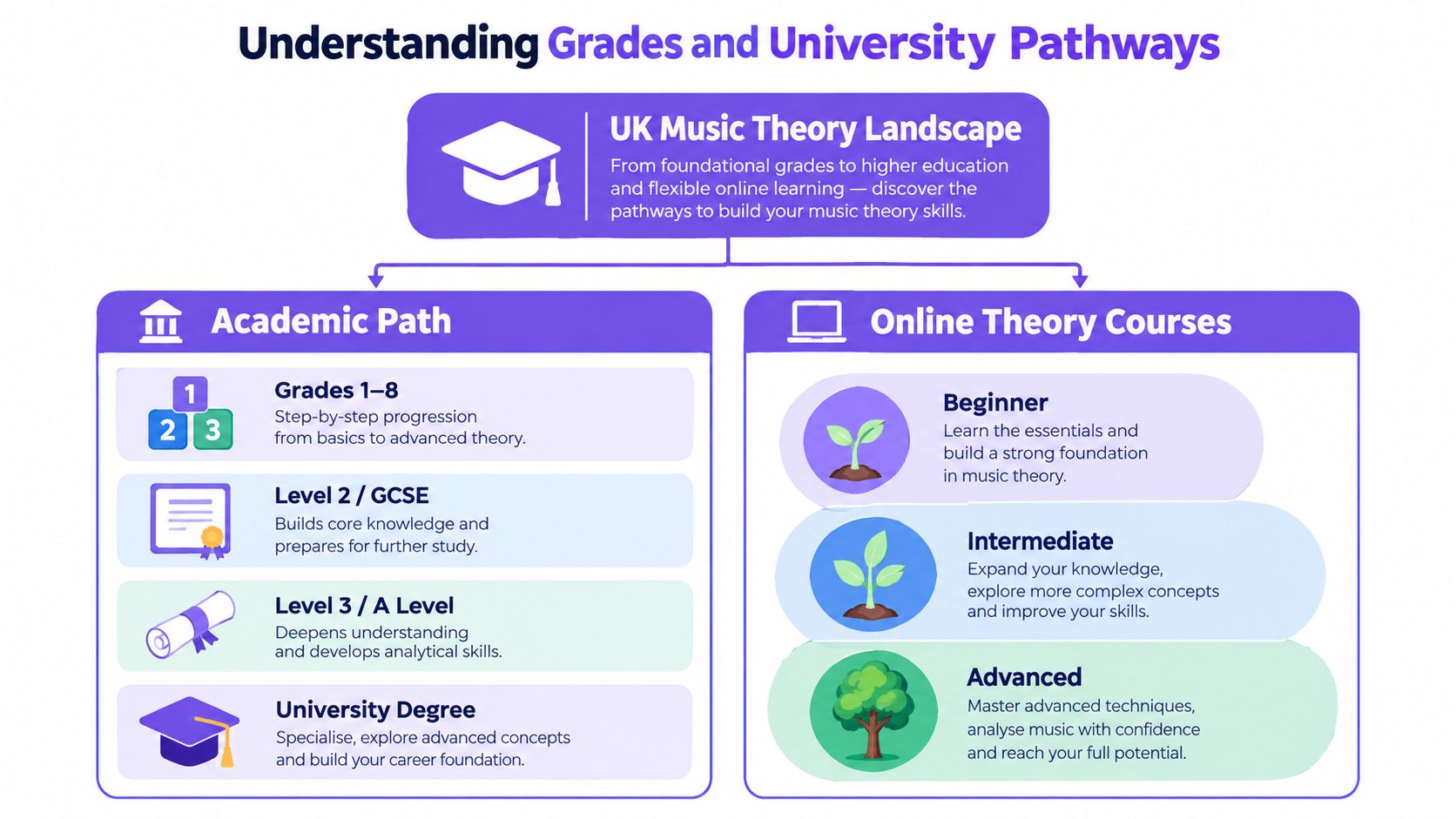
Understanding Levels Grades and University Pathways
A common situation goes like this. You enjoy music, you start looking at online theory courses, and within ten minutes you are staring at labels that seem to belong to different systems: Grade 5 Theory, GCSE, Level 2, Level 3, UCAS points, university entry. The confusion usually comes from reading those labels as separate tracks. They make more sense when you read them as one progression ladder, from early theory study to pre-university work and then to degree-level music.
Why graded theory still matters
Graded theory has stayed in UK music education for so long because it gives schools, teachers, and universities a shared checkpoint. Trinity College London began offering external music exams in 1877, and ABRSM was founded in 1889. ABRSM later standardised the modern graded structure of 1 to 8 in 1933, creating a pathway that still shapes progression today. The same historical overview notes that Grade 5 Theory became a requirement for advancing to higher practical grades, which is why theory study often connects directly to performance progression in UK music education (Trinity College London history resource).
For an online learner, that matters because a theory course is not only teaching terms and symbols. It may be preparing you for a recognised point on that ladder.
How grades and levels line up
The simplest way to sort the labels is to group them by level. Grades 1 to 3 are Level 1, Grades 4 to 5 are Level 2, and Grades 6 to 8 are Level 3, according to the UCAS qualifications guide. That means the jump from Grade 5 to Grade 6 is not just “one more grade”. It is more like moving from secure foundation work into advanced pre-university study.
That distinction helps with course choice. A Level 2 learner usually needs a course that strengthens fluency in notation, keys, rhythm, and basic harmony. A Level 3 learner needs a course that supports comparison, analysis, style awareness, and written explanation. The course fits the stage, just as the right rung fits the height of the ladder.
School qualifications fit into the same broader picture. If you are comparing graded theory with classroom music study, looking at a GCSE Music course structure can help you see how written knowledge, listening, composing, and performing are grouped at Level 2 before students move on to more advanced study.
Where university fits
Students rarely want a history lesson here. They want to know what each stage leads to.
The Complete University Guide states that Associated Board or Trinity Grade 7 or 8 performance or theory may be accepted instead of A-level Music, and that music degree entry requirements vary across institutions (Complete University Guide music subject advice). The University of Manchester's 2027 entry requirements for Music BMus say that applicants not taking A-level Music must have AAB plus ABRSM Grade 5 Theory, and the university states that it accepts Grade 5 Theory as evidence of equivalent theoretical understanding (University of Manchester Music BMus entry requirements for 2027).
There is more than one Level 3 route. The Royal College of Music lists RSL Level 3 Diploma for Music Practitioners and RSL Level 3 Diploma in Creative Music Industries among accepted alternatives to A-levels for Bachelor of Music entry (Royal College of Music BMus entry information).
So the useful question is not “Which theory course is best?” The useful question is “Where am I on the ladder, and what does the next rung require?” If you are at Level 2, choose a course that gets you ready for Level 3 study. If you are already at Level 3, choose one that supports the entry profile universities recognise.
What to Expect Inside an Online Theory Course
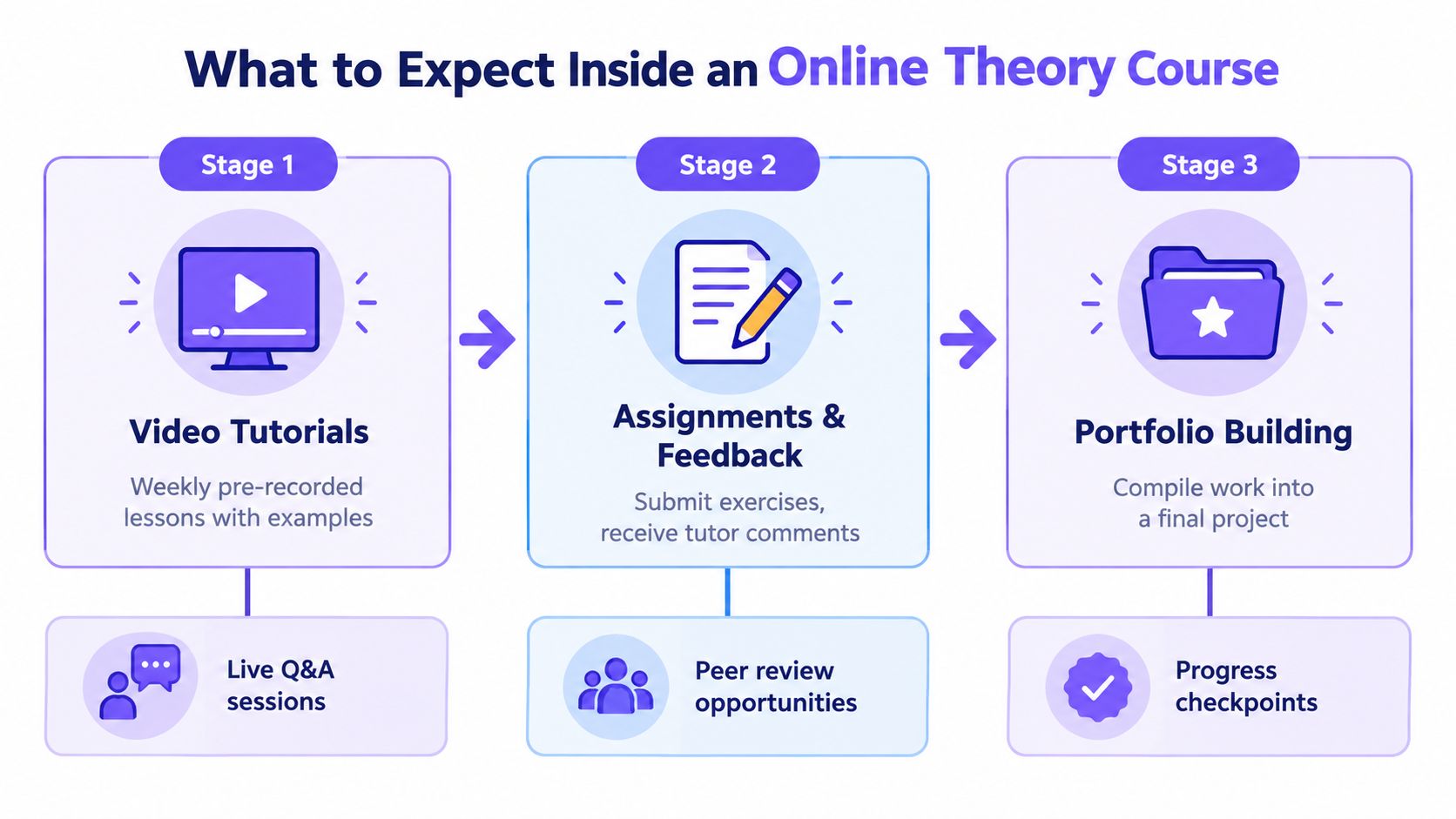
You log in after school or work, open the next unit, and see a clear job for that session: learn one idea, try it, get it checked, then use it in music. That is what a good online theory course feels like. It should guide you in the same way a careful teacher does, one small step at a time, so Level 2 foundations can support Level 3 study later on.
Theory builds like brickwork. If one layer is uneven, the next layer feels harder than it should. A course that works well online respects that order.
The usual learning cycle
Most courses follow a pattern like this:
- Meet the new idea through video teaching, worked examples, annotated scores, or tutor explanation.
- Try it straight away in short tasks such as clapping rhythms, naming intervals, spotting triads, or correcting notation.
- Get feedback before a weak guess turns into a repeated mistake.
- Use it in real music through listening, short analysis, composing tasks, or set coursework.
- Review it later so the topic stays available when the next unit depends on it.
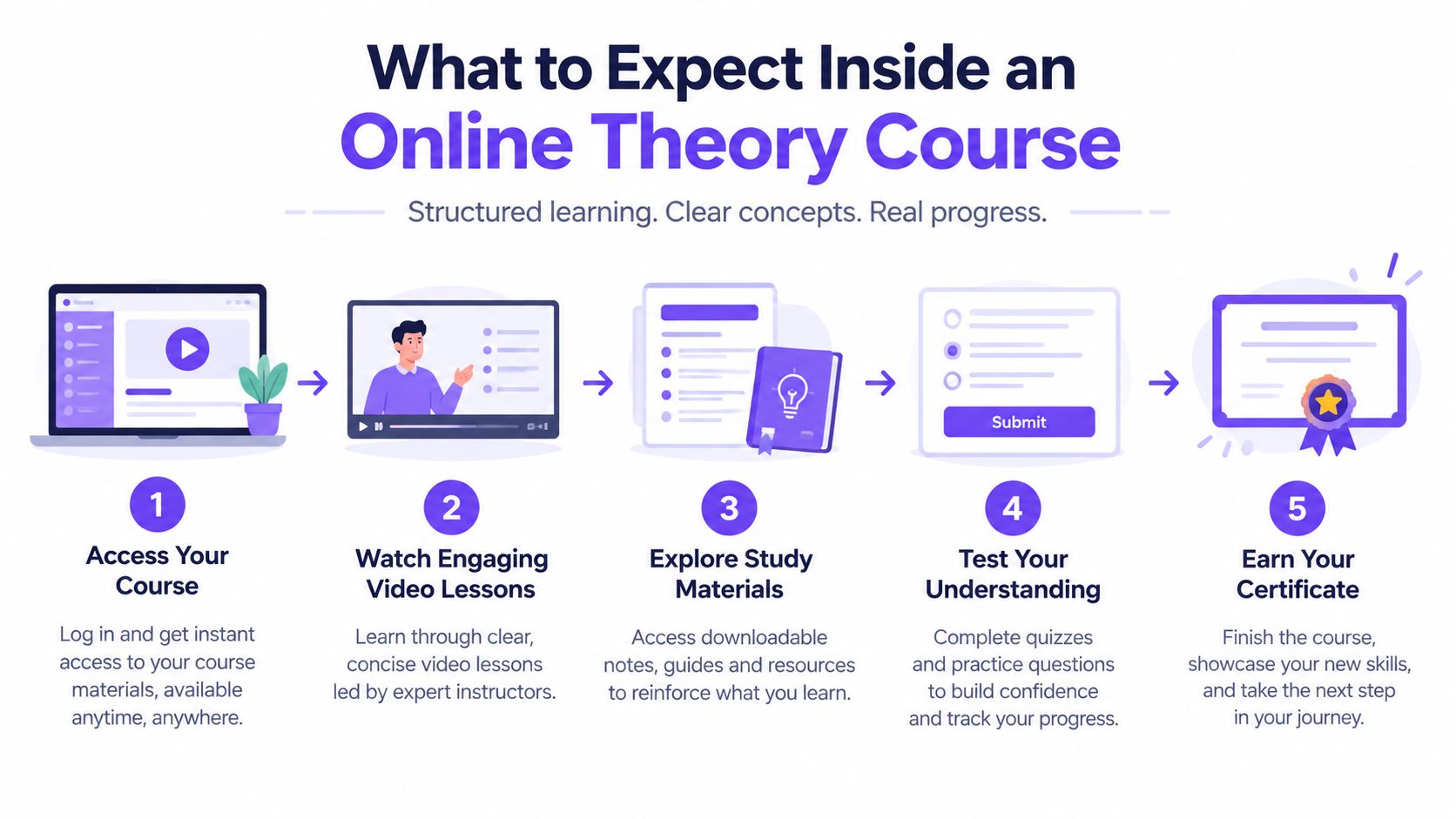
That sequence matters.
A learner who is still hesitating over note values will often struggle with metre and harmonic rhythm. A learner who has not secured key signatures will read analysis slowly and make avoidable errors in harmony work. Good online teaching prevents that pile-up by organising topics in a sensible order instead of placing everything in one large resource bank and leaving you to sort it out alone.
Self-paced does not mean unsupported
Many learners choose online study because they need flexibility. That helps, especially when one topic clicks quickly and another needs three extra tries. But flexibility alone is not enough if your goal is steady progress from Level 2 to Level 3.
The strongest courses usually mix independent study with regular tutor contact, marked work, live sessions, or scheduled check-ins. The self-paced part gives you time to revisit awkward areas. The guided part answers the questions that often block progress, such as why a cadence feels unfinished, why a chord label is wrong, or why your rhythm grouping does not match the time signature.
If you are trying to judge whether the self-paced side of a course is well designed, this piece on designing effective self paced training gives a useful framework for spotting whether independent learning has real structure.
What the workload usually feels like
For most learners, theory is difficult for a practical reason. Gaps stay hidden for a while, then appear all at once when the work becomes more connected.
A typical week might include one short lesson, a worksheet or quiz, corrections based on feedback, and a follow-up task that applies the same idea in context. For Level 2 learners, that might mean learning key signatures, then using them in simple melody work. For Level 3 learners, it might mean reviewing chords, then applying them in analysis or composition. The topics change, but the pattern stays similar because understanding grows through repeated use.
Look for these signs that a course supports real progress:
- Clear sequencing, so each unit prepares you for the next one
- Explained feedback, not just ticks and crosses
- Regular checkpoints, so you can see what is secure and what still needs work
- Applied tasks, especially if your next step includes coursework, auditions, or university preparation
A course with plenty of videos but no feedback can still help with revision. It is less reliable as a progression route. If your aim is to move up the UK ladder, from Level 2 confidence to Level 3 readiness and then toward university entry, the course should do more than present information. It should show you what to practise, check how you did, and prepare you for the demands of the next rung.
How to Choose the Right Online Music Theory Course
A student at Level 2 might need help reading key signatures with confidence. A Level 3 learner might already manage that, but struggle to explain harmony clearly in analysis or coursework. Those two students should not choose the same kind of course, even if both are searching for “online music theory”.
The better question is simple: where are you on the UK progression ladder, and what does your next step require? Once you know that, course options become easier to judge. You are no longer choosing the most attractive sales page. You are choosing the course that prepares the next rung.
Match the course to your next step
Online music theory courses usually fall into a few clear groups. Some help you build missing basics. Some prepare you for graded theory exams. Some sit inside Level 2 or Level 3 study, where theory supports listening, composing, appraising, and written assignments.
A useful way to sort them is to ask what job the course is doing.
| Choosing Your Online Music Theory Course at a Glance | |||
|---|---|---|---|
| Course Type | Level and Accreditation | Tutor Support | Best For |
| Introductory theory course | Non-award or internal progression | Varies from none to regular check-ins | Learners building confidence with notation, rhythm, keys, and chords |
| Graded theory preparation | Aligned to recognised grade study | Often focused on exam-style correction | Students aiming for structured milestones such as Grade 5 or above |
| GCSE or equivalent music pathway | Level 2 | Usually tutor-led with marked assignments | Learners needing theory linked to listening, appraising, and coursework |
| A Level or Level 3 music route | Level 3 | Regular academic feedback and guidance | Students preparing for advanced study and university applications |
| Diploma-based creative music pathway | Level 3 | Often project and portfolio based | Learners who want theory applied to performance, composition, and progression |
The key difference is progression. An introductory course may help you fix weak spots. A Level 2 or Level 3 pathway shows how theory connects to assessed work and to what comes next after the course ends.
Questions to ask before you enrol
Course descriptions often tell you what is included, but not always where it leads. Ask questions that reveal how the course fits your stage of study.
Where does this course sit on the UK ladder?
If you are unsure whether you need Level 2 or Level 3 study, compare your current stage with this guide to which course level is right for you.What will I be able to do by the end?
“Covers harmony” is vague. “Write a chord sequence, analyse cadences, or support A Level coursework” is clearer.Is the theory taught on its own, or linked to a wider goal?
That matters if you are preparing for GCSE Music, A Level Music, a diploma, auditions, or university entry.How is progress checked?
A learner aiming for progression usually needs more than video watching. Marked work, corrections, and tutor comments show whether understanding is improving.Does the pace suit my life?
Home education, work, caring responsibilities, rehearsals, and SEND support needs all affect what a realistic course looks like.
Beginner, graded, or integrated route?
Many learners get stuck because all three can sound useful.
A beginner course works well if your foundations are uneven. It helps you secure the musical alphabet, note values, scales, intervals, and basic chords before the work becomes more demanding. A graded theory course suits learners who already have those basics and want a recognised target with a clear syllabus. An integrated Level 2 or Level 3 route suits students who need theory to support broader music study, especially if the next aim is formal assessment or university preparation.
Theory study works like building stairs. If one step is missing, the climb feels awkward. If the staircase stops halfway, it may help for a while but not take you where you need to go.
Choose the course that removes your next barrier and prepares the next stage after that.
For many learners, the strongest choice is not the course with the longest topic list. It is the one that fits your present level, gives you evidence of progress, and connects clearly to the next stage of the UK pathway, from Level 2 confidence to Level 3 readiness and then toward university study.
How OCAD Supports Music Theory Learners Online
A common problem appears once theory starts to matter for assessment. A learner may understand scales one week, then hit a wall when that knowledge has to feed into analysis, composition, coursework, or a university-focused portfolio. OCAD addresses that gap by placing music theory inside a wider online study route, including GCSE Music, A Level Music, and Level 3 options such as RSL Music Practitioners.

Theory works better when it has somewhere to go. In the same way that grammar becomes clearer when you use it in essays, music theory becomes more secure when you apply it to listening tasks, written work, and creative decisions.
What that looks like in practice
OCAD teaches through Microsoft Teams for Education alongside an online studio that stores units, assignments, video tutorials, and portfolio work. That gives learners one place to study a topic, complete tasks, receive corrections, and keep evidence of progress together. For Level 2 and Level 3 students, that joined-up structure can reduce a lot of confusion. You are not trying to remember which platform held the lesson, which file had the feedback, and which folder contained the final version.
The setup can suit several groups well:
- Home-educated students who need accredited creative study online
- Adult learners fitting study around work or family life
- International learners studying across different time zones
- SEND learners who benefit from clearer structure and more flexible pacing
Why the progression route matters
The distinctive point is the ladder. OCAD's theory support is not a bank of isolated lessons. It sits within recognised stages of UK study, so learners can see how Level 2 preparation supports Level 3 work, and how Level 3 work supports university applications and later specialist study.
That matters because the questions change as you move up. At an earlier stage, you may be learning how key signatures and intervals work. Later, you need to explain musical choices clearly, use accurate terms in analysis, and show that understanding in assessed work. A course linked to progression helps each step prepare the next one.
For a clearer picture of the day-to-day experience, this guide to working online with OCAD shows how tutor contact, assignments, and the online learning space fit together.
A practical fit for progression-minded learners
This model can be especially useful for students moving from Level 2 to Level 3 who want theory study to count for something larger than short-term revision. Instead of collecting separate resources for drills, feedback, and portfolio building, they work within a course structure that supports recognised progression.
That can make online theory feel less like extra homework and more like part of a clear route toward the next qualification, then toward university.
Next Steps to Start Your Music Theory Journey
If you've been putting theory off, the best next move isn't to wait until you feel fully ready. It's to work out where you are on the ladder and choose the course that fits that rung. Once the level is right, theory usually becomes much less intimidating.
Start with a short self-check:
Current stage
Are you building fundamentals, strengthening Level 2 work, or preparing for Level 3 and university?Main goal
Do you need general confidence, graded theory preparation, support inside GCSE or A Level Music, or a broader diploma pathway?Type of support
Do you work well independently, or do you need regular tutor feedback and live contact?Progression target
Are you aiming for the next course, a qualification milestone, or a university application?
Small, steady theory study works better than panic revision. Consistency builds fluency.
Once you've answered those questions, compare providers carefully. Look for recognised progression, clear tutor access, realistic workload, and a structure that connects theory to actual music-making. If you're a Level 2 or Level 3 creative student aiming for university, don't settle for a course that's only a content library. Choose one that helps you move to the next stage with evidence, support, and purpose.
Theory isn't there to block your creativity. It's there to give names, patterns, and structure to what you're already hearing and making. When the course is well chosen, online study can turn a weak spot into a progression route.
If you want a tutor-led route that connects music theory to recognised creative qualifications, The Online College of Art & Design supports learners through online GCSE Music, A Level Music, and Level 3 pathways with flexible delivery, live teaching, and portfolio-based study. You can explore the available options and see how the progression ladder works at The Online College of Art & Design (OCAD).