

Are you choosing a college online graphic design course because it fits your life, or because you already know which qualification level a university will accept? Many students discover too late that a creative course can be enjoyable, practical, and still not provide the right progression route for a degree application. The important question is whether you can study graphic design online. It's whether your course will help you build the skills, evidence, qualification, and portfolio that your next step requires.
For a home-educated learner, adult career changer, or student with SEND needs, a structured online pathway can make that route clearer. You can begin with foundational study, progress to Level 3, receive tutor feedback, and prepare a portfolio without assuming that a traditional sixth-form or campus timetable is the only way forward.
Table of Contents
- Why Online Graphic Design Is the Future of Creative Education
- The Growing Demand for Creative Skills in the UK
- Navigating the UK Qualification Ladder for Design Students
- How Flexible Tutor-Led Online Courses Work
- Building a University-Ready Portfolio for 2026
- Choosing the Right Online College for Your Needs
- Your Next Steps Toward a Creative Career
Why Online Graphic Design Is the Future of Creative Education
A student may begin with a familiar worry: they enjoy drawing, photography, typography, or digital images, but they aren't sure whether those interests add up to a university application or a career. They may also have work commitments, caring responsibilities, limited local provision, or a learning profile that makes a busy classroom difficult. For that student, online education isn't merely a way to watch lessons at home. It can provide a staged route from uncertainty to assessed creative work.
A typical journey starts with visual fundamentals. The learner studies composition, colour, typography, image-making, and visual communication. They then apply those ideas to practical briefs, such as a brand identity, an editorial layout, a poster series, or a web page concept. Each project becomes more useful when a tutor explains what works, identifies what needs refinement, and asks the student to justify their decisions.

From flexible study to professional habits
Online study can develop habits that matter beyond the classroom. Students need to organise files, meet deadlines, explain choices, respond to critique, and present work clearly. Those behaviours resemble the working patterns of freelance and remote design teams more closely than an exercise completed once and forgotten.
A strong course also gives the learner a visible record of progression. Early sketches can sit alongside revised layouts, design rationales, and final exports. That sequence shows how the student thinks, not just what the finished image looks like. For visual projects that use generated or edited imagery, students can also consult the insights from AI Image Detector to think more carefully about image manipulation, authenticity, and responsible presentation.
Practical rule: Choose online study that makes your development visible. A collection of final images is useful, but documented decisions and revisions provide stronger evidence of learning.
The result is a pathway that can support a beginner without treating them as incapable, while giving a more experienced learner room to specialise. Flexible scheduling removes some barriers, but tutor-led assessment is what turns flexibility into education.
The Growing Demand for Creative Skills in the UK
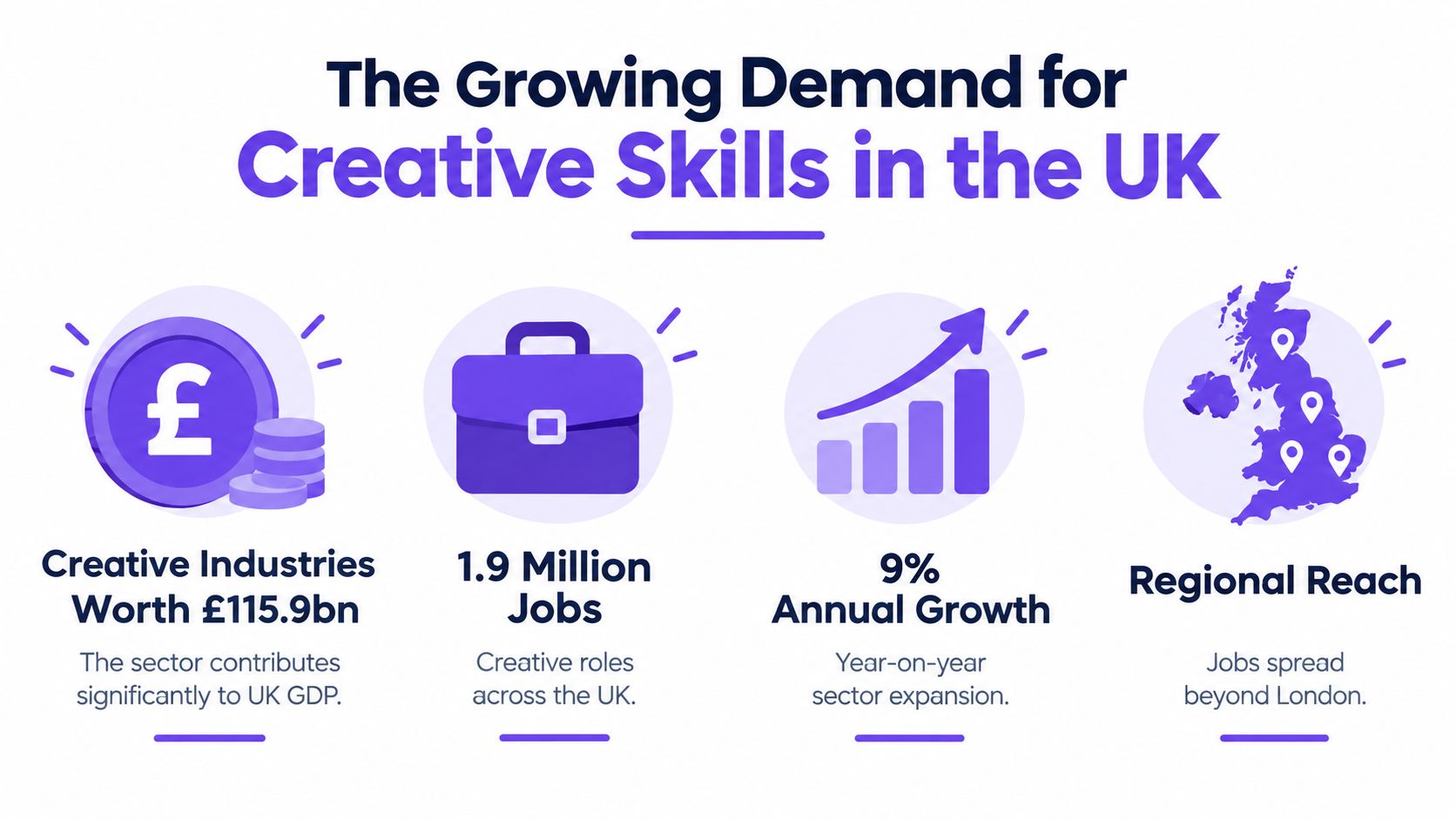
Why does graphic design appeal to learners beyond traditional classrooms? The answer lies in the breadth of the UK creative industries, where visual communication connects with digital content, publishing, advertising, media, technology, and other fields. In 2023–24, the UK creative industries contained approximately 2.4 million filled jobs, around 7% of all filled jobs, according to the House of Lords Library analysis of creative industries, jobs, and productivity.
Employment in this field also follows a different pattern from the wider workforce. Twenty-eight per cent of creative-industry jobs were self-employed, compared with 14% across the UK workforce, according to the same House of Lords Library analysis. The figure does not suggest that every designer should become a freelancer. It does show why students need more than software skills. Portfolio quality, client communication, independent organisation, and careful interpretation of a brief all support progression into creative work.
Location creates another barrier. London accounted for 29% of creative-industry jobs and the South East for 17% in 2023–24. The North West and East of England each accounted for 8%, according to the same employment analysis. Online learning can give students outside the largest employment centres access to structured study and portfolio development before they decide whether relocation is necessary.
For home-educated learners and career changers, the qualification threshold can be difficult to judge. A Level 2 starting point may build confidence and practical ability, while university applications often require evidence of Level 3 study or an accepted equivalent. OCAD's pathway model helps make that progression clearer by connecting foundational learning with more advanced design study, rather than asking learners to guess which step comes next.
What employers need from designers
Technical preparation matters because forty-three per cent of UK creative-industry employers report skills shortages or gaps, while 63% of employers expecting to grow and upskill their workforce anticipate rising demand for digital skills, driven largely by hardware, software, and artificial-intelligence upgrades, according to the Creative Industries Skills Audits.
A practical curriculum should teach students to:
- Build vector artwork: Create scalable logos, icons, and illustrations with clean structure.
- Edit raster images: Prepare photographs and digital artwork for different uses.
- Prepare digital publishing: Apply layout, typography, and suitable export settings.
- Create interface concepts: Use visual hierarchy and usability principles on screens.
- Manage production files: Supply editable source files, print-ready PDFs, and web-optimised assets.
- Document a portfolio: Explain the brief, process, audience, decisions, and revisions.
The cited skills evidence identifies graphic and multimedia designers among roles facing growing demand. Students do not need to chase every new tool. They need design judgement combined with technically current production skills, so their work can adapt as software, platforms, and delivery formats change.
Navigating the UK Qualification Ladder for Design Students
The most common misunderstanding is simple: Level 2 is not usually the same as Level 3, and neither phrase automatically guarantees university entry. The UK Government qualification-level guide lists GCSE grades 9–4, Level 2 certificates and diplomas, Level 2 Functional Skills, and intermediate apprenticeships as Level 2 qualifications. These awards can provide a foundation for progression, but they aren't generally the same qualification level as A levels or other typical university-entry awards.
That distinction matters when a student asks, “Can I apply for a BA with my Level 2 creative diploma?” The answer depends on the specific university and course. A university may accept the award with other evidence, ask for Level 3 study, recommend a foundation year, or assess an alternative route. You need to read the published entry requirements for the actual degree, rather than relying on the phrase “GCSE equivalent”.
A practical progression route
Think of the ladder as a sequence of increasing subject depth and independence:
- Level 1: A starting point for learners who need to establish confidence, study routines, and introductory creative knowledge.
- Level 2: A GCSE-equivalent stage in relevant cases, useful for foundational art and design skills and progression planning.
- Level 3: The stage many students use to develop a substantial portfolio and prepare for advanced study or degree applications. A Level 3 Foundation Diploma can be particularly relevant for creative applicants because it combines practical projects with sustained development.
- University study: A BA application requires the target institution to assess your qualification, portfolio, and other entry evidence. A foundation year may be appropriate if you need another bridge into degree-level work.
GCSEs, iGCSEs, A levels, and creative diplomas can all appear in a learner's route, but they aren't interchangeable labels. A home-educated student may build Level 2 evidence before moving to a Level 3 foundation pathway. An adult learner may already have general qualifications and need a portfolio-led creative award instead. The right route is the one that closes the gap between your current evidence and the university's stated requirements.
How Flexible Tutor-Led Online Courses Work
Online learning comes in very different forms. A library of recorded tutorials gives you convenience, but it may leave you unsure whether your layout is solving the brief. A live-only timetable creates interaction, yet it can be difficult for a learner managing work, health, family, or travel. Tutor-led online study combines planned independent work with access to teaching, critique, and feedback.

Comparing the learning experience
A useful online studio usually contains units, assignment briefs, video demonstrations, submission areas, and a place to develop portfolio work. You might study a lesson independently, upload a sketchbook page, attend a Microsoft Teams for Education session, and then revise your work after individual or group feedback. That model protects your ability to work at your own pace without removing the social and critical aspects of design education.
Ask how often tutors respond, how feedback is recorded, and whether you can discuss a difficult brief before submission. A helpful critique should do more than say that a design is attractive. It should address hierarchy, legibility, audience, technical execution, and the connection between the brief and the outcome.
Live teaching can demonstrate a process in real time, while asynchronous resources let you replay a difficult software technique. Neither approach is sufficient by itself for every learner. The strongest arrangement gives students several ways to engage and provides a clear route when they need extra support.
A short demonstration of an online design session can also help you judge whether the teaching style suits you:
Questions to ask before enrolling
Check whether the provider offers one-to-one tuition, group lessons, portfolio review points, recorded resources, and flexible submission arrangements. Find out what hardware and software you'll need, whether free or alternative tools can be used, and how the course handles missed live sessions.
Flexibility should never mean disappearing from the learning process. You should know who assesses your work, how you receive guidance, and what happens if you fall behind.
Building a University-Ready Portfolio for 2026
A university-ready portfolio doesn't need to show that you can already produce professional work in every design discipline. It needs to show curiosity, control, development, and reflection. Admissions tutors want to see how you investigate an idea, test alternatives, respond to feedback, and arrive at a considered outcome.
A structured online course can turn separate assignments into a coherent body of evidence. For example, a branding brief might include audience research, thumbnail sketches, type experiments, colour testing, logo refinements, mock-ups, and a final rationale. A web-design project could show wireframe decisions, interface hierarchy, accessibility considerations, and exported screen designs. Keeping the earlier stages matters because they reveal your thinking.
Use the guide to making a graphic-design portfolio as a practical reference while selecting, sequencing, and presenting projects. The same principle applies when you prepare written material for applications. Resources such as interior design cover letter samples can help you understand how to connect creative evidence with clear communication, even when the specialism differs.
Design fundamentals plus technology awareness
The portfolio should demonstrate more than software familiarity. It should show that you can choose an appropriate typeface, create a readable hierarchy, use space deliberately, and adapt a visual system to its audience. Those fundamentals remain important even when a designer uses automation or artificial-intelligence tools.
The skills mix is changing. Fifty-three per cent of creative employers identify advanced or specialist IT skills as a development need, compared with 27% across all industries, according to the Skills England creative-sector assessment. The same assessment reports that 65% of hard-to-fill creative-industry vacancies were caused by skills shortages, compared with 41% across all sectors.
For a portfolio prepared during 2026, that means combining:
- Typography and layout: Make information clear before adding visual decoration.
- UX and accessibility: Consider how different people move through and interpret a design.
- Digital production: Supply suitable files for print, web, and further editing.
- Motion or multimedia awareness: Understand how a static identity might work across moving or interactive formats.
- AI evaluation: Test outputs critically, check suitability, and explain your creative decisions rather than presenting automation as authorship.
- Client communication: Show that you can interpret a brief and discuss revisions professionally.
A traditional portfolio isn't obsolete, but a portfolio with no process, context, or technology awareness may give an incomplete picture of your readiness.
Choosing the Right Online College for Your Needs
Don't choose a provider solely because its website displays attractive student work. Start with the progression question: What qualification will I receive, who recognises it, and what can I apply for afterwards? Then examine how the provider assesses practical work and whether tutors give specific feedback throughout the course.
Accessibility also needs a technical checklist, not a general promise. HESA-based figures for 2021/22 show that 451,580 of 2,862,620 UK students, 16%, declared a disability, while 61% of disabled learners in the cited distance-learning context had either a specific learning difficulty or a mental-health condition, according to the research on accessibility in online learning. A suitable platform should support captions, transcripts, keyboard navigation, descriptive text, high contrast, scalable text, and downloadable materials that work with screen readers.
Use this checklist before committing. You can also compare beginner expectations with online graphic-design courses for beginners before speaking to a provider.
| Factor | What to Look For |
|---|---|
| Qualification | A clearly named level, awarding organisation, and explanation of how it relates to your next application. |
| Assessment | Practical briefs, written rationales, portfolio checkpoints, and transparent marking criteria. |
| Feedback | Individual guidance, revision opportunities, and a stated response process. |
| Delivery | Live teaching alongside asynchronous materials, with recordings or alternatives where appropriate. |
| Accessibility | Reasonable adjustments, adapted pacing, accessible files, and a named support contact. |
| Progression | Advice about Level 3, foundation routes, university applications, and portfolio presentation. |
| Software | Clear hardware requirements, file-format guidance, and realistic alternatives for learners. |
A pathway provider such as The Online College of Art & Design can offer online study from entry level through Level 3, including creative qualifications, portfolio-centred assignments, live tuition, and dedicated SEND routes. Check the exact award and progression advice for your circumstances, especially if you're applying to a particular university.
Your Next Steps Toward a Creative Career
Begin by writing down your current qualification level, your target degree, and the evidence that university requests. If you hold Level 2, don't assume you're blocked. Treat it as a foundation and ask whether the next step should be a Level 3 Diploma, a Foundation Diploma, additional academic study, or an alternative route accepted by your chosen institution.
Then audit your portfolio. Keep work that shows development, not only polished outcomes. Add short rationales, record tutor feedback, and identify gaps such as typography, digital production, UX, accessibility, or presentation. A structured resource on becoming a professional graphic designer without A levels can help you consider routes outside the conventional sixth-form pattern.
Funding needs its own check. GOV.UK explains that undergraduate finance may include a Tuition Fee Loan and Maintenance Loan, but eligibility depends on factors including the institution, course, previous higher-education study, age, nationality, and residency. The student-finance eligibility guidance also sets conditions for England, including eligible higher-education study, residency requirements, and a course intensity of at least 25%.
Finally, contact providers with specific questions. Ask how Level 2 leads to Level 3, how assignments are assessed, what feedback looks like, which adjustments are available, and how the portfolio supports a university application. That conversation will tell you more than a generic promise of flexible online learning.
The Online College of Art & Design (OCAD) offers flexible, tutor-led online study in art and design, including Level 2 routes and a Level 3 Foundation Diploma in Graphic Design with portfolio-focused coursework. Visit The Online College of Art & Design (OCAD) to explore a progression route suited to home-educated learners, adults, career changers, and SEND students.