

The Ofqual subject-level requirements for GCSE Art and Design assign 25% of the qualification to each assessment objective. A polished final painting cannot replace evidence of the investigation, experimentation and recording behind it. Process pages carry marks too: they show how you looked closely, tested ideas and made decisions.
Table of Contents
- The Four Assessment Objectives at a Glance
- How the Objectives Split Across Portfolio and Externally Set Task
- AO1 Investigating Sources and Developing Ideas
- AO2 Refining Ideas Through Experimentation
- AO3 Recording Observations and Insights Beyond Drawing
- AO4 Making a Personal Response That Realises Your Intentions
- What Grade 5 and Grade 8 Work Looks Like
- From GCSE Objectives to A Level and a University Portfolio
The Four Assessment Objectives at a Glance
| Objective | What it assesses | Weighting | Evidence examiners look for |
|---|---|---|---|
| AO1 | Developing ideas through investigation and critical understanding of sources | 25% | Research pages, artist studies and annotated sources |
| AO2 | Refining ideas through experimentation with media, materials, techniques and processes | 25% | Test sheets, material experiments and selected and rejected trials |
| AO3 | Recording ideas, observations and insights as work progresses | 25% | Observational studies, photographs, annotations and reflective notes |
| AO4 | Presenting a personal and meaningful response that realises intentions | 25% | Final outcomes, displays and deliberate choices of visual language |
These are the GCSE Art assessment objectives in practical terms. Together, they account for 100% of the assessment under Ofqual's framework, so research, experimentation, recording and final presentation have no formal weighting advantage over each other.
Say you're developing a project about a neglected garden. You investigate how artists represent tangled growth, compare ways of making broken textures, photograph stems against a fence and eventually produce a mixed-media panel. The panel matters, but so do the decisions that made it possible.
What counts as evidence?
Your sketchbook, contextual research, development studies, material tests, annotations and outcomes can all help demonstrate attainment. A page doesn't become valuable because it looks expensive or takes a long time to decorate. It becomes useful when someone can understand what you noticed, tested or decided.
The framework comes from Ofqual's subject-level requirements and provides a common basis across regulated specifications. Your centre's awarding organisation supplies the detailed specification and mark scheme, so learn its language alongside these plain-English explanations.
Practical rule: Don't ask only whether a page looks finished. Ask what it proves about your thinking.
Take a completed project and label the pages that provide evidence for each objective. A page can support more than one objective, but don't force a label onto work that doesn't demonstrate it. Any objective with no convincing evidence is the gap to address first.
How the Objectives Split Across Portfolio and Externally Set Task
The portfolio contributes 60% and the externally set task contributes 40% in the structure set out in Ofqual's GCSE Art and Design subject-level requirements. These component weightings describe where you earn marks, not separate sets of artistic skills. Both components require evidence across the assessment objectives.
Before organising your submission, make these checks:
- Confirm the specification. Identify the awarding organisation, qualification title and specification version your centre follows.
- Separate the components. Keep portfolio evidence clearly distinguishable from work produced for the externally set task.
- Protect the process. Save photographs, scans and working files as you develop the work, rather than trying to reconstruct the journey later.
Why the portfolio needs more than outcomes
The portfolio is sustained, centre-set project work. It should make your investigation, refinement, recording and realisation understandable over time, so retain the experiments and development studies that explain your choices.
A discarded composition may be useful evidence if you explain why it didn't communicate your intention. An abandoned sheet with no connection to the project is less helpful. Keep relevant decisions, not every scrap indiscriminately.
The externally set task begins with an awarding-organisation theme or starting point and requires an independent response within prescribed conditions. It isn't a session for making a final piece. Your preparation needs a coherent direction, with research and trials that inform what you make.
At OCAD, students seeking nationally recognised qualifications provide assessment evidence to awarding bodies through photographs, video recordings of presentations and written assignments. Coursework submitted as assessment evidence must clearly be the student's own work, produced while enrolled on the course.
Give the portfolio sustained attention rather than leaving development pages until the end. For the externally set task, begin with a short planning sheet describing what investigation, experimentation, recording and a resolved response might look like for your chosen starting point. Follow your centre's rules about preparation, supervision and permitted assistance.
AO1 Investigating Sources and Developing Ideas
AO1 asks whether investigation helps you develop an idea. Sources might include artists, cultural objects, architecture, natural forms or photographs. Collecting them is only the beginning; you need to show what you understand and how you'll use that understanding.
Consider a project about wire sculpture. A weak research page contains a sculptor's image and a general comment about liking the shapes. A stronger page identifies how looping wire describes a body while leaving open spaces, then asks whether repeated lines could suggest movement in your own sculpture.
Turn a source into a decision
An annotation might explain that overlapping wire creates a denser outline when viewed from the side, while the front view feels more open. The next practical question follows naturally: could changing the spacing between loops make a bird appear to stretch its wings?
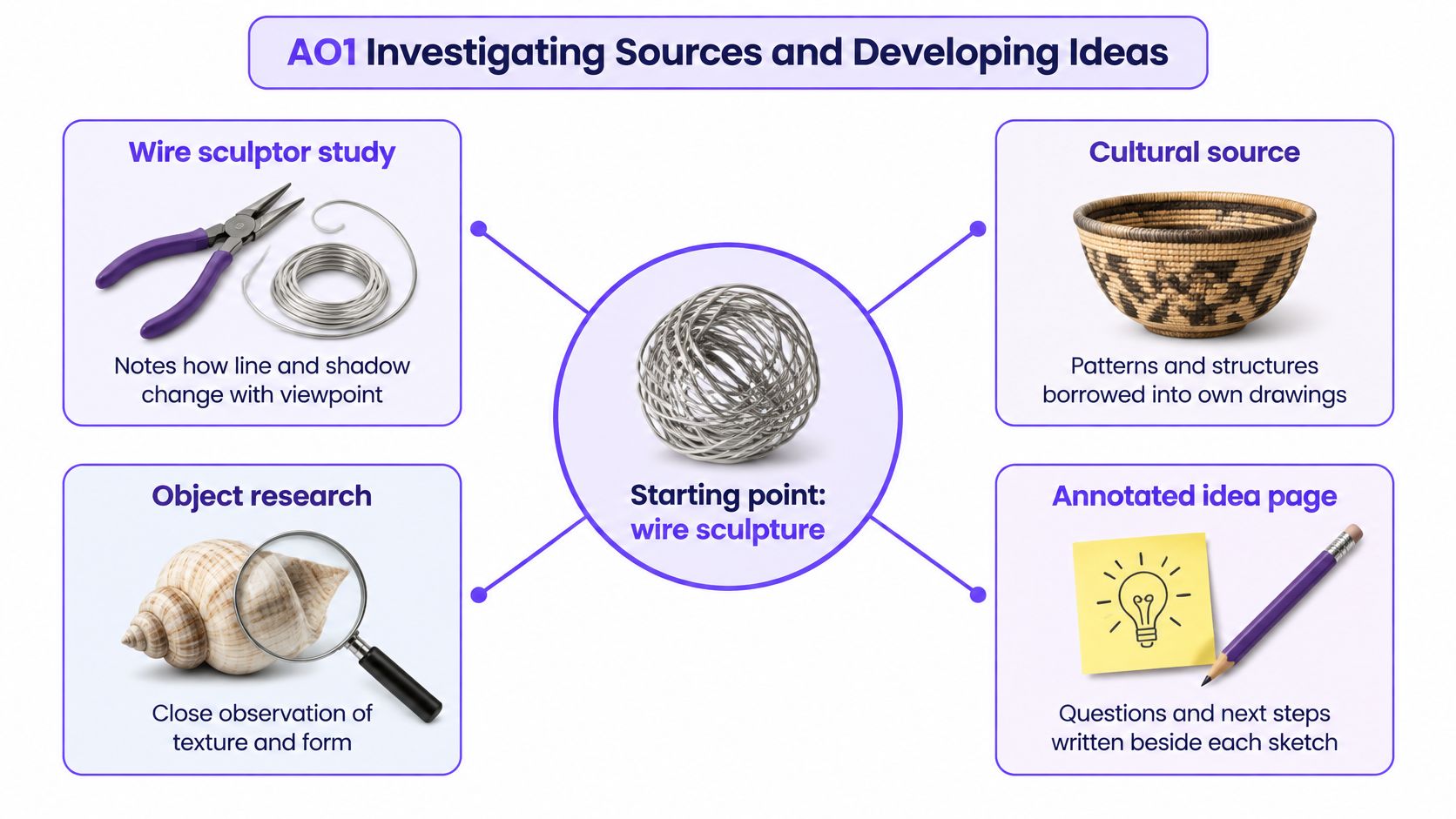
Use the concept map as a route from source to question, test and decision. A woven basket could prompt investigation into interlocking structures, while a shell could suggest a relationship between a curved outline and its internal supports. Identify the maker and cultural context where available rather than treating a cultural object as an anonymous pattern.
For an animal-based direction, William Tucker Art's animal anatomy images for art projects offer reference material to examine alongside your sculptural sources. Look for the underlying structure you need to understand, rather than copying a photograph's surface appearance.
Show critical understanding
- Compare sources. Explain how a sculptor's open structure differs from the compact form of your observed object.
- Select deliberately. State which approach you'll adapt and which you'll reject.
- Connect to intention. Explain why the selected approach suits the movement or character you want to convey.
If you're unsure where interpretation ends and imitation begins, use our guide to using references without copying.
Finish each research page with a decision. For this project, that might mean choosing widely spaced loops for the wings and a tighter structure around the body. The investigation has now changed the work.
AO2 Refining Ideas Through Experimentation
AO2 is purposeful testing followed by selection. You explore materials, techniques and processes because you need to solve an artistic problem, not to fill a page with different effects.
Suppose your project explores weathered surfaces. You could make small test sheets using torn-paper collage, graphite, wax resist and ink. Label each sheet with the medium, support, time spent and what changed during the test.
Make the comparison useful
Keep the subject or composition similar while changing the material. That makes it easier to judge whether the texture comes from the technique rather than from a completely different drawing.
For a wax-resist test, a useful annotation might explain that heavy wax pressure blocked too much ink and flattened the surface. A lighter application left broken marks that better suggested peeling paint. That's cause and effect, not a preference.
| Visible evidence | What it helps demonstrate |
|---|---|
| Comparable tests using different processes | Exploration with a purpose |
| Notes describing what caused an effect | Understanding of materials |
| Selected and rejected trials with reasons | Informed judgement |
| A larger trial adapting the chosen approach | Refinement rather than repetition |
Select the strongest results and explain why the others don't serve your intention. Then carry the chosen technique into a larger trial, where scale, drying, adhesion or control may create new problems.
A successful experiment doesn't have to produce an attractive image. It has to help you make a better decision.
Try a controlled test-sheet exercise
As a practical exercise, produce six test sheets over a week, changing a single variable each time: scale, medium, support or colour. Keep enough consistent information on each sheet to make the comparison meaningful.
Choose the three most useful results, reject the others with reasons and develop a selected process further. These quantities are an exercise, not a required submission formula.
Avoid repeating a familiar medium without developing it, leaving sheets unannotated, or moving directly from an isolated effect to the final artwork. The important evidence is the visible progression between an initial test and a more resolved trial.
AO3 Recording Observations and Insights Beyond Drawing
AO3 is evidence of seeing and thinking, not drawing alone. The GCSE Art and Design subject content expects learners to record ideas, observations, insights and independent judgements visually and through written annotation as work progresses.
Observational drawing can be excellent evidence, but the objective isn't restricted to pencil studies. Photographs, screenshots, digital studies, audio notes converted into text and concise evaluations can contribute when they show relevant observation and judgement. Confirm acceptable formats with your centre or awarding organisation, especially when arranging adaptive methods.
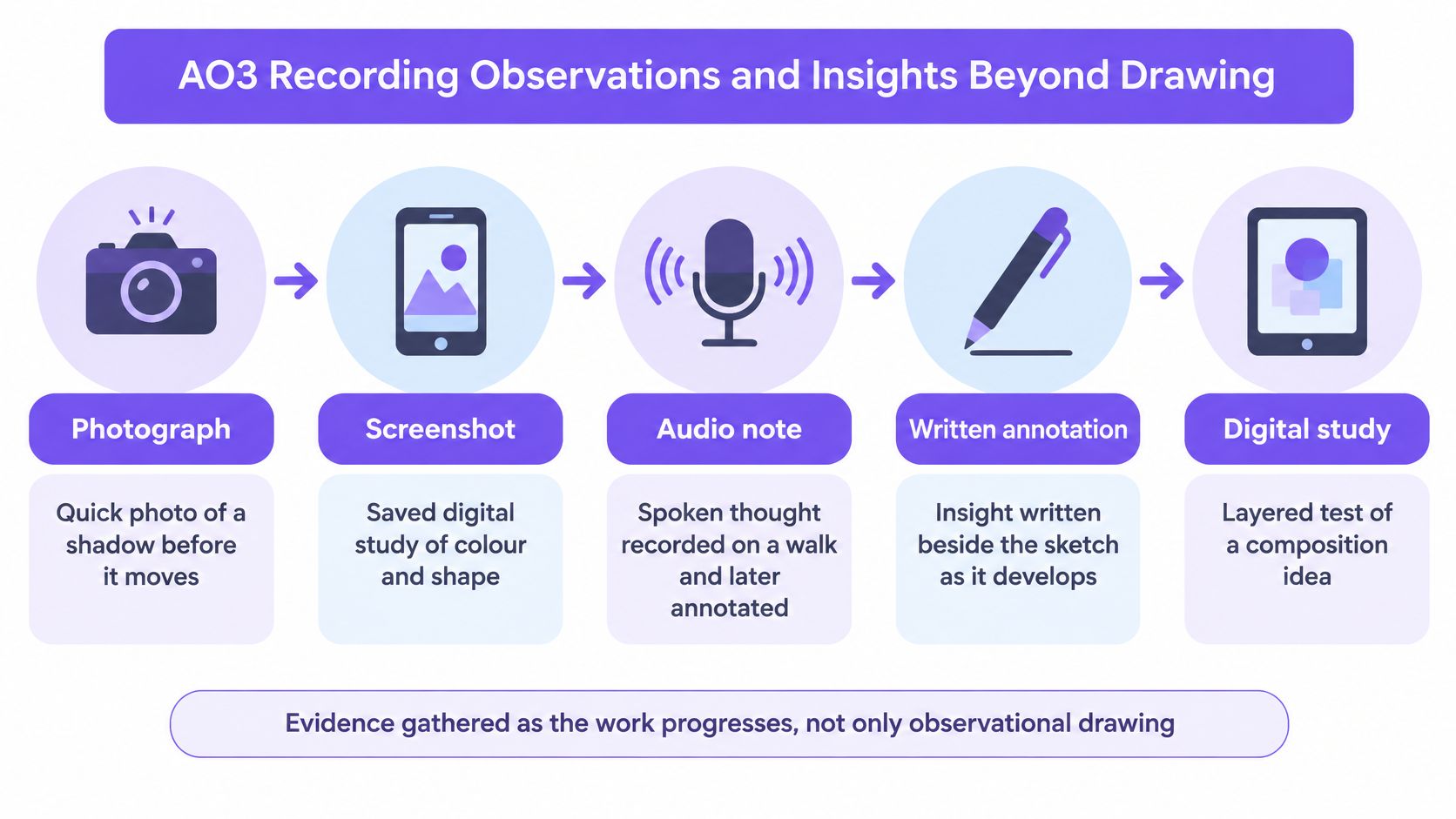
Add the thinking to the image
A photograph of a rusted gate records its appearance. To make your observation more meaningful, identify the repeating pattern, describe how side lighting catches the raised edges and explain how those features suggest a printmaking approach.
Your annotation could explain that the bright edges disappear in a flat tracing, so you'll test broken white lines against a dark ground. Now the photograph supports an independent judgement and a practical next step.
Use this routine:
- Save and date the stage. Photograph a changing surface, scan a sketch or preserve a digital version.
- Annotate promptly. Ideally within a day, explain what you saw, what changed and why.
- Make a judgement. Identify what helps or weakens the intention.
- Set the next test. Record what you'll investigate rather than ending with a vague promise to improve.
Keep accessible evidence rigorous
If you use speech-to-text, adaptive tools or digital drawing, keep the same standard of selection and reflection. Accessibility changes how you document your thinking, not whether you need to demonstrate it.
Our explanation of why every artist should keep a sketchbook can help you treat the sketchbook as a working record rather than a display book. At OCAD, students upload photographs of completed work and assignments throughout their course to receive feedback and build an art portfolio.
Don't leave yourself with a folder of finished-work photographs and no account of the decisions between them.
AO4 Making a Personal Response That Realises Your Intentions
Start with what you want to communicate, why it matters to you and which visual choices might carry that meaning. AO4 concerns a personal, meaningful response that realises your intentions and demonstrates understanding of visual language.
Say your starting point is urban noise. Your intention could be to convey how crowded streets feel overwhelming during your daily journey. Dense, layered marks, abrupt colour contrasts and tightly cropped compositions offer possible ways to express that experience.
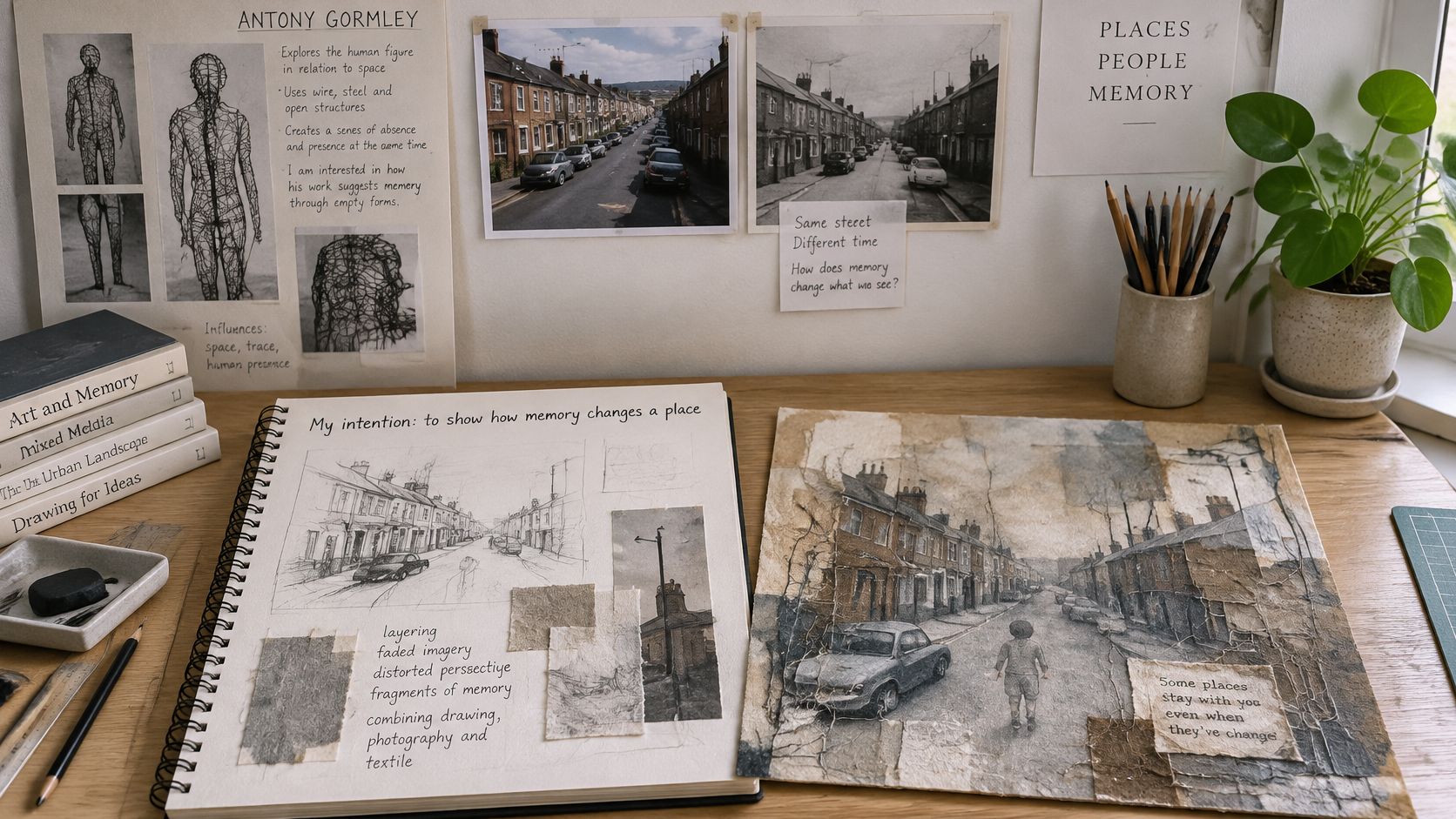
Judge the outcome against the intention
In this project, an evenly spaced, delicate composition might undermine the intended sense of pressure. A compressed arrangement of overlapping forms could communicate it more convincingly, provided that choice follows from your development rather than being added as an explanation afterwards.
An annotation might explain that you cropped out the skyline because the open space made the scene feel calmer. Another could describe retaining rough charcoal marks because smooth blending removed the agitation you wanted.
Personal doesn't have to mean private or autobiographical. It means you've developed a response through your own interpretation and decisions, rather than reproducing someone else's solution.
- Resolve the work. Address unfinished relationships between colour, composition, material and subject.
- Select with purpose. A coherent group of strong pieces is preferable to adding weaker work merely to increase the quantity.
- Explain presentation. Show why the order, spacing, mounting or digital sequence suits the intended experience.
Before submitting: Look at the work without its title. Which visual features actually communicate your intention?
Common problems include drifting away from the starting question without explaining the change, copying an artist's style without personal development, and overlooking presentation. Intentions can evolve, but document the reason so the outcome remains understandable.
Ask yourself: What am I communicating? Which visual choices carry it? What would I change with another week? The final answer isn't an admission of failure. It shows that you can evaluate the outcome.
What Grade 5 and Grade 8 Work Looks Like
| Objective | Grade 5 descriptor | Grade 8 descriptor |
|---|---|---|
| AO1 Investigation | Competent investigation | Independent critical investigation with in-depth understanding of sources |
| AO2 Experimentation | Some experimentation with a range of skills | Experimentation and innovation across a wide range of creative and technical skills |
| AO3 Recording | Clear observations | Perceptive observations |
| AO4 Personal response | Competent use of visual language | Advanced use of visual language, technique, media and contexts |
This comparison groups the official GCSE Art and Design grade descriptors by objective, contrasting grade 5 competence with grade 8 independence, depth and perceptiveness. These are broad descriptions of attainment, not a checklist that guarantees a particular grade.
Does neater work earn a higher grade?
Not by itself. Careful presentation helps a teacher follow your submission, but decorative borders and immaculate lettering don't demonstrate independent investigation or informed refinement.
Consider contrasting lino-print projects. A more competent submission might include relevant source investigation, clear drawings, some ink trials and a controlled print. If its annotations merely list colours, however, they give little explanation of the student's decisions.
A more ambitious submission would show how test prints prompted changes to the block, why the student altered the negative space and how the final sequence develops an idea from the source investigation. The distinction is the depth of judgement, not merely a cleaner print.
What should you improve first?
- Replace description with reasoning. Explain why an alteration matters, rather than just stating what you did.
- Make connections visible. Let the reader trace a source through experimentation into the outcome.
- Investigate independently. Follow questions that arise from your own work instead of waiting for every next step to be assigned.
Don't assume every unsuccessful trial should disappear from a strong portfolio. A technically awkward test can still show perceptive evaluation if you diagnose the problem and demonstrate a useful response.
For students preparing for university, these habits matter more than polishing away every sign of uncertainty. Use the descriptors for self-checking, but let your teacher apply the official mark scheme to the whole submission. A single impressive page can't establish a grade on its own.
From GCSE Objectives to A Level and a University Portfolio
At A level, the broad objectives remain, but each has a permitted weighting range of 20% to 30%, rather than GCSE's fixed equal weighting, under Ofqual's A level Art and Design requirements. The emphasis includes sustained, focused investigation, selecting resources, refining ideas, critical reflection and a personal response that makes relevant connections.
For a Level 3 applicant, that means extending a question rather than adding more test sheets. Contextual investigation should shape the project, reflection should explain changes in direction, and a resolved outcome should make your intentions visible.
Can I use GCSE work in a university portfolio?
You can retain it as potential material, then select according to the university course's requirements and your current strengths. Keep research, experiments, annotations, development work and outcomes so you can choose evidence of how you work, not just what you finish.
Our guide to what a portfolio for university is explains the purpose of that selection. A university application portfolio isn't automatically identical to your assessed coursework submission.
Is a Level 2 Certificate the same assessment as GCSE?
Don't assume equivalent level means identical assessment rules. Our Level 2 Certificate in Art and Design is listed under the GCSE course pathway, but students should follow their actual qualification's assessment requirements rather than transferring another specification's component structure.
At OCAD, students develop their own media portfolio for assessment with feedback and guidance from tutors. That process helps students identify what their work communicates and where the evidence needs strengthening.
What should Level 2 and Level 3 applicants do this week?
Choose a project and write a concise intention. Then check whether you still have:
- Relevant research showing how your direction developed.
- A refined experiment demonstrating a meaningful choice.
- A dated observation with an independent judgement.
- A resolved outcome that communicates the intention.
For Level 2 students, this is a manageable way to practise explaining decisions. For Level 3 students, ask whether the project sustains a question sufficiently and whether the portfolio selection makes that investigation understandable. Neither exercise guarantees admission, but both give you specific work to discuss with your tutor.
The Online College of Art & Design (OCAD) offers flexible, tutor-led online creative courses with portfolio development and feedback. Visit The Online College of Art & Design (OCAD) to explore a suitable study pathway and build the investigation, experimentation, recording and personal responses your assessment requires.