

A university portfolio is a curated set of creative work, with the process behind it, that shows an applicant's skill and potential for a specific course.
You might have paintings stacked against a wall, photographs saved on your phone and sketchbooks full of unfinished ideas. The difficult part isn't necessarily making more work. It's deciding what belongs together and how to help an admissions tutor understand the decisions behind it.
Table of Contents
- What a University Portfolio Is and Why It Matters
- Which Courses Require a Portfolio
- Assessment Criteria Admissions Tutors Use
- What Goes Into a Portfolio, Item by Item
- Strong and Weak Portfolios Across Art and Design
- How to Build a Portfolio Project Step by Step
- Frequently Asked Questions About University Portfolios
- Pre-Submission Checks and Your Next Step
What a University Portfolio Is and Why It Matters
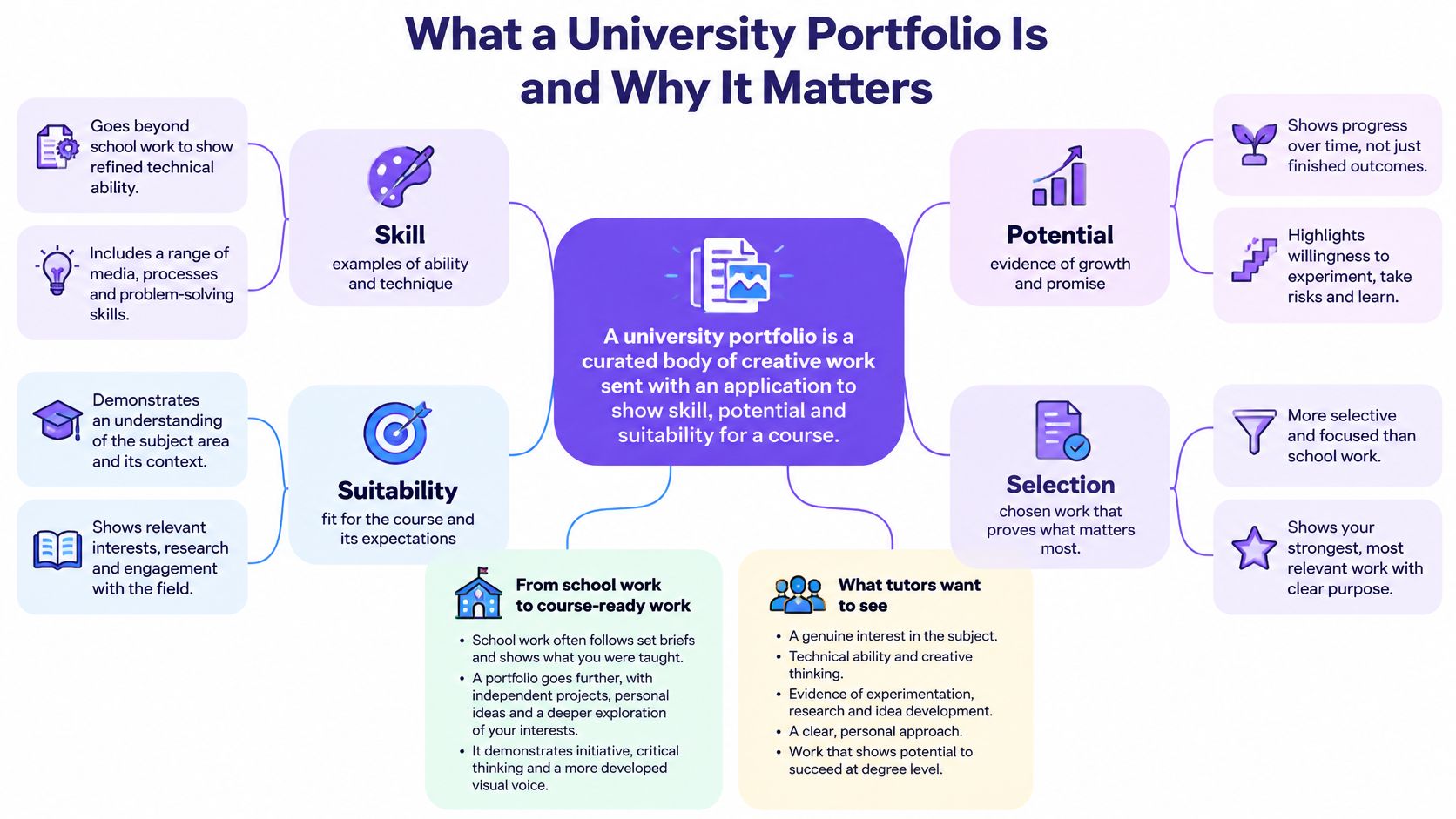
A university portfolio is a selected body of work submitted with an application to demonstrate creative ability, development and suitability. Selected matters: you're not handing over everything you've ever made.
Say you've designed a garment inspired by coastal erosion. A gallery-style presentation might show a photograph of the finished garment. A portfolio could also include shoreline drawings, fabric experiments, an unsuccessful construction test and notes explaining why you changed the silhouette.
The photograph demonstrates what you made. The supporting material helps a tutor understand how you think.
More than a gallery
Think of a portfolio as a job interview in which your work does some of the talking. A confident final image introduces your abilities; the development pages explain how you respond to problems, learn techniques and make choices.
UCAS's art and design application guidance encourages applicants to discuss portfolio projects, explain their approach and identify relevant influences. It also explains that many specialist institutions request creative evidence and may accept non-traditional qualification combinations, including A levels and BTECs.
Creative admissions can bring together qualifications, the personal statement, interviews, auditions and practical work. Your portfolio contributes evidence that a grade or written claim alone can't provide: the actual marks, materials, revisions and outcomes.
Practical rule: Don't just tell a tutor that you're experimental. Show an experiment and explain what you learnt from it.
What your selection needs to demonstrate
Keep these purposes in mind when choosing work:
- Current skill: Include work that shows your control of relevant techniques and materials.
- Capacity to learn: Make changes, discoveries and responses to feedback visible.
- Suitability: Choose projects that connect with the course's subject and expectations.
You don't need to pretend you're already a professional artist or designer. You need to give a reviewer convincing reasons to believe you're ready to develop through degree-level study.
Which Courses Require a Portfolio
A student applying for Interior Design may need to submit a digital portfolio, while another creative course may assess applicants through different materials. Portfolio requirements depend on the course and university, even when the course titles sound similar.
The University of Edinburgh's Interior Design course listing specifies a digital portfolio demonstrating artistic skill and potential. Treat each course as a separate application: one portfolio submission may not meet every institution's requirements.
Course types and their portfolio requirements
| Course Type | Role of the Portfolio | What to Check |
|---|---|---|
| Specialist art and design degree | Often central to the application | Whether the course requests a digital portfolio |
| Creative course with interview or audition | May be considered alongside an interview or audition | Interview dates and any audition brief |
| Course assessed mainly on qualifications | May be requested as supporting evidence | Whether a portfolio is optional or required |
| Foundation Diploma route | Developed through project work during the course | Entry requirements and assessment dates |
A Foundation Diploma is a preparation route, not another name for a degree. Explore Foundation courses in art to understand how this project-based route can prepare you for further study.
Check the actual submission instructions
Start with the course page, then read the university's admissions or portfolio guidance. Follow any instructions sent directly to applicants, especially those about deadlines and interview tasks.
Before arranging your work, make a checklist:
- Content: Required subjects, project types, sketchbooks or supporting statements.
- Files: Accepted formats, file-size limits and rules for moving-image work.
- Submission: Upload method, deadline and whether the portfolio is requested separately.
If you have limited experience in a formal creative subject, independent work can show your engagement with the subject. Check the entry requirements too, since a portfolio does not replace them.
Assessment Criteria Admissions Tutors Use
The University of Edinburgh's portfolio preparation guide publishes four assessment criteria: visual research and enquiry, idea development, selection and resolution, and contextual awareness. Academic staff with professional and specialist expertise assess the submissions.
Other institutions may weigh these areas differently. Nevertheless, they provide a useful way to ask whether your portfolio contains assessable evidence rather than attractive images alone.
| Criterion | Evidence to make visible |
|---|---|
| Visual research and enquiry | A question, direct observations and relevant research sources |
| Idea development | Sketches, tests and revisions showing how an idea changed |
| Selection and resolution | A considered final outcome and reasons for choosing it |
| Contextual awareness | Connections with artists, designers, practices or movements |
Research and development
Visual research and enquiry starts with purposeful looking. For a project about public seating, you could record how people use benches, sketch worn surfaces and investigate the relationship between comfort and material.
A page of downloaded pictures isn't enough by itself. Explain what you noticed and what you wanted to investigate.
Idea development requires evidence of change. Show how an initial drawing became a model, what the model revealed and how you adjusted the design. A failed material test is useful when the annotation identifies the problem and explains your response.
Decisions and context
For selection and resolution, make your editing visible. If you rejected a complicated composition in favour of a quieter one, explain how that decision strengthened the intended effect. Finishing something carefully matters, but so does knowing why that outcome deserves attention.
Contextual awareness means connecting your choices to relevant creative practice. For example, you might examine how a named photographer uses framing, then test a related approach in your own images. Identify the source and explain the connection rather than placing an artist's name beside your work.
For OCAD learners, a practical project structure is: question, research, experiments, tutor feedback, revisions, outcome and reflection. Keep the development material distinguishable from the final presentation.
Can someone identify the question, the experiment and the choice behind each finished image?
A polished outcome without that supporting evidence leaves important decisions invisible. A tutor can assess what's on the page, not the thinking you've left in your head.
What Goes Into a Portfolio, Item by Item
Start with the projects that best match your intended course, then select material that explains them. You're building readable project accounts, not filling separate folders just to prove you've used different media.
The following items serve different purposes. You don't need to squeeze every category onto every page.
Portfolio item types, their purpose and examples
| Item | What It Shows | Art and Design Example |
|---|---|---|
| Finished outcomes | Technical skill and resolution | Oil painting series or a completed garment |
| Sketchbook pages | How ideas develop | Annotated studies from life or observation |
| Experiments | Willingness to take risks | Failed screen print with notes on what changed |
| Research boards | Range of influences | Artist references with a reason for each |
| Written reflection | Critical thinking | Caption explaining why one version was chosen |
Give each item a clear job
Finished outcomes need clean presentation. Label a painting with its title, medium and dimensions; photograph a garment so its construction and overall form are visible. Avoid decorative backgrounds that compete with the work.
For sketchbook pages, select spreads with purposeful observation and development. Include enough detail for annotations to remain readable. A crowded photograph of an entire book spread won't help if the viewer can't distinguish the studies.
An experiment should show what you tested. Beside an unsuccessful screen print, explain whether the difficulty involved registration, ink coverage or the image itself, then show the adjustment.
Research boards need relationships, not just references. Place a short note beside each source explaining what you investigated, such as colour, structure, symbolism or material behaviour.
With written reflection, be precise. Instead of describing an outcome as successful, explain that you removed a background pattern because it distracted from the figure.
Choose depth rather than padding
Foundation Diploma portfolios are usually more specialised than A Level portfolios, which universities prefer. Confirm the expected breadth and specialism on each course page, rather than treating that preference as a universal entry rule.
The course brief determines the required amount and length of work. A compact selection of developed projects can communicate more than a large collection of disconnected pieces.
Label process evidence and final outcomes clearly within each project. That distinction lets a reviewer examine your exploration without mistaking a rough test for your intended finished result.
Strong and Weak Portfolios Across Art and Design
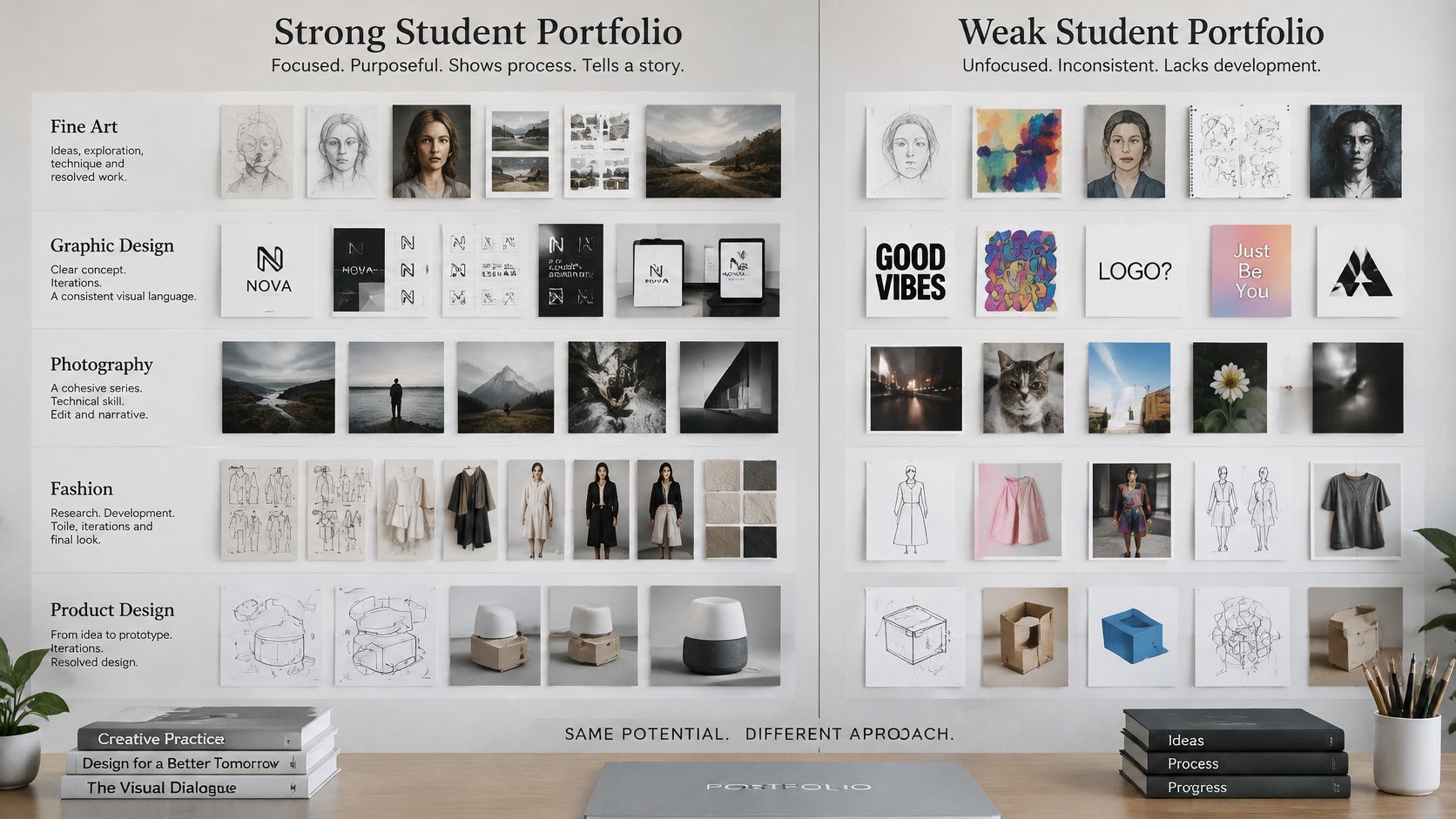
Consider a hypothetical applicant who has arranged polished images into an elegant PDF. The work looks accomplished, but the reviewer can't tell which choices were deliberate or how the applicant responds when an idea doesn't work.
The applicant adds selected roughs, a material test and a short explanation of a rejected version. The finished work hasn't changed. What's changed is the evidence available to assess it.
How that difference looks in practice
| Discipline | Stronger evidence | Weaker evidence |
|---|---|---|
| Fine art | A sustained question explored through related series, studies and a visible change of direction | Unrelated paintings with no explanation |
| Graphic design | A brief, rough concepts, typography tests and a final system applied in context | Polished mock-ups without development |
| Photography | Contact sheets, editing decisions and a coherent series | Favourite photographs assembled without a connecting purpose |
| Fashion and textiles | Mood boards, toiles, fabric swatches and a finished garment with fit notes | Fashion illustrations alone |
| Illustration | Character development, thumbnails and sequential sketches | Isolated images in a single style with no development |
These contrasts aren't instructions to use identical layouts. Each discipline needs evidence appropriate to the problem being explored.
A photography applicant, for instance, could mark rejected images on a contact sheet and explain that they repeated information already communicated elsewhere in the series. That reveals editorial judgement, not merely camera technique.
Make the relevant decisions visible
A graphic design project might need a close-up showing how lettering performs at a small scale. A fashion project might need a side-view photograph explaining a fit adjustment. Include the evidence that answers the likely question.
If you're moving towards spatial design, examining interior design portfolio examples can help you consider how plans, models and material choices might work together in a project presentation.
Don't confuse strong evidence with excessive documentation. Including every photograph or sketch can make the important decisions harder to find.
Editing test: Keep a page when it adds a distinct piece of evidence. Revise or remove it when it only repeats what the reviewer already knows.
Across disciplines, the useful rule is the same: show what you attempted, what you changed and what the resulting work demonstrates.
How to Build a Portfolio Project Step by Step
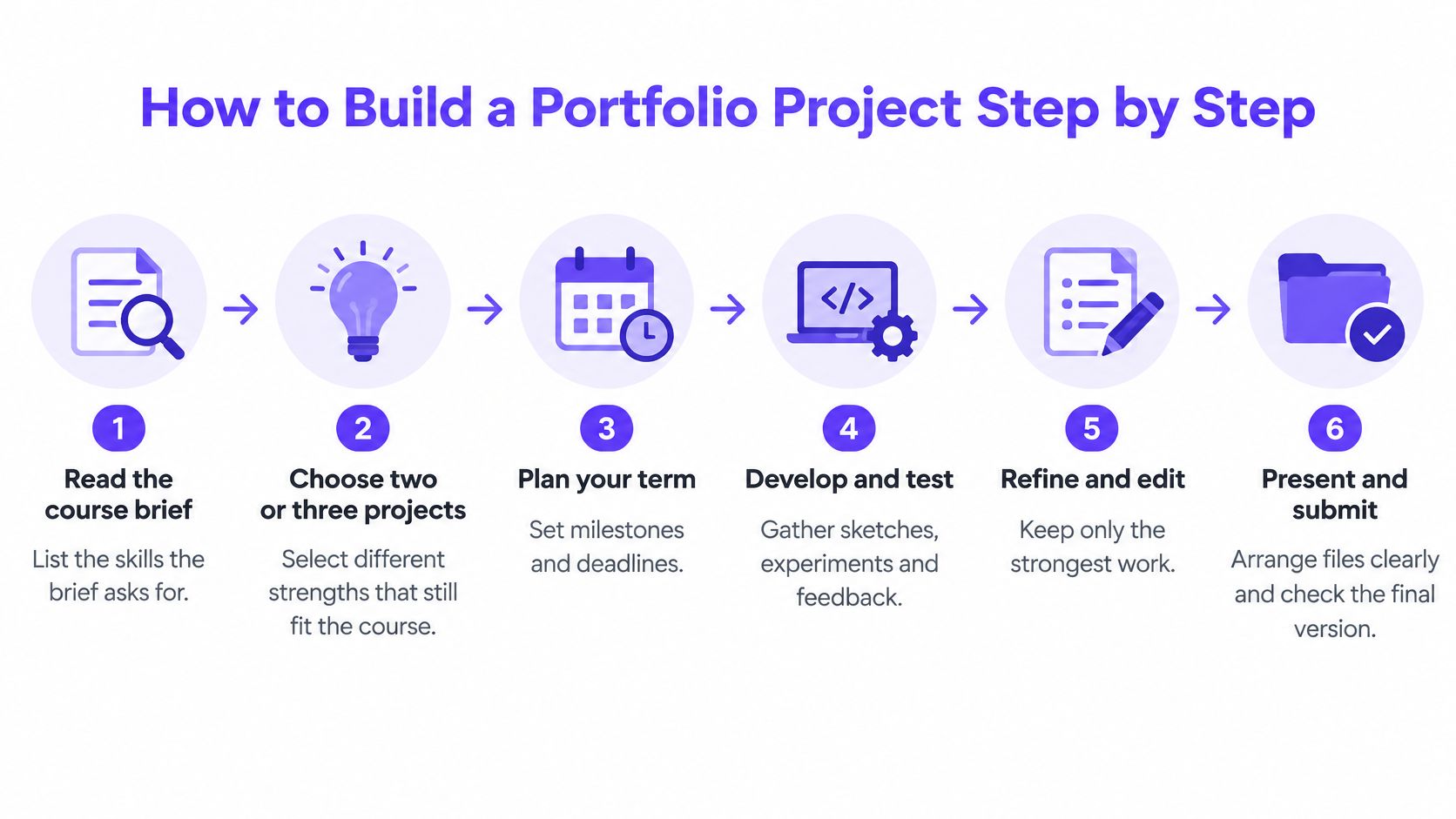
Build your portfolio alongside your creative work rather than trying to reconstruct everything before submission. Set milestones across your term for research, testing, feedback, refinement and photography.
From brief to finished project
Read the course brief. List the abilities it asks you to demonstrate, such as observational drawing, spatial enquiry or visual storytelling. Skipping this step can leave you with appealing work that doesn't answer the admissions task.
Choose connected projects with different strengths. You might combine an observational project with a material-led investigation, provided both support your intended direction. Don't choose unrelated subjects just to make the portfolio look broad.
Gather research and record sources. Save the creator, title, source location and access date alongside reference material. Keep your own photographs separate from found images so authorship remains clear.
Experiment and retain useful failures. Test composition, materials, construction or sequencing in a sketchbook or working file. Don't discard an attempt before recording what it taught you.
Seek feedback during development. Ask your tutor a specific question, such as whether the sequence communicates the intended narrative. Note what you changed afterwards rather than recording feedback without acting on it.
Select and refine the outcome. Compare alternatives against the project's purpose and explain your selection. Avoid choosing a version solely because it took the longest to make.
Photograph and label the work. Use even daylight, a neutral background and consistent colour; include scale where it helps. Warm artificial light can distort colour, while angled photographs can misrepresent flat work.
Arrange a readable sequence. Move from the starting question through relevant development to the outcome and reflection. Check that captions explain decisions rather than merely naming what's already visible.
Keep the evidence manageable
For photographing fashion work as a coherent sequence, Sprello's a production guide for merchandising teams offers a commercial reference point. Use it to think about consistent presentation, while keeping university assessment requirements in charge of your selection.
At OCAD, students develop their own media portfolio for assessment with tutor feedback and guidance. They upload photographs of completed work and assignments throughout the course, so the portfolio develops as the work is made.
Coursework used as assessment evidence must clearly be the student's own work, produced while enrolled on the OCAD course. Before closing a project, ask someone unfamiliar with it to follow the sequence: can they explain how the final piece came about?
Frequently Asked Questions About University Portfolios
Questions from Level 2 and Level 3 students
Is a portfolio just my best pieces?
No. Include selected development alongside the outcomes, such as an annotated observational study beside the painting it informed. Your most useful evidence isn't always your most polished image.
How many pieces do I need?
Follow the amount specified by each course, including any separate rules for pages, projects or sketchbooks. As a hypothetical comparison, a small group of connected, developed projects can communicate more clearly than a much larger set of unrelated pictures, but neither approach overrides the brief.
Can I use coursework from my Level 3 course?
Yes, where the university permits it and the material is your own. For OCAD assessment evidence, it must also have been produced while you were enrolled; choose coursework that makes the enquiry, testing and reflection understandable, such as a textile project with swatches and development notes.
Qualifications and alternative routes
Does a portfolio replace my qualifications?
No. It adds practical evidence to the application rather than automatically replacing academic requirements. For example, a convincing design project won't by itself establish that you've met a course's stated qualification conditions.
Can I apply without an art A level?
Potentially, yes. Some specialist institutions accept non-traditional qualification combinations, including A levels alongside BTECs, but you must check the exact course requirements. Independent drawing, photography or design projects can help demonstrate sustained practice when your school subjects don't tell that story.
If you're studying at Level 2, distinguish between preparing for further creative study and meeting degree-entry requirements. A strong starting portfolio can help you identify what to develop next, but the intended route still determines the qualifications you need.
For anyone asking what is a portfolio for university, the practical answer is a course-specific selection, not a universal package. Confirm the current instructions on each course page and leave time to resolve uncertainties: a portfolio can't rescue a late or incomplete application.
Pre-Submission Checks and Your Next Step
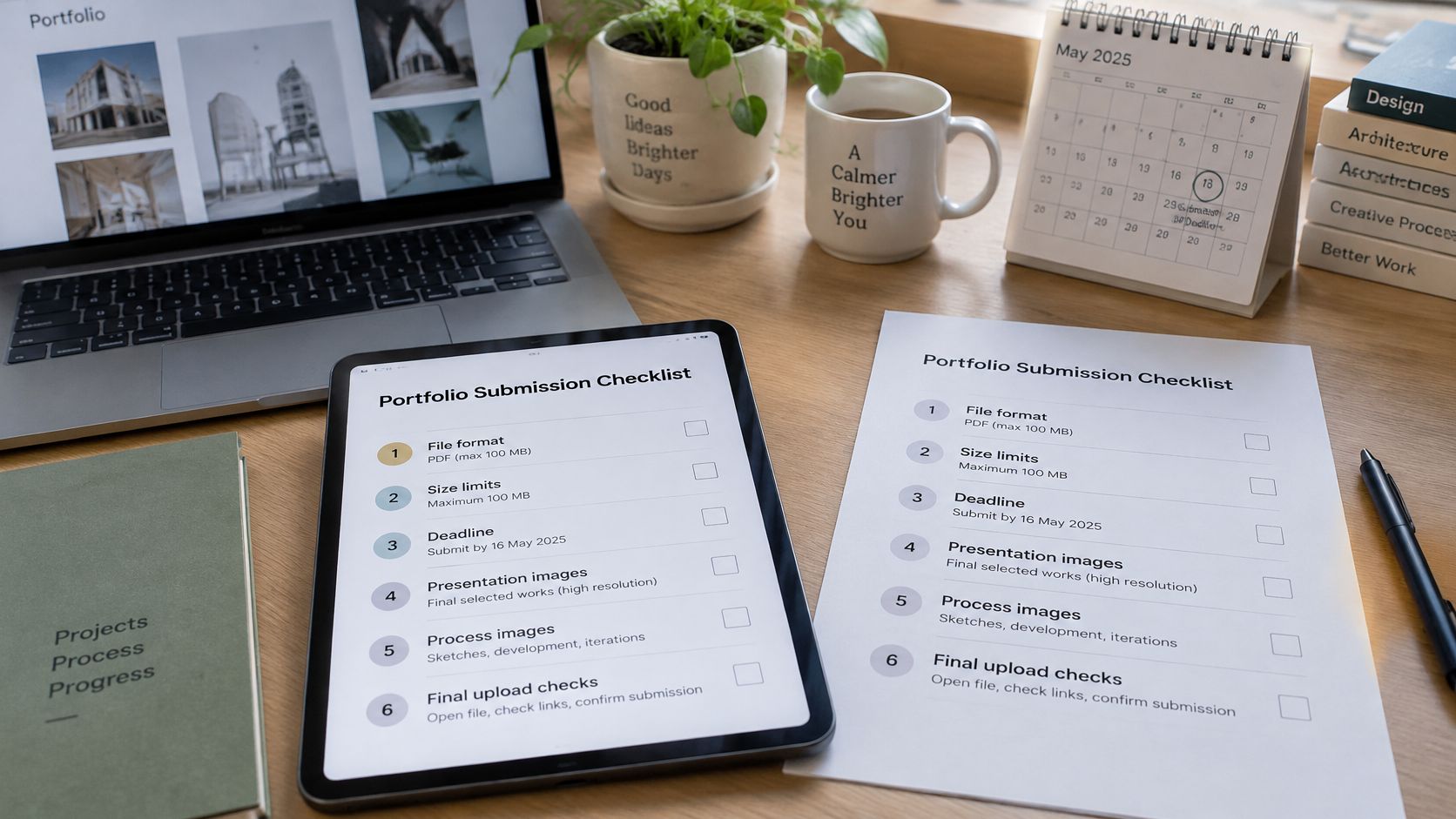
- Confirm the upload rules. Recheck accepted file formats, size limits and the deadline against the current course instructions.
- Check labels and grouping. Make presentation images and process evidence easy to distinguish without sending reviewers through unnecessary folders.
- Verify authorship and dates. Ensure your work is identified correctly, references are credited and assessment coursework meets enrolment requirements.
- Review the exported sequence. Open the actual submission file and follow each project from question to outcome.
- Request a final criteria check. Ask a tutor to assess the submission against the intended course's requirements, not just its appearance.
Turn your draft into a clear next step
At OCAD, our Level 3 courses prepare students for an A Level or Foundation Diploma and university applications. Your online studio provides course units, materials, assignments, video tutorials, learning resources and a portfolio workspace; students who complete our Level 3 courses can progress to university, and we support the UCAS application.
Give the written application equal attention. Our guide to writing a personal statement for a Foundation art course can help you explain your interests alongside your practical evidence.
Book a conversation with an OCAD tutor to review your draft against the intended course's criteria before the application deadline. Choose your route, confirm each course's requirements and start your first project this week.
The Online College of Art & Design (OCAD) offers flexible, tutor-led creative study with project feedback and an online portfolio workspace to help you develop evidence for university applications. Visit The Online College of Art & Design (OCAD) to explore your study route and arrange a conversation about your current work and next steps.