

Yes, you can complete Functional Skills qualifications entirely online, including regulated on-screen assessments, if you have the required hardware and connectivity. Pearson's 2025/26 figures include first-time pass rates of 41% for Maths Level 2 and 63% for Writing Level 2, showing that online learners can achieve recognised results.
You may be a Level 2 or Level 3 art, design, photography, film, or music student who has discovered that a university application still asks for English or maths evidence. Perhaps your portfolio is developing well, but a missing GCSE grade is slowing your next step. Online Functional Skills can fit around creative practice, work, or family life, but the learning platform is only one part of the process. The final assessment has rules about devices, internet speed, identity checks, browser access, and the room you use.
Table of Contents
- Understanding Online Functional Skills for Creative Students
- Qualification Levels and Proven Learner Outcomes
- Navigating On-Screen Assessments and Technical Requirements
- The Real Economics and Accessibility of Remote Study
- Connecting Functional Skills to Creative University Pathways
- Steps to Enrol and Prepare for Your Online Assessment
Understanding Online Functional Skills for Creative Students
A creative student often needs a qualification that supports progression without taking them away from studio work. You might be preparing a photography portfolio during the day, working part-time, or studying a Level 3 course with deadlines that don't fit a traditional classroom timetable. In that situation, the answer to can you do Functional Skills online is yes, from course study through to the regulated assessment, provided your chosen centre offers approved remote invigilation.
Functional Skills qualifications are structured through official government requirements for Functional Skills. The framework covers English, maths, and digital skills, and Level 1 and Level 2 provision can be delivered online. Digital Functional Skills assessments are designed for on-screen and online delivery, while entry-level assessments remain paper-based under the current framework.
That distinction matters. Online lessons aren't just informal revision materials, and an online exam isn't a quiz that you can complete whenever you happen to have a spare moment. An approved centre must deliver assessment through controlled processes that protect your identity and the integrity of your result.
Practical rule: Choose the qualification and awarding organisation before you assume that every part of the journey will be remote.
Why online study suits creative progression
Level 2 Functional Skills is commonly described by UK providers and guidance sources as GCSE-equivalent. It can therefore provide a practical route for adults and other learners who need English or maths evidence before applying for further education or university, although each university sets its own entry requirements.
Online delivery also gives you control over when you study. Learners can use flexible education guidance such as study online as an adult when comparing home study with classroom attendance. For creative students, that flexibility can protect time for sketchbooks, editing, rehearsals, portfolio curation, and feedback.
If maths is the missing requirement, review the course structure and assessment arrangements in online Functional Skills Maths before enrolling. Ask whether teaching, mock assessments, exam booking, and invigilation are all included, or whether you'll need to arrange the final assessment separately.
Qualification Levels and Proven Learner Outcomes
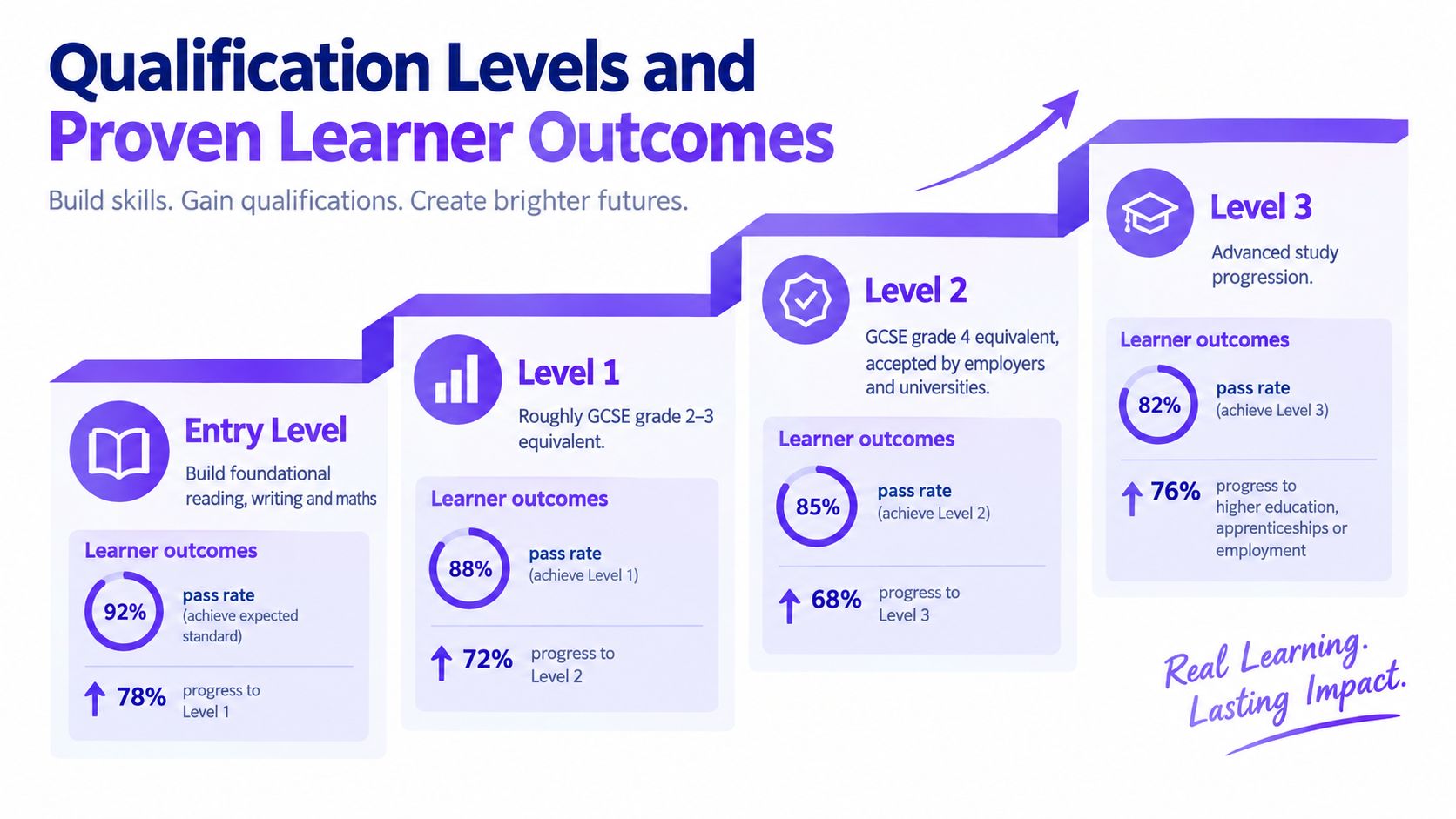
Functional Skills offers a progression ladder rather than one single qualification. In England, English and maths run from Entry 1 to Level 2, while Digital Functional Skills is available at Entry Level 3 and Level 1, as outlined by City & Guilds Functional Skills information.
Entry levels support foundational literacy and numeracy. Level 1 develops more secure practical ability, while Level 2 is the level most likely to matter when a university or higher-level course asks for GCSE-equivalent English or maths. Level 3 isn't part of the Functional Skills English and maths ladder described here, so a creative student at Level 3 normally uses Functional Skills Level 2 as an entry requirement alongside their advanced creative qualification.
What the recent results show
Recent awarding-organisation data gives a useful benchmark. Pearson's 2025/26 UK table reports first-time pass rates of 42% for Maths Level 1, 41% for Maths Level 2, 75% for Reading Level 1, 59% for Reading Level 2, 61% for Writing Level 1, and 63% for Writing Level 2. Pearson also reports individual-learner pass rates of 51% for Maths Level 1 and 50% for Maths Level 2 in the same table, available through its Functional Skills pass-rate data.
NCFE's 2024/25 figures show first-time pass rates of 47% for Level 1 maths, 50% for Level 2 maths, 67% for Level 1 reading, 75% for Level 2 reading, 68% for Level 1 writing, and 81% for Level 2 writing. Its digital results include first-time pass rates of 68% at Entry Level 3 and 58% at Level 1, with overall pass rates of 67% and 56% respectively, in the same published Pearson reference.
These figures don't prove that online study is automatically easier. They do show that digital delivery is established and produces measurable learner outcomes. Before choosing a course, use guidance on which course level is right for you and confirm the exact level your intended university accepts.
Navigating On-Screen Assessments and Technical Requirements
Studying from home is flexible. Sitting the final exam from home is controlled. Government guidance defines online assessment as the delivery of assessment materials to a centre and the return of learner responses to the awarding organisation through the internet. Digital Functional Skills assessments are therefore regulated on-screen assessments, not ordinary remote worksheets.
What your setup must support
One UK proctoring guide specifies a minimum 2.0 Mbit/s upload speed, 10 Mbit/s download speed, and ping below 25 ms for a proctored exam. It also requires a webcam, microphone, and strict browser controls that prevent access to other websites or tabs. The guide is available in the VTCT Skills proctoring instructions.
Separate learner instructions require at least 10 Mb/s download and 1 Mb/s upload, and they don't allow tablets or phones. Dual screens are prohibited, the camera must show you during the assessment, and your seating arrangement must meet controlled-condition requirements.
Before booking, check these points:
- Device: Use a laptop or desktop, not a tablet or phone. Some providers may also exclude Chromebooks.
- Connection: Test the actual room and device you'll use. A general household speed result isn't enough.
- Room: Arrange a quiet, private space with no unauthorised people or materials.
- Controls: Expect identity checks, webcam monitoring, microphone checks, and restricted browser access.
- Support: Ask how reasonable adjustments and assistive technology are handled.
A centre using suitable test prep centre software may help organise practice and readiness, but software can't remove awarding-body rules. Read the provider's technical checklist before you pay.
For creative learners, this is similar to preparing a photography shoot. You don't wait until the session to discover that the battery, lens, or memory card won't work. Run the connection test, check the operating system, confirm camera and microphone access, and ask what happens if the platform fails.
You can also explore how online learning makes photography education accessible while comparing flexible creative study with assessment conditions.
The Real Economics and Accessibility of Remote Study
Online Functional Skills may reduce travel and timetable pressure, but it isn't automatically cheaper or simpler. Gatsby sector research notes that delivering Functional Skills online can cost up to the £724 apprenticeship funding cap, as discussed in Gatsby's Functional Skills research. For apprenticeships and adult reskilling, the provider still has to fund tutors, assessment administration, identity checks, technical support, and secure delivery.
That cost can affect what a course includes. One provider may include teaching and the exam, while another may charge separately for assessment or remote invigilation. Compare the full route, not just the advertised learning fee.
Accessibility needs early attention
A learner may be able to watch lessons online but still struggle to sit the final assessment remotely. Remote invigilation commonly requires a laptop or desktop, webcam, microphone, stable internet, and a compatible browser. A school-issued device, low-spec computer, mobile-only setup, or assistive technology may not work without prior approval.
Pearson says some access arrangements must be applied for at least 6 weeks in advance, so don't wait until the booking email arrives. Ask the provider these questions in writing:
- Can I use my assistive technology during the assessment?
- Does the awarding organisation approve my adjustment?
- Is my device compatible with the exam platform?
- What happens if I only have mobile internet?
- Can I take the assessment at a centre if remote delivery isn't suitable?
Access isn't a last-minute technical detail. It forms part of the qualification decision.
A blended or onsite option may be more appropriate if your home connection is unreliable, you share a room, or you need specialist support. Online study suits learners who can create a dependable assessment environment, not only learners who prefer studying in pyjamas. If your phone is your only device, research options carefully, including affordable iPhone deals for students, while remembering that a phone won't replace the laptop or desktop required for the exam.
Connecting Functional Skills to Creative University Pathways
Functional Skills works best when you treat it as one part of a progression plan. A Level 2 English or maths certificate may address a specific entry requirement, while your creative qualification demonstrates subject knowledge, commitment, and portfolio development.
National Careers Service guidance describes Functional Skills as supporting literacy, numeracy, and ICT improvement through its Functional Skills course search. Pearson also explains that Functional Skills in England are available from Entry 1 to Level 2 and can form part of apprenticeship standards for 16 to 18-year-olds in England.
Build the route around the university requirement
Start with the admissions page for the specific art, design, photography, film, or music degree. Check whether it asks for GCSE English, GCSE maths, Functional Skills Level 2, or another accepted equivalent. Don't assume that one university's policy applies to another.
A practical route might look like this:
- Confirm the gap: Identify whether you need English, maths, or both.
- Complete the prerequisite: Study the accepted Level 2 qualification online.
- Develop the portfolio: Continue producing and refining work for the creative application.
- Check evidence: Ask admissions whether the certificate must be received before application or before enrolment.
Training Qualifications UK describes a remote online option for Level 1 and Level 2 maths and English where learners can book and sit an assessment at any time and anywhere, including booking and sitting it on the same day, subject to the provider's arrangements. That flexibility can help a student coordinate assessment with a portfolio deadline, but you should still allow time for results and certificate processing.
Functional Skills won't replace a portfolio where a creative degree requires one. It can remove an academic obstacle so your portfolio, personal statement, and interview can receive proper attention.
Steps to Enrol and Prepare for Your Online Assessment
Choose the qualification by working backwards from your university application. First, identify the exact subject and level. Then email the admissions team with the awarding organisation and qualification title you plan to take. Keep their reply, because it gives you a clear record if the course page uses broad wording such as “GCSE equivalent”.
A practical preparation checklist
- Compare approved providers. Confirm the awarding organisation, tutor support, exam inclusion, remote invigilation, and certificate arrangements.
- Complete an initial assessment. Use the result to decide whether Entry Level, Level 1, or Level 2 is realistic. Starting at the wrong level can waste time and weaken confidence.
- Check accessibility before enrolment. Tell the provider about SEND needs, assistive technology, extra time, or communication requirements before booking.
- Test the equipment. Use the intended laptop or desktop. Check the webcam, microphone, browser, operating system, and internet connection in the room where you'll sit the exam.
- Practise under exam conditions. Complete timed practice, keep your desk clear, and learn which calculator or resources the awarding organisation permits.
- Book with a buffer. Some remote providers offer flexible or on-demand booking, but don't leave the assessment until the university deadline is close.
- Prepare your identity and room. Have accepted photo ID ready, remove unauthorised materials, and ensure nobody enters during the assessment.
TQUK explains that some learners can book and sit a remote assessment on the same day. That convenience is useful, but a same-day booking doesn't remove the need to pass the technical checks or secure the required arrangements. A reliable provider will explain the process before you commit.
Your final decision should balance three things: university acceptance, assessment readiness, and accessibility. If all three are confirmed, online Functional Skills can fit neatly beside a Level 3 creative course and keep your progression moving.
The Online College of Art & Design (OCAD) offers online Functional Skills courses in Maths, English, and Digital Skills, with online lessons and exams, alongside tutor-led creative qualifications and portfolio-centred Level 3 pathways. Visit The Online College of Art & Design (OCAD) to compare a Functional Skills route with the creative study options that can support your university plans.