

Your child has just moved into Year 7, or you've started home educating an 11 year old who loves drawing, and you're staring at a timetable wondering what art is supposed to involve now. It's no longer just colouring in on a Friday afternoon, but it isn't GCSE yet either. Key Stage 3 art and design sits in that middle ground, and once you can see how it's built, the projects, sketchbooks and artist studies start to make much more sense.
Table of Contents
- What Is Key Stage 3 Art and Design
- The National Curriculum Framework for KS3 Art
- Core Skills and Knowledge in KS3 Art
- Sample Projects and Schemes of Work
- Assessment and the Sketchbook Evidence Trail
- Progression to GCSE and iGCSE
- Online Study and How OCAD Supports KS3 Learners
What Is Key Stage 3 Art and Design
A parent I spoke to recently assumed her son's Year 8 art homework, a page of thumbnail sketches of his own shoe from different angles, was busywork before the painting started. In fact those thumbnails were the work. He was recording observations, testing composition and learning to look properly before committing to a final piece.
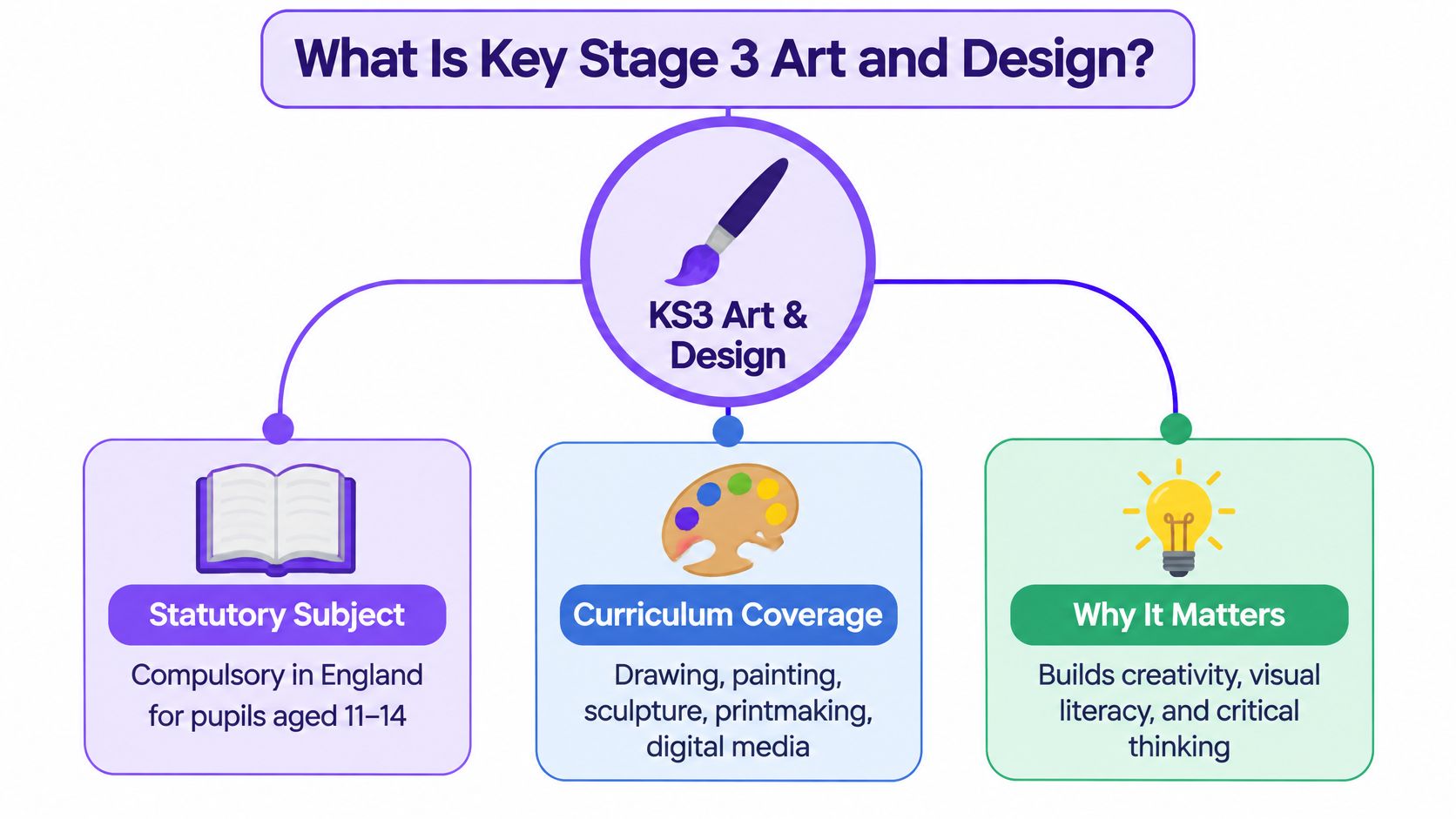
That's a good way to understand Key Stage 3 art and design. It's the statutory art programme in England for pupils aged roughly 11 to 14, usually Years 7 to 9, and it's designed as a complete subject, not an introduction to drawing. Pupils make work, but they also research artists, designers and architects, document how an idea developed, and explain in words why they made one choice rather than another.
Who It Is For and Where It Sits
In maintained schools in England, this isn't an optional extra you can drop to make room for more maths. It's a statutory subject, which means schools must teach it across the key stage. Home educators aren't legally bound in the same way, but many follow the same framework because it gives a clear progression route and keeps doors open for GCSE later.
The age range matters for expectations. An 11 year old in Year 7 might be learning to control tone with a pencil for the first time in a deliberate way. By Year 9, that same pupil should be able to develop a personal theme, compare how two practitioners handled similar problems, and revise work based on evidence from their own experiments. It's a three year build, not three repeats of the same lessons.
More Than Making Pretty Pictures
Parents often ask why so much lesson time goes on sketchbooks, annotation and artist research when their child just wants to paint. The short answer is that KS3 combines four strands that support each other.
- Practical production: Drawing, painting and work in at least one other medium, with increasing control over materials.
- Reflective documentation: Sketchbooks and journals that show observations, tests and changes of direction.
- Contextual research: Looking at art, craft, design and architecture across history and connecting it to your own decisions.
- Critical judgement: Analysing your own work and other people's, using subject vocabulary to explain what works and what doesn't.
A final piece with no development behind it tells a teacher very little. A modest final piece with thoughtful testing and honest evaluation tells them a great deal.
That balance is why getting this stage right matters. Pupils who leave Year 9 able to observe closely, experiment without panicking when something fails, and talk clearly about visual choices have the exact habits later courses build on. Pupils who've only copied finished examples often struggle when they're first asked to develop ideas independently.
The National Curriculum Framework for KS3 Art
The framework behind all of this has a legal basis, and understanding it helps you judge whether a course, school scheme or home education plan is covering KS3 properly. The statutory framework was formalised through the Education Order 2008 for third key stage art and design, which came into force on 1 August 2008 and gave legal effect to the programme of study, including transitional provisions for pupils already in the key stage.
That history matters because it established KS3 art as a nationally specified, progressive curriculum rather than an optional enrichment activity a school could shape entirely on its own. The current programme defines the subject around creativity, technical proficiency, critical understanding and art history. Those four words do a lot of quiet work in lesson planning.
What Pupils Are Required to Do
Strip away the official language and the requirements are practical. Pupils aged approximately 11 to 14 must learn to develop ideas and improve how they execute them, using a range of techniques and media, including painting. They must record observations in sketchbooks, journals and other media. They must handle different materials with increasing proficiency over time, not just try each material once.
Alongside making, they must analyse and evaluate their own work and the work of others. They must also study the history of art, craft, design and architecture from ancient times to the present day. That last requirement surprises some families, but it doesn't mean memorising dates. It means a pupil studying pattern, for example, might look at historical textile design alongside contemporary work and notice how similar visual problems get solved differently in different periods.
Why It Is Structured as a Journey
Notice the verbs in the framework. Develop. Improve. Increase. Analyse. The curriculum assumes pupils get better at something through repeated, structured practice, and that their understanding deepens as they revisit skills in new contexts. A Year 7 project on colour might focus on mixing and basic theory. A Year 9 project might return to colour through symbolism, mood and personal meaning.
A useful check: If a KS3 plan is just a list of disconnected fun activities with no build in skill or thinking between them, it isn't really following the framework, however enjoyable the lessons look.
That progressive design is also your protection as a parent or home educator. If you're choosing resources, look for sequences where observation leads to experimentation, experimentation leads to development, and development leads to a final piece and evaluation. When that chain is missing, pupils often produce attractive work but can't explain how they got there, and they can't repeat the success on a new theme.
Core Skills and Knowledge in KS3 Art
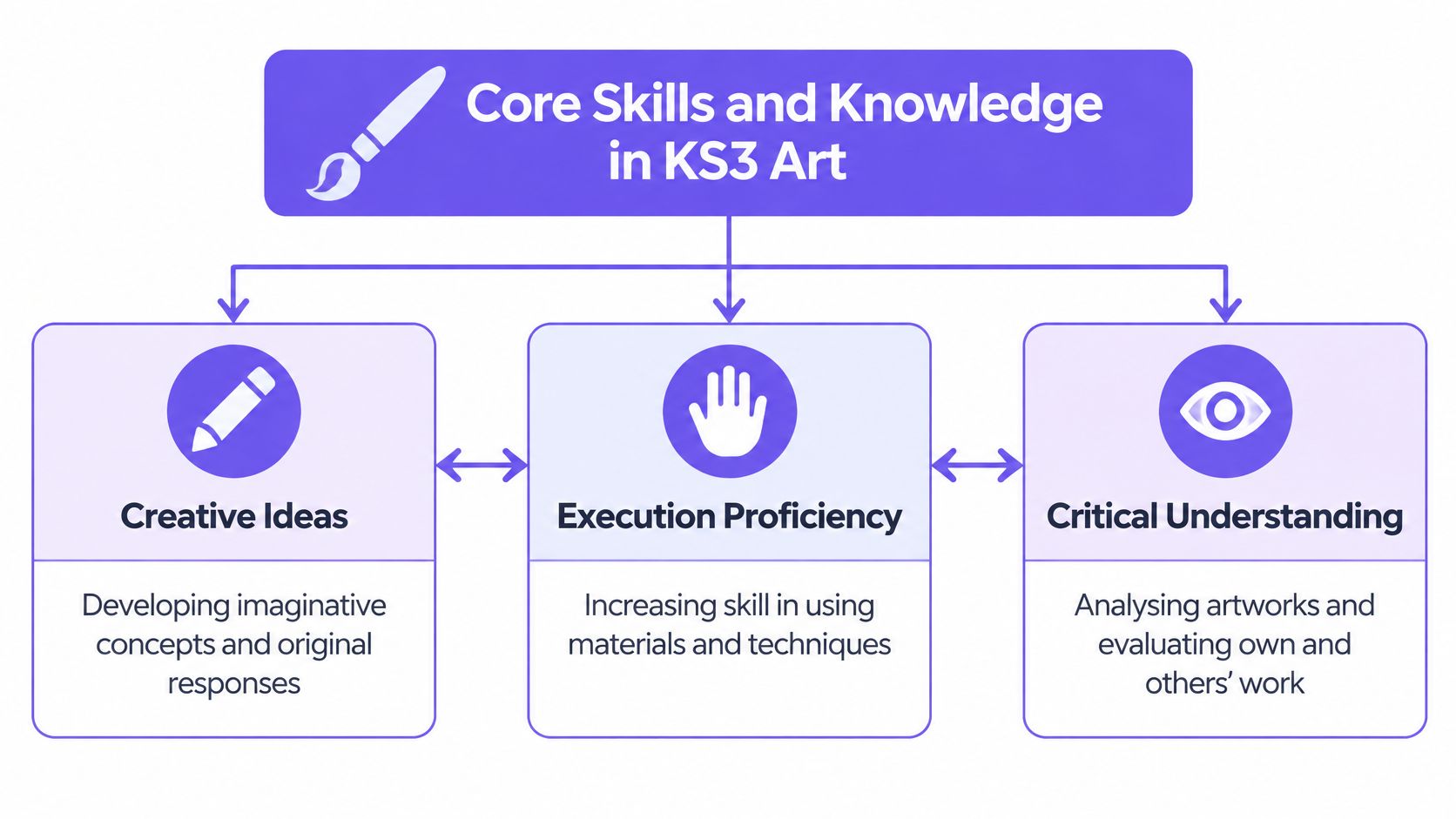
Teachers plan KS3 around three linked technical capabilities, and it helps to see them working together rather than as separate targets on a report. The national curriculum describes them as developing creative ideas and increasing proficiency in execution, building critical understanding of artists, architects and designers, and using reasoned judgements to inform practical work, as set out in the national curriculum programme of study for art and design.
Capability One Developing Ideas and Execution
This is the making strand, but it's broader than neatness. A pupil might start a project on natural forms by drawing shells and seed heads from observation. They then test how charcoal, ink and watercolour each capture texture differently. Only after those tests do they choose a medium for a developed piece.
Proficiency grows through that kind of repetition. Handling materials well means knowing that watercolour behaves differently on wet paper, that acrylic can be layered opaquely, and that collage can solve a composition problem when paint won't. Pupils can't learn that from watching a demonstration alone. They need controlled chances to test, fail and adjust.
Capability Two Critical Understanding of Practitioners
The second capability stops artist research becoming a copied page from the internet. Good KS3 research is annotated and comparative. A pupil doesn't just stick in an image and write a biography. They note the formal properties, colour, scale, composition, materials, and they consider intended meaning. Then they ask a practical question. What can I borrow from this approach for my own theme, and what doesn't fit?
That shift converts subjective preference into explicit visual reasoning. Instead of "I like this artist," a pupil learns to say, "This photographer crops tightly to create tension, and I want a similar effect in my portrait series, so I'll test close framing."
Capability Three Reasoned Judgements That Change the Work
The third capability is where thinking feeds back into making. A judgement only counts if it informs a decision. In a critique, a pupil might realise their background is competing with their subject because both use the same tonal range. The reasoned response is to darken one, lighten the other, or simplify the background, then record why.
- Observation first: Sketchbooks and journals capture what the pupil saw, not what they assumed.
- Varied media: Painting is required within a broader range, so pupils shouldn't spend three years only drawing.
- Historical range: Study covers different periods, styles and movements, not just one favourite artist repeated.
A practical benchmark for any course is a portfolio showing process evidence across drawing, painting and at least one additional medium, with feedback tied to material control, idea development, contextual understanding and evaluation. If feedback only comments on presentation, it's missing most of what KS3 is meant to build.
Sample Projects and Schemes of Work
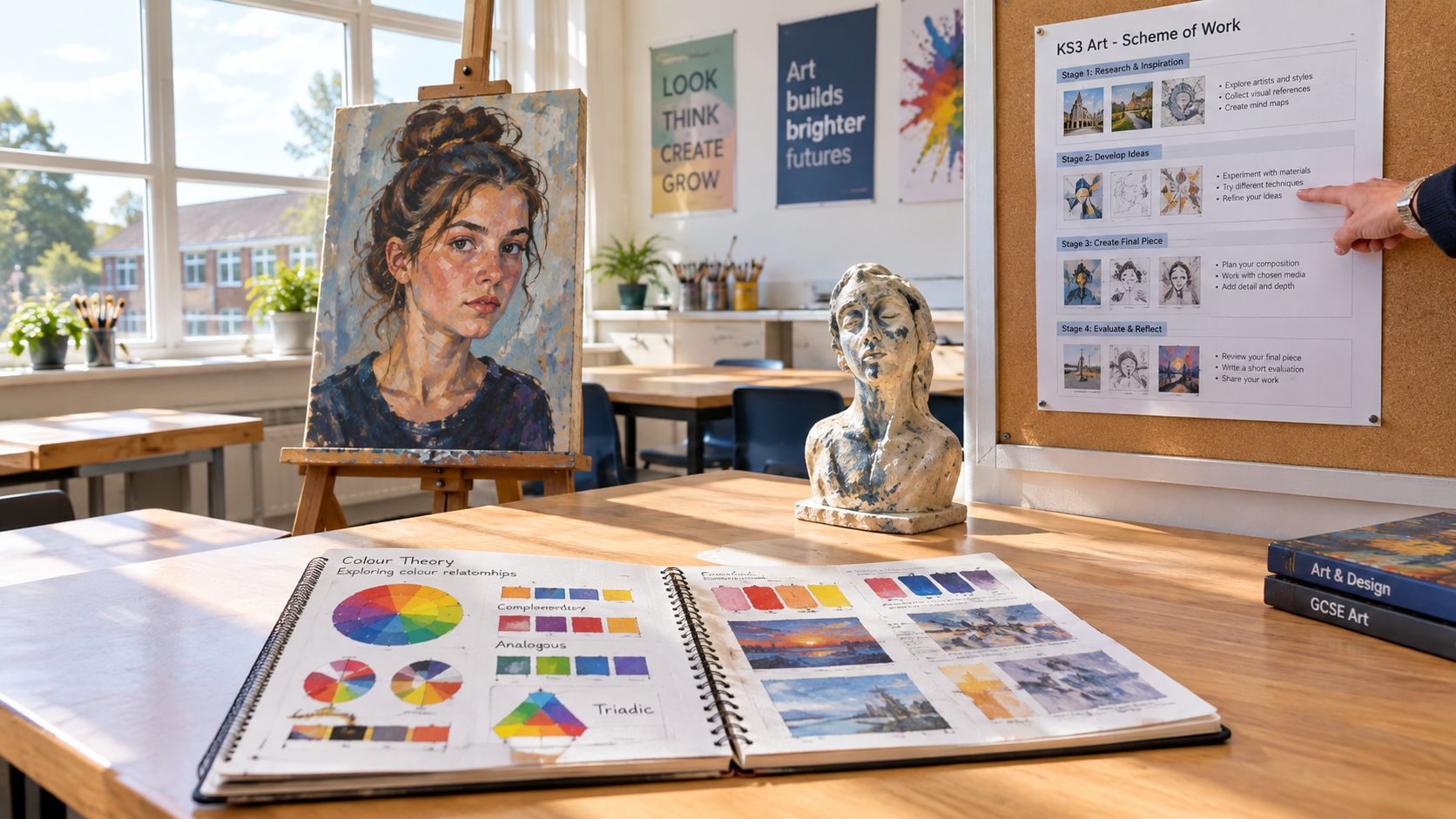
Abstract capabilities become clearer when you watch a project unfold. Take a typical Year 8 scheme on identity and portraiture, the sort of theme that allows personal interpretation while still teaching specific skills. You can see a wider range of structured examples in these Key Stage 3 art projects, but the shape below is what a sound scheme usually follows.
Walking Through One Project
Week one starts with observation, not a final portrait. Pupils draw facial features from life and from photographs they've taken themselves, working on proportion and tone. The drawings are often awkward, and that's fine. They're evidence of looking.
Next comes contextual research. Pupils compare two contrasting approaches to portraiture, perhaps a painted self portrait and a contemporary photographic series. Their annotations focus on composition, expression and symbolism. They're looking for tools they can use, not writing an essay.
Then comes material experimentation. Pupils test the same image in pencil, charcoal, collage and paint. A mixed media test might explore opacity, texture, layering and adhesion. Which combination holds together? Which surface suits the mood they want? They annotate each test, including the ones that didn't work.
Development Before the Final Piece
This middle stage is where weak schemes often jump straight to a best copy. Strong schemes insist on iterative development. Pupils produce two or three compositional thumbnails, try a colour study, and get peer or tutor feedback before starting the final work. One pupil might discover their collaged background overwhelms the face. Another might find that leaving areas of bare paper creates the quiet feeling they wanted.
The final piece then grows out of decisions the pupil can explain. After completing it, they write or record a reflective evaluation. What did the artist research change? Which experiment mattered most? What would they revise with more time?
The sequence is the point. Observe, research, test, develop, make, evaluate. Remove the middle steps and pupils learn to copy outcomes instead of building them.
Sequencing Across Three Years
Across the key stage, schemes should compound. A Year 7 still life project establishes tonal drawing and basic colour mixing. A Year 8 cultural pattern project might add printmaking and historical research. A Year 9 personal theme project then asks pupils to select their own starting point and media strategically, drawing on everything before it. Themes give freedom, but the underlying skills are deliberately sequenced so pupils aren't starting from zero each term.
Assessment and the Sketchbook Evidence Trail
Many parents judge art progress by the work that comes home for the wall. Teachers judge it largely by the sketchbook, and understanding why will change how you support your child. The sketchbook is the evidence trail that shows how a final piece came to exist. There's good practical thinking on building that habit in this guide to why every artist should keep a sketchbook, and the principle applies just as strongly at 12 as at 30.
What Assessors Are Actually Looking For
Sound KS3 assessment records both artefact quality and progression in experimentation, explanation, evaluation and independent decision making. A polished final image copied from a photograph might score less well than a rougher piece where the pupil tested three media, responded to an artist in a personal way, and revised a weak composition after critique.
That's because repeated recording and material testing gives learners more chances to spot visual problems and adjust. A pupil who has drawn a subject six times in different ways has far more information to work with than a pupil who went straight to a final version and hoped for the best.
Making Arts Learning Technically Purposeful
There's a wider reason this structured approach matters. The Education Endowment Foundation synthesis found a positive average association between arts participation and wider academic outcomes equivalent to approximately three additional months of progress, based on 80 studies with evidence rated moderate in security, according to the EEF Teaching and Learning Toolkit on arts participation. That doesn't mean any art activity automatically boosts other subjects. The implication for KS3 is to make participation technically purposeful, with explicit knowledge attached to each task.
In practice, that looks like this. Technical vocabulary improves the precision of critique. Precise critique identifies a specific weakness, perhaps flat modelling or an unbalanced composition. Targeted revision then strengthens the work. The mechanism is traceable, and pupils can feel it working.
- Experimentation: Are tests controlled and annotated, or random and unexplained?
- Development: Does the work change in response to research and feedback?
- Evaluation: Can the pupil justify one revision using evidence from their own experiments?
Giving and Receiving Critique
Teach your child that useful critique is specific and kind. "That's good" helps nobody. "Your dark background makes the face stand out, but the hand is getting lost because it's the same tone" gives the artist something to act on. Pupils who learn to receive that kind of comment without taking it personally, and to record what they changed as a result, are building exactly the reflective habit KS3 assessment rewards.
Progression to GCSE and iGCSE
KS3 isn't a qualification, so families sometimes treat it as a waiting room before the serious study starts. The entry figures for what follows suggest that's a mistake. GCSE art and design is a substantial national pathway, and the pupils who thrive in it are usually the ones whose KS3 years built sustained habits of observation, experimentation and evaluation.
Government provisional entries recorded 197,505 entries across GCSE art and design subjects in England for summer 2024, up from 187,710 in summer 2023, before entries eased to 194,190 in summer 2025, according to the provisional GCSE entries statistics for summer 2025. Those figures cover the whole subject grouping, not KS3 pupils alone, and the movement between years is a useful reminder that participation fluctuates rather than rising in a straight line.
| Year | Entries | Change |
|---|---|---|
| 2023 | 187,710 | Baseline year shown |
| 2024 | 197,505 | Up 9,795, or 5.2% |
| 2025 | 194,190 | Down 3,315, or 1.7% |
Turning Experimentation Into a Portfolio
The practical bridge question is this. How does exploratory KS3 work become a coherent GCSE ready portfolio without losing breadth or creativity? The answer isn't to teach GCSE templates early. It's to introduce low stakes portfolio habits during KS3. Date your experiments. Keep the failed tests and annotate why they failed. Photograph three dimensional work before it deteriorates. Write short evaluations while decisions are fresh.
GCSE and iGCSE courses then formalise what the pupil already does. Personal themes, sustained development and contextual study feel familiar rather than frightening, because the pupil has been documenting process and justifying choices since Year 7.
Frequently Asked Questions From Level 2 and Level 3 Students Aiming for University
Older siblings and adult learners often ask the next set of questions, and they're worth answering plainly. Does a Level 2 or Level 3 creative qualification count as a degree? No. Government guidance lists first degrees such as BA, BSc and BEd, foundation degrees, HNCs, HNDs and Certificates and Diplomas of Higher Education as higher education qualifications that may attract undergraduate student finance, so a Level 3 qualification can support progression but doesn't itself constitute a degree, as explained in the government guidance on who qualifies for student finance. You must check each university's stated entry requirements.
Can anyone studying with a UK provider get student finance? Not automatically. For full support in England, applicants generally need to have lived in the UK, Channel Islands or Isle of Man for the three years before the course starts, with England as their home rather than a place moved to solely for study, according to the government guide to how student finance is assessed and paid. The course must also be at an eligible institution and lead to an approved qualification. Does previous study matter? Yes, applicants are usually funded only for their first higher education qualification, with limited exceptions. Check your individual position early rather than assuming.
Online Study and How OCAD Supports KS3 Learners
For some families, the challenge isn't understanding KS3. It's accessing it. Your child might be home educated, have SEND needs that make a busy classroom difficult, live far from specialist provision, or attend a school where art time is squeezed. Online study can fill that gap, but only if the course is built around genuine process and feedback rather than video instructions to copy.
The need is real. In 2025, expressive arts subjects represented 6.6% of GCSE entries in the most deprived fifth of local authorities compared with 8.3% in the least deprived fifth, with a similar gap at A level of 4.2% versus 5.4%, as reported in coverage of inequalities in school arts take up across England. GCSE art and design also accounted for 3.4% of all UK GCSE entries in 2025 with 206,598 entries. The subject has substantial participation, but access to strong progression support clearly isn't evenly spread.
What to Look For in an Online Course
- Tutor led feedback: Comments tied to your child's actual experiments and decisions, not generic praise.
- Portfolio centred structure: Projects that require observation, research, testing, development and evaluation in sequence.
- Flexible pacing: Room for fluctuating energy, family schedules and time zones without losing continuity.
- Adapted routes: Options such as collage instead of wet media, photography instead of drawing, or recorded reflection instead of long written evaluation, without lowering the artistic challenge.
That last point matters for inclusion. A learner can pursue composition, symbolism and observation through an adjusted route and still meet the same concepts. Simplification isn't the goal. Access is.
The Online College of Art & Design (OCAD) offers an online Key Stage 3 Art course within a broader pathway running from entry level through GCSE and iGCSE to A Level and foundation diplomas, with tutor led delivery and portfolio based coursework. If you want a clearer picture of the day to day experience, this account of working online with OCAD explains how lessons, feedback and tutorials fit together.
Choose on evidence: Ask any provider to show you what a pupil's development work looks like, not just finished pieces. The process pages tell you whether real KS3 learning is happening.
Whichever route you choose, protect the exploratory spirit of these years. Strong progression doesn't mean rushing a 12 year old into exam templates. It means building habits of looking, testing, researching and reflecting that will still be serving them at GCSE, at Level 3, and far beyond.
If you're planning Key Stage 3 art and design at home or looking for structured support alongside school, The Online College of Art & Design (OCAD) offers tutor led online KS3 art courses with portfolio centred projects, iterative feedback and clear pathways onward to GCSE, iGCSE and beyond. Visit the site to explore the course structure, check which year of KS3 suits your child, and talk through the route that fits your family's circumstances.