

You're staring at a degree page that asks for a portfolio, a Level 3 qualification and a clear specialism, but your sketchbook is a mix of photography, painting and half-finished design ideas. You're not sure if your Level 2 course counts towards UCAS, or whether you should apply straight to university.
That's the exact gap art foundations courses are built to fill. They give you structured time to test disciplines, build evidence of your process and check what universities accept, before you commit to three years in the wrong subject.
Table of Contents
- What an Art Foundation Course Is and How Long It Takes
- Who an Art Foundation Course Suits Best
- Curriculum and Learning Outcomes Across Disciplines
- Choosing a Specialist Route Once the Foundation Year Ends
- How Foundation Courses Connect to Degrees and UCAS Points
- Building a Portfolio That Shows Your Process
- What Foundation Courses Cost and How Online Study Works
- Frequently Asked Questions for Level 2 and Level 3 Students
- Confirm Your Route Before You Enrol
What an Art Foundation Course Is and How Long It Takes
An art foundation course is a structured programme, typically one year full time, that lets you try several creative disciplines before choosing a degree or career. Think of it as a tasting menu. You sample fine art, design, photography, textiles, fashion and media before ordering a main course.
In the UK it sits between general education and specialist study. Tate's history of British art schools traces it through curriculum changes from 1960 to 2010 and notes that, from January 2009 to February 2014, the number of part-time teachers connected with the course quadrupled in four years, showing it became a structural stage, not an add-on.
What the Hours Mean
| Qualification | Level | Guided learning hours | Total qualification time |
|---|---|---|---|
| Level 3 Foundation Diploma in Art, Design and Media Practice (Pearson) | Level 3 | 642 | 1,150 |
| Level 3 Foundation Diploma in Art and Design (learner-data specification) | Level 3 | 680 | 1,200 |
Pearson's specification for the Level 3 Foundation Diploma in Art, Design and Media Practice assigns 642 guided learning hours and 1,150 total qualification time. The government's learner-data specification lists 680 guided learning hours and 1,200 total qualification time for a Level 3 Foundation Diploma in Art and Design.
The roughly 500-hour gap isn't extra classes. It's independent research, experimentation, documentation, portfolio building and evaluation. Spread across a year, that's steady weekly studio work plus tutor-led time, not a short taster.
First check: Confirm the qualification level, the total hours, and whether your target degree accepts that exact award title.
Who an Art Foundation Course Suits Best
School leavers who haven't chosen a discipline gain comparison. You can discover that you love spatial design but tire of fashion construction, without locking yourself into a degree.
A Level students torn between fine art, design and media gain direction. The year tests whether you prefer open-ended making, client-style briefs or image-based storytelling.
Adults and career changers gain a current portfolio after years away from practice. Old school work rarely shows what you can do now, and universities want recent development.
Home-educated learners without a formal art qualification gain documented evidence. Dated projects, tutor feedback and assessed outcomes show readiness more clearly than loose images on a phone.
Who Else It Can Help
Students with special educational needs may benefit from adapted pacing and assessment that fits how they work. International learners who need flexible, tutor-led study around work or family can also use the year to build a UK-style portfolio.
Ask yourself three fit questions:
- Have I produced enough work to show direction? A thin folder suggests you need more sustained projects.
- Do I want to gain experience before I specialise? If yes, breadth is the point.
- Can I commit to about a year of steady weekly study? Sporadic work leaves gaps in your process evidence.
You may skip it if you've got a strong, focused portfolio, you know your degree subject, and that degree accepts direct entry. Don't add a year you don't need.
Curriculum and Learning Outcomes Across Disciplines
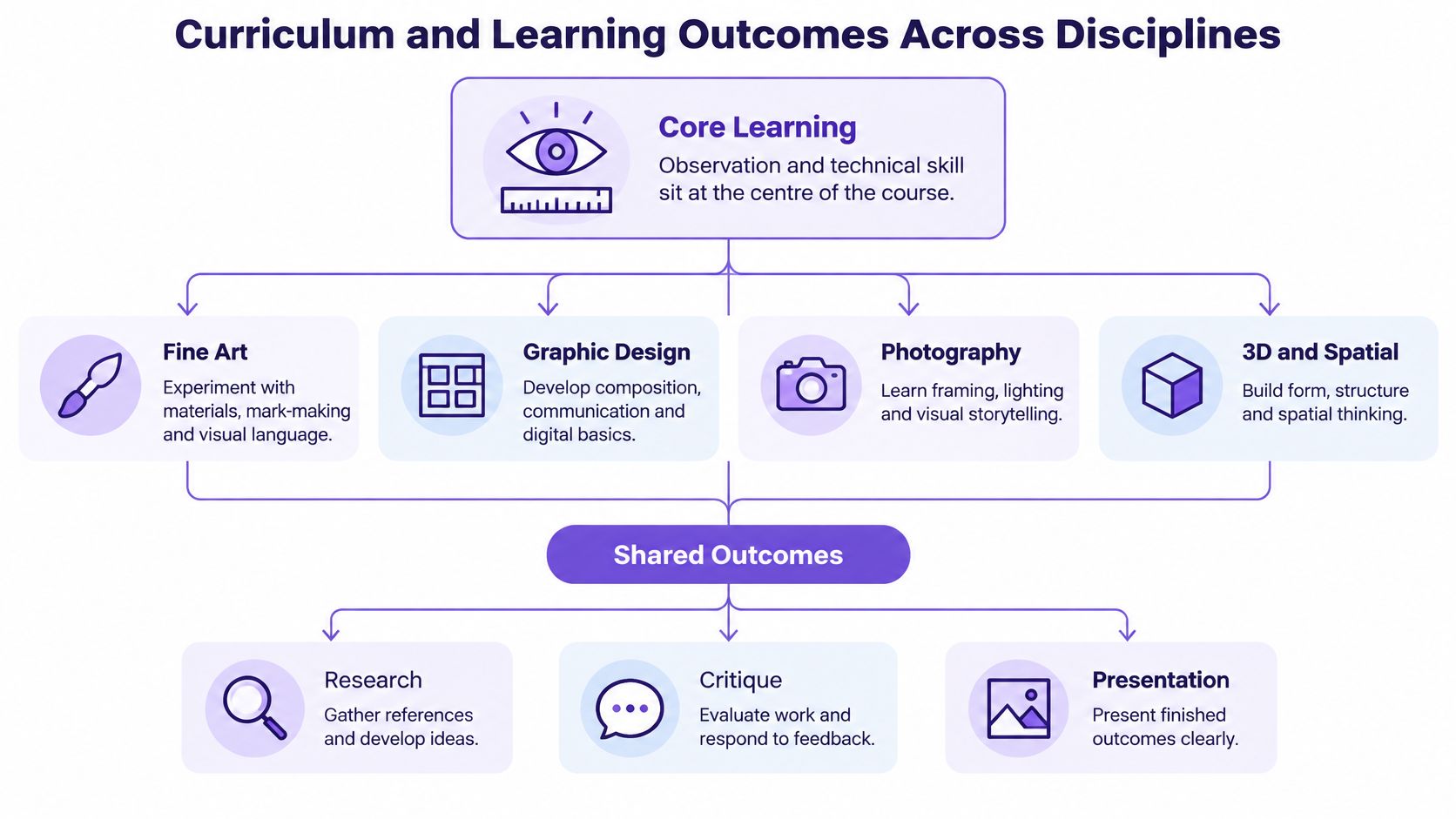
The core is observation and technical skill. You move across disciplines, but you keep returning to looking carefully, testing materials and explaining decisions. It's like learning each knife in a kitchen before deciding which one suits the dish.
| Discipline | Skills developed | Portfolio evidence |
|---|---|---|
| Drawing and observation | Volume, form, light and tonal relationships | Observational sketchbook pages and tonal studies |
| Painting | Oils, watercolour and acrylic handling | Finished studies in at least two media |
| Colour theory | Colour harmony and temperature | Annotated colour swatch sheets |
| Composition and perspective | Picture structure and perspective drawing | Thumbnail sketches and perspective studies |
| Mixed media and photography | Combining materials and documenting work | Experimental sheets and documented photographs |
| Art history and visual analysis | Reading and comparing artworks | Written annotations and reflections |
The Weekly Rhythm
A typical cycle runs brief, research, experiments, tutor feedback, refinement, written reflection. You don't just make a final piece. You show why you changed scale, swapped acrylic for collage, or cropped a photograph.
By the end, check yourself against clear outcomes:
- Observational accuracy: You can record form, proportion and tone from life.
- Technical control: You handle at least two media with intent, not accident.
- Experimentation: You test materials and keep the failures that taught you something.
- Evaluation in writing: You can explain strengths, weaknesses and next steps.
- Linked series: You communicate one idea across several connected pieces.
If you can't point to evidence for each outcome, that area needs another project before application.
Choosing a Specialist Route Once the Foundation Year Ends
Edit your work down and your direction usually gets clearer.

An Ofsted report on an Arts University Bournemouth foundation diploma found students first experimented across multiple art forms before specialising, then learned to edit work into a concise portfolio, with a very high proportion progressing to relevant higher education and around half entering degree courses at that university. Breadth creates comparison, and comparison produces a better choice.
Common routes include fine art, graphic design, fashion design, textile design, interior design, architectural design, film and animation, and photography. If textiles keep pulling you back, explore what a specialist course in textiles involves before you commit.
Use a Comparison Log
For each project, record four things in a notebook or spreadsheet. Note time spent, what sparked interest, feedback that recurred, and work you returned to voluntarily. Patterns beat gut feeling.
Watch how editing and selection work in practice before you finalise your own shortlist.
Then narrow with diagnostic questions. Do you prefer making objects, communicating to an audience, or working with space? Which discipline produced your strongest pieces, which feedback repeated, and which degree courses match that work?
Don't choose by reputation alone. Choose where your evidence is strongest.
How Foundation Courses Connect to Degrees and UCAS Points
A student finishes a Level 2 art certificate, applies to university, and finds it earns no UCAS Tariff points at all. This is the trap Level 2 applicants hit first. UCAS guidance on calculating Tariff points confirms that Tariff points apply to Level 3 and SCQF Level 6 qualifications, never to Level 2 awards such as GCSEs or their equivalents.
Level 2 still does useful work. It proves subject knowledge and opens the Level 3 step that does carry points. At OCAD, you can study A Level art or design without a GCSE in art if you hold an equivalent formal qualification such as a Level 2 Certificate, a BTEC, high school art or an Arts Award. The certificate itself runs as a standard two-year course or an intensive one-year option, so the step up can be shorter than many students expect.
| Starting qualification | Typical next step | UCAS Tariff points |
|---|---|---|
| GCSE or Level 2 Certificate in Art and Design | Level 3 foundation diploma or A level | None; Level 2 qualifications do not carry Tariff points |
| Level 3 foundation diploma | Degree in a related subject | Calculated from size and grade bands; check the exact listing |
| One-year Art Foundation | Primary route into some art and design degrees | Check each course listing |
Each Level 3 award produces its own points total. The UCAS Tariff technical FAQs explain that a qualification receives a size band from 1 to 4 and a grade band from 3 to 14, and multiplying the two bands gives the points. Two foundation awards at the same grade can land on different totals if their sizes differ, so check the exact listing for the award you plan to take.
Run the same check on funding. Many local authorities fund the Level 2 Certificate in Art & Design with SEND Support Package and the Level 3 Diploma in Design and Level 3 Diploma in Fine Art SEND Support Packages for students with an EHCP.
UCAS advice on choosing a course describes the one-year Art Foundation as widely recognised and a primary route into some prestigious degrees rather than a universal requirement, and it notes applicants can apply to up to five courses at once. Read each listing for its qualification, grade and portfolio rules before you shortlist.
Building a Portfolio That Shows Your Process
Your portfolio isn't only a gallery of best pieces. It's evidence of process. Sketchbooks, visual diaries, preparatory work and experiments show how you think, not just what you finished.

The University of Wales Trinity Saint David foundation course page reflects UK admissions practice where review may include preparatory work, sketchbooks, visual diaries, experimentation, technical skills and artistic direction. Excluding development work can disadvantage applicants whose final pieces are modest but whose experimentation is strong.
Formats differ by university, so follow each brief exactly and read guidance on what a portfolio for university should contain before you select images. For presentation, practical advice on presenting art to get noticed helps you sequence work so tutors see development, not a random dump.
Evidence Without a Studio
You don't need expensive equipment to build credible evidence:
- Observational studies: Draw everyday objects in pencil, pen or charcoal.
- Process logs: Date experiments and note what changed.
- Reflective annotations: Write two or three sentences beside key decisions.
- Iterative digital work: Save versions, not only the final export.
- Low-cost experiments: Use collage, cardboard, phone photography and found texture.
Tutors spot authentic development from sequence. They see a weak first test, a noted problem, a material change and a stronger outcome. Polished but context-free images don't tell that story.
Say you're home-educated and your final paintings are modest, but your sketchbook shows 30 dated observations, colour tests and honest reflection. That can be a strong application because it proves you can learn at degree level. If you're disabled, ask each university early about reasonable adjustments to format, deadlines or interview presentation.
What Foundation Courses Cost and How Online Study Works
Foundation does not automatically mean funded or cheap, especially if you are 19 or over. Two students can enrol on the same diploma and pay different amounts, because funding follows your age, qualification history and the exact qualification title, not the subject you pick.
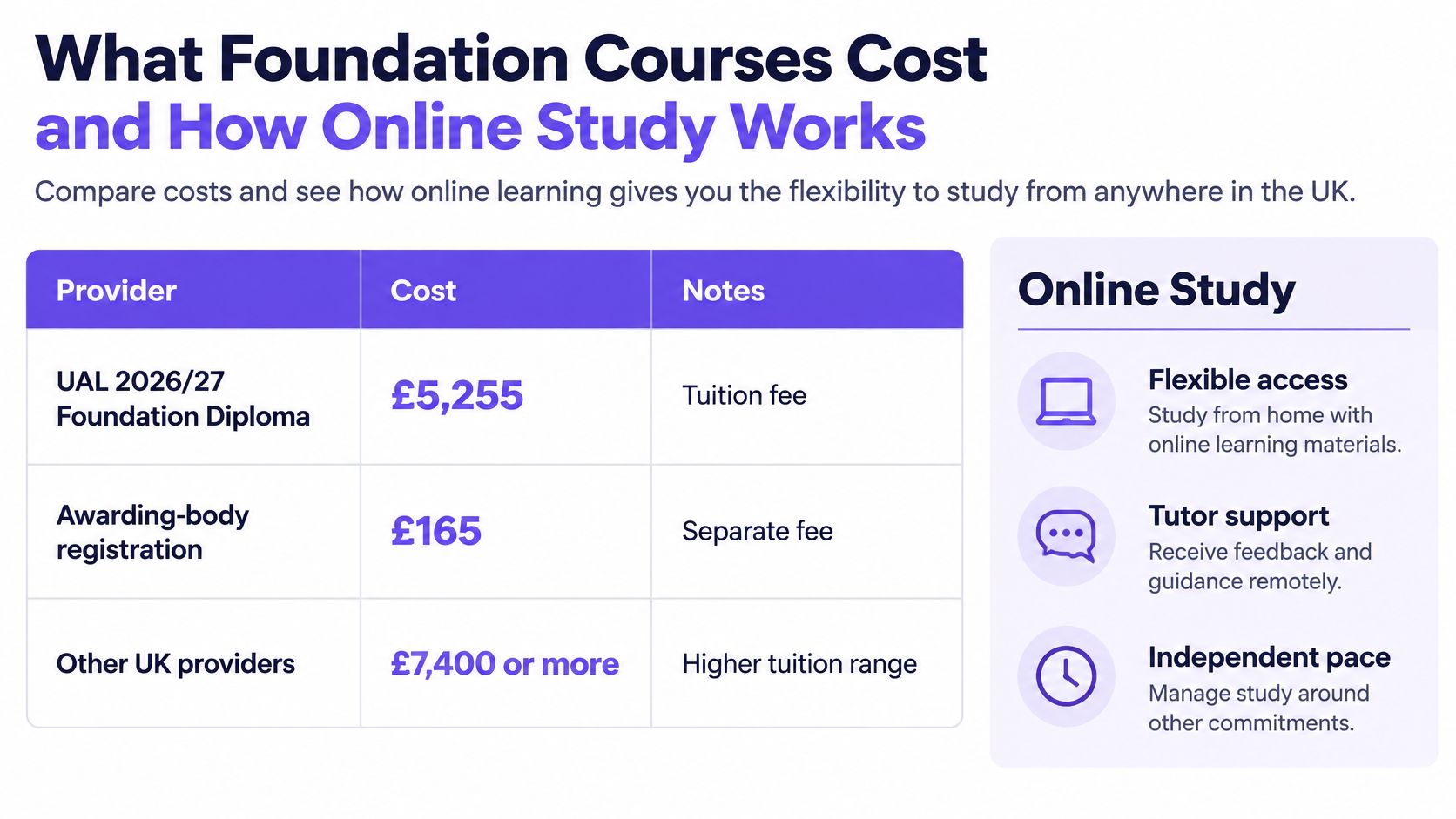
| Cost item | Figure | What to check |
|---|---|---|
| UAL Foundation Diploma tuition, 2026/27 | £5,255 | Confirm the fee category for your age |
| Awarding-body registration fee (UAL) | £165 | Added to tuition |
| Tuition at other UK providers | Set by each provider | Ask for a written fee schedule before you compare |
| Materials, travel and lost working time | Varies by course and location | List each cost separately before enrolling |
The UAL further education tuition fees page lists £5,255 tuition plus a £165 awarding-body registration fee for its 2026/27 Foundation Diploma. Other providers set their own figures, so ask each one what registration, assessment and studio access the headline fee includes before comparing.
The hidden costs are where budgets break. A funded place still leaves you paying for sketchbooks, paint, printing and trips to galleries, and part-time work lost to studio hours is a real cost even though no invoice shows it.
Check the level on the certificate too. Level 2 sits at GCSE equivalent, while Level 3 is the A-Level and Foundation Diploma equivalent that degree applications count on. A free Level 2 place is useful groundwork, but it will not do the job if your target degree expects Level 3. If you have an EHCP, many local authorities fund the Level 2 Certificate and Level 3 Diploma SEND support packages, so ask your authority before assuming you must self-fund.
Online study removes travel and relocation, and live tutor sessions, often run through Microsoft Teams, fit around work or caring responsibilities. The trade-off is discipline: you still buy materials and must protect regular studio time at home, because nobody timetables it for you. At OCAD we offer foundation diplomas across fine art, fashion design, textile design, interior design, architectural design, film and animation, photography and graphic design, with Level 2 and Level 3 routes plus SEND pathways that can be studied entirely online from home.
Frequently Asked Questions for Level 2 and Level 3 Students
Can I Apply Without a Formal Art Qualification
Often, yes, if the provider asks for a portfolio rather than an art GCSE. Build dated sketchbook pages, observational studies from everyday objects and short experiment logs at home. Check each entry statement, because some providers use an interview or short task instead.
Will a University Accept an Online Foundation Diploma
Delivery mode rarely decides admissions. The award title, Level 3 status, size and your portfolio matter more. Email admissions and ask in writing whether your target degree accepts that specific diploma.
Can I Change Specialism During the Year
Many programmes let you rotate in the first term, then settle. Rules and cut-off points differ, so ask before enrolment if you're still torn between, say, photography and graphic design.
What If My Target Degree Does Not Require a Foundation Year
Apply direct with a strong portfolio. Keep foundation as a fallback and use your five applications to compare both routes sensibly.
Is It Worth It If My Portfolio Is Already Strong
Only if you need to test disciplines, or the degree requires a Level 3 award you don't yet hold. If you've already got both direction and the right qualification, an extra year adds cost without adding much evidence.
Confirm Your Route Before You Enrol
Run this five-point check before you pay anything:
- Level fit: Confirm the qualification level matches your starting point.
- Hours fit: Compare guided hours and total study time with your weekly availability.
- Degree fit: Check exact entry requirements for grade, portfolio and interview.
- Portfolio fit: Read each target university brief, not a generic example.
- Fee fit: Confirm your fee category and funding status for your start year.
When you're ready to apply, use guidance on how to write a personal statement for a foundation art course to link your process evidence to your chosen route. At OCAD, students can skip A Level art and go straight to the Foundation Diploma, including the Online Foundation Diploma in Fine Art and the Online Foundation Diploma in Photography, and we offer online SEND art and design courses with fully accredited qualifications at Level 2 (GCSE/BTEC equivalent) and Level 3 (A-Level/Foundation Diploma equivalent).
If you need a flexible online route that builds a university-ready portfolio with tutor feedback, explore the foundation diplomas in fine art, photography, fashion, textiles, interior, architectural, film and animation, and graphic design at The Online College of Art & Design (OCAD). Check your level, compare the specialist options, and talk to a tutor about whether your target degree accepts the award before you enrol.