

You've got the sketchbook open on one side of the table and a blank document on the other. The portfolio is nearly finished, the final piece is dry, the annotation is legible. Then your tutor's message lands: artist statement, 250 words, due Friday. You've reread it four times hoping it means something else.
Most Level 2 and Level 3 students stall at exactly this point, and for the same reason. You've spent months making the work and about nine minutes thinking about how to describe it. The statement is a craft document with a shape, though, not a personality test. Every statement you write in the next two years is built from the same three movements: what the work investigates, how it's made, and why it matters now. Only the length and the voice change.
Table of Contents
- What an Artist Statement Is and How Long It Should Be
- How to Write Your Artist Statement Step by Step
- Prompts That Get the First Draft Moving
- Artist Statement Examples for GCSE, A Level and Foundation
- Tone and Word Choices That Build Trust
- Fitting Your Statement Around UCAS from 2026
- Questions Level 2 and Level 3 Students Ask Before Applying
- Revision Checklist and Your Next Step
What an Artist Statement Is and How Long It Should Be
An artist statement is a short professional document that explains the ideas, methods, materials and intended audience behind your work. It isn't a biography, a CV or a list of achievements. Getting that distinction wrong is the most common reason a strong portfolio arrives with a weak statement attached.
Length isn't a matter of taste. Every context you submit to sets its own target, and the target changes how you sound as well as how much you write.
| Where you use it | Target length | Voice | Keep in mind |
|---|---|---|---|
| UCAS personal statement (2026 entry) | 3 answers, 350+ characters each, 4,000 characters total | First person | Split evidence across all three questions |
| General portfolio statement | 150-250 words | First person | Your default draft length |
| Introductory or open-call statement | 100-200 words | First person | Artquest guide for short intros |
| Exhibition statement | Up to 1 page | Third person often preferred | Check the venue's own brief |
| Residency or funding application | 150-250 words or as specified | First person | Follow the funder's brief exactly |
That table turns a vague anxiety into a number. Write the number at the top of your draft page before you type a sentence, because drafting without a limit is how a 250-word statement becomes 700 words, and how your best material gets cut in a panic ten minutes before the deadline.
Selectors, curators and funders read statements in batches and reward claims they can check against the work. The field they work in is substantial: provisional government estimates published by DCMS valued the UK creative industries at £145.8 billion in 2024, equal to 5.5% of UK gross value added, with real-term growth 19.7% above 2019. Inside a sector that size, spanning visual arts, photography, design, film and digital practice, precise terminology is what separates your contribution from everyone else's. Vague promotional language costs you.
So give the statement one job and do it well: identify the central concern of your practice, describe the processes or materials that recur, and connect formal choices to meaning. Keep it grounded in observable work. Don't inflate your status, because a reader can tell the difference between a student who has exhibited once and one who claims a thriving professional career.
How to Write Your Artist Statement Step by Step
The sequence below produces both your short and your long version from one set of notes. It takes about an hour, and you can split it across two sittings.
The five stages fit together like this.
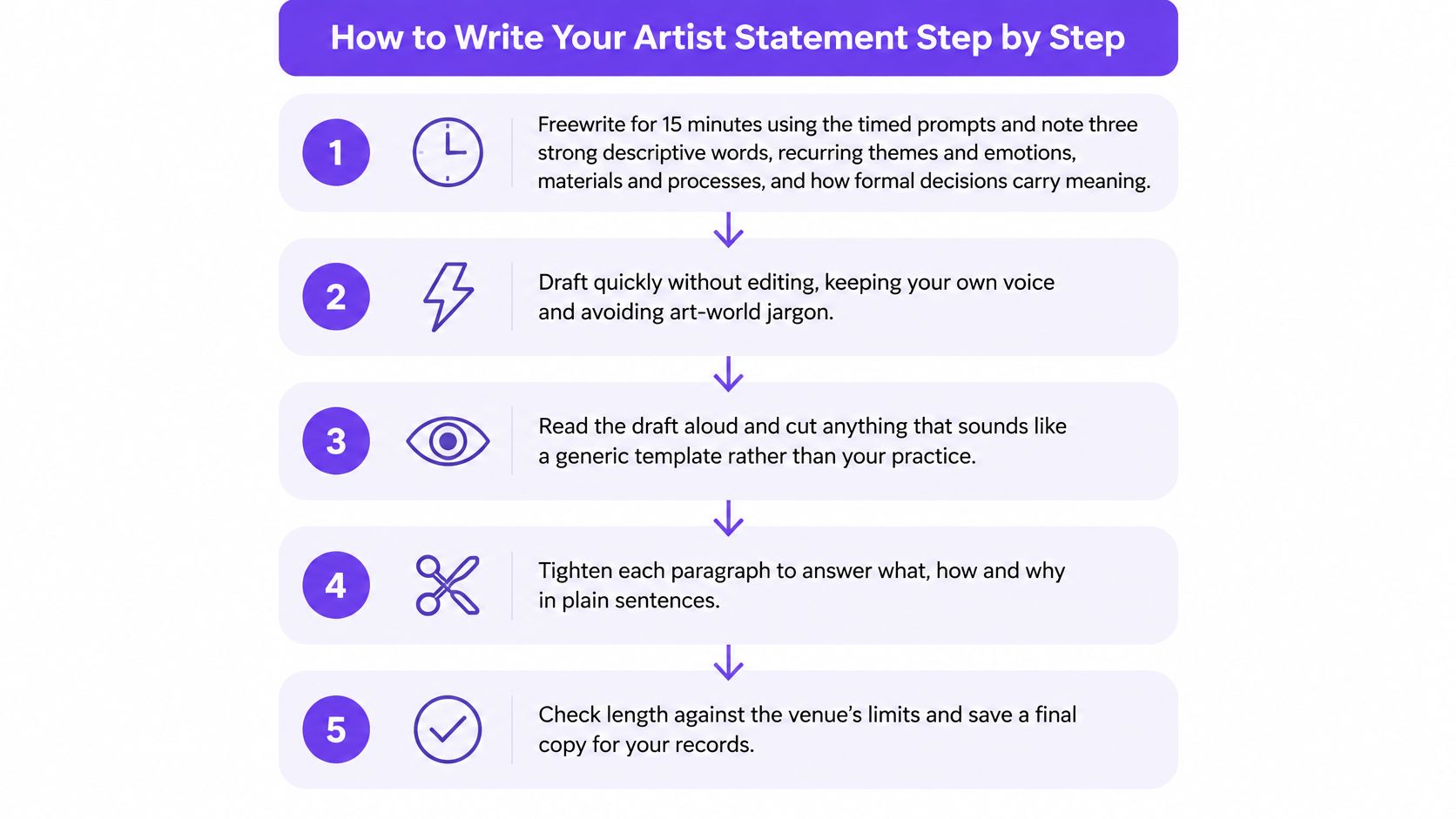
Freewrite for 15 minutes. Set a timer and keep your hand moving without editing. Record three strong descriptive words, the themes and emotions that keep returning, your materials and processes, and one place where a formal decision, such as a crop, a scale or a seam, changes what the work means. The rough notes hold the phrasing you'll reuse, and editing early destroys it.
Name the central concern in one sentence. Make it specific and arguable rather than a single theme word. Pin that sentence above your draft, because every paragraph should serve it. If the sentence would fit anyone in your class, it's still too broad.
Shape the notes into three paragraphs. Open with an overview of what you make and why, follow with a middle paragraph on media, processes and one or two named works, then close on why the approach matters now and what links the pieces. Artquest's artist statement guide sets out the same three-stage route of writing freely, converting the notes into paragraphs and editing for the specific opportunity.
Replace abstraction with observable evidence. Where you've written a theme, write the experience, cultural reference, visual strategy or research question underneath it instead. That's the difference between describing a category and describing your work.
Cut biography, philosophy, marketing language and theory used for effect. No childhood, no claims about art changing the world, no name-dropped philosopher. Keep specialist vocabulary, though, and define it in a clause, because knowing the terms of your discipline is part of what you're demonstrating.
Read it aloud and cut about a fifth. Your ear catches the sentence you wrote to sound impressive, and it catches the one that repeats the paragraph before. Then check that every claim points to a work, project or experience the reader can see.
Save two versions under clear file names. A short statement of about 100 words for forms and open calls, and the fuller draft for interviews and application questions. Artquest puts the introductory target at roughly 100 to 200 words and allows about a page at the top end, so the same notes have to stretch and shrink.
Where the draft usually goes wrong
The slip that costs most marks is writing about the idea and never about the making. If your middle paragraph could describe anyone's practice in your medium, you've skipped the part selectors read hardest, which is how the decisions got made.
Practical rule: if a sentence could sit in someone else's statement unchanged, it isn't evidence yet.
If your problem is structure rather than content, the outlining technique in this guide to how to outline a personal essay transfers straight across. Build the skeleton first, then improve the sentences inside it.
Prompts That Get the First Draft Moving
You have a page of notes, but the statement still feels out of reach. Start by choosing three prompts below and answering them in bullet points. Set a short timer, then underline details that are specific to your work.
| Prompt | What it uncovers | Use the answer in |
|---|---|---|
| Which materials do you reach for without thinking, and why? | Recurring media and the instincts behind them | How the work is made |
| Which piece taught you the most this year, and what did it teach? | Concrete evidence of development | How the work is made |
| What do you want a viewer to notice first, and what after that? | How formal choices carry meaning | What the work investigates |
| Whose work do you keep returning to, and what do you borrow from it? | Influences and research | What the work investigates |
| What question or argument runs through your recent projects? | Your central concern | What the work investigates |
| What would a stranger see if they watched you work for an hour? | Process in plain language | How the work is made |
| What have you changed your mind about recently? | Reflection and development | Why the work matters now |
| Where does your subject come from: place, memory, culture or news? | The context behind the work | Why the work matters now |
Use your answers to build three movements: what the work investigates, how you make it, and why it matters now. You do not need to answer every prompt. A few precise details will give you more to work with than a full set of broad opinions.
For UCAS 2026, map those movements onto the three questions: what interests you in the subject, how your studies and experience have prepared you, and what else you have done to prepare. The same detail can serve more than one question, but make its purpose clear each time.
When you begin drafting, use sentence starters as temporary scaffolding: “My work investigates…”, “I make… using… because…”, “Recent work has tested…”, or “I return to the work of… because…”. Delete the starter once you have found your own phrasing. To see how working artists describe their practice in public, read the statements published alongside gallery exhibitions and on artists' own websites, and notice how quickly the specific ones establish what they do. You can also browse creator workflows and examples.
Before expanding the draft, check each answer for a concrete anchor: a named place, material, technique, project or influence. If several ideas overlap, sketch their connections in an A Level art mind map. That can help you choose which thread belongs in the statement and which can stay in your notes.
Artist Statement Examples for GCSE, A Level and Foundation
Examples are where this clicks. Read the two below as structures, not scripts.
| Level | Selectors look for | Example sentence | Common slip |
|---|---|---|---|
| GCSE / iGCSE (Level 2) | Honest description of materials, process and a personal subject | "I build layered collages from bus tickets and old maps to trace the journeys I take across London." | Borrowing a professional artist's grand claims |
| A Level (Level 3) | Influences connected to your own decisions, not just named | "Adopting a restrained three-tone palette, my portrait series lets gesture read before detail." | Name-dropping artists without saying what you took from them |
| Foundation Diploma | A developing direction and informed next steps | "This term's installations tested how recorded sound changes a viewer's pace; next I want to work with interview audio." | Describing the course instead of your own practice |
Here's the shape working at Level 2.
My photographs document the shut shops of my high street. I shoot at dawn using a tripod and long exposures, so empty buildings appear solid while passing traffic blurs away. The series borrows the patient framing of documentary photography to ask who a high street belongs to when the businesses have gone.
Three sentences, three movements. The first names the subject, the second names the tools and the effect they produce, the third names an influence and turns it into a question. Concrete nouns carry it: shutter, tripod, traffic, shopfronts. Nothing in it praises the work.
At A Level, the same shape has to show a developing direction.
My series of graphite drawings maps the bus routes I take between two estates in Leeds. I work from memory on cartridge paper with a single soft pencil, so each line records a journey rather than a view. Using the restrained tonal method of graphite drawing, I flatten the sky into a pale wash so the roads become the only texture. The work asks how a city's daily routines shape what its residents notice, and next term I want to test whether a larger scale changes that reading.
What lifts it above the GCSE model is a named city, a technical choice with a stated consequence, and a next step. That last clause is what Foundation selectors are looking for in the table above: evidence that you can evaluate your own decisions.
Write two or three sentences at your own level using the same shape before you draft the full statement, then read them against your row. If photography is your medium, the sequencing advice in this guide to building a photography portfolio for college matters here too, because the order of works in the portfolio should match the order of ideas in your text.
Don't lift any of these sentences. Statements get checked for similarity, interviewers probe anything that sounds borrowed, and a copied phrase collapses the moment someone asks what you meant by it. Copy the shape, not the words.
Tone and Word Choices That Build Trust
Write in the first person with active verbs and concrete nouns. Keep specialist terms and define each one in a clause. Those three rules fix most weak statements before you touch the content.
Delete these on sight.
- "Passionate about art" says nothing a portfolio doesn't already say, and every second applicant uses it.
- "Since I was a child" spends your word count on biography instead of practice.
- "Thinking outside the box" and "unique vision" are marketing filler, not description.
- Rhetorical questions ("What is identity, really?") delay the point and read as an essay mannerism rather than an artist's voice.
Before-and-after pairs do more than rules. "I am passionate about abstract painting" becomes "I paint abstract seascapes that reduce the horizon to two bands of colour". "I experimented with many techniques" becomes "I tested cyanotype, then abandoned it when the blue overwhelmed the drawing". Each rewrite swaps a feeling for a decision.
There's a practical reason for the restrained tone. A UK government review of Arts Council England reported that the median annual income for a visual artist was £12,500, against £23,795 for full-time national minimum-wage employment, and that 73% of creative and cultural freelancers earned under £25,000 from freelance work, as recorded in Baroness Margaret Hodge's independent review. Hype reads badly next to those numbers. Communicate value through intellectual clarity, distinctive practice and evidence of development instead.
Frame uncertainty as enquiry. "I am currently testing whether…" is more credible than a claim of mastery, because any selector knows an early-career artist is still developing, and a statement that admits the experiment reads as honest rather than unfinished.
Then apply the confidence test to every line. Each sentence should describe a decision, a material or an effect the reader can verify in the portfolio. Delete anything that only praises the work, since selectors judge quality from the images.
Fitting Your Statement Around UCAS from 2026
For 2026 entry, the personal statement is no longer one uninterrupted essay. UCAS now asks three questions: why you want to study the subject, how your qualifications and studies have prepared you, and what you've done outside education to prepare. Each answer needs at least 350 characters, and the whole set stays inside 4,000 characters including spaces.
| UCAS question | What to include | Limit |
|---|---|---|
| Why do you want to study this subject? | Central concern, influences and why their work matters to yours | At least 350 characters |
| How have your qualifications and studies prepared you? | Projects, techniques, critique and portfolio development | At least 350 characters |
| What have you done outside education to prepare? | Exhibitions, galleries, competitions, sketchbook habits and independent projects | At least 350 characters |
| All three answers together | Overall limit including spaces | 4,000 characters |
Sort your existing statement material into those three boxes before you write a word of the application. Question one takes your central concern and the artists who shaped it. Question two takes specific projects, the techniques you learned in them, the critique that changed them and how the portfolio developed. Question three takes gallery visits, competitions, sketchbook habits and anything you built on your own initiative.
The art and design guidance from UCAS is blunt about what earns its place. Name the artists or designers who influenced you, explain why their work matters to yours, and discuss contemporary art, exhibitions or independently developed projects in terms of what they changed in your ideas or methods, as set out in UCAS advice for art and design applicants. The written statement accompanies the portfolio and interview. It never substitutes for either.
Write for the interview, not just the form: every sentence is an invitation to a question, so only claim what you can talk about for a minute without notes.
One thing you never have to include is a disclosure. Disabled applicants don't have to mention a disability or mental-health condition in a UCAS application, as UCAS explains on sharing a disability or mental-health condition; sharing it is entirely your decision. Universities must make reasonable adjustments under the Equality Act 2010 so disabled students aren't disadvantaged, and those can include flexibility with deadlines, alternative assessment methods, specialist equipment, extra examination time or an alternative exam location. Contact the university's disability or student-support adviser early to discuss accessible portfolio submission, assessment or interview arrangements, and keep the statement itself focused on your practice.
Questions Level 2 and Level 3 Students Ask Before Applying
Do I write one artist statement or a separate UCAS personal statement? Two documents, shared evidence. The artist statement serves portfolios and open calls, while UCAS asks three questions with their own minimum lengths and their own audience. Reuse the examples and the language about your process, never the identical sentences.
Can I use the same wording for my portfolio and my application? Only the specifics travel. Rewrite the framing for each reader, because a curator wants the work's context and an admissions tutor wants your readiness to study it.
What if I have no exhibitions yet? Use the evidence you do have: independently developed projects, gallery visits, sketchbook habits and tutor critique, all of which UCAS guidance welcomes. If you're unsure what to gather, start with what a portfolio for university expects and work backwards.
Do I need to mention a disability or mental-health condition? No. Disclosure is your decision, and you can ask your school or college adviser early about adjustments such as extra time, alternative assessment or specialist equipment.
Should I name artists who influence me? Yes, but explain what you took from each one and which decision in your own work it changed. A name alone is decoration.
Does a statement have to be in the first person? For almost every student submission, yes. Check the brief for exhibitions or funders that ask for the third person, and follow their format.
Revision Checklist and Your Next Step
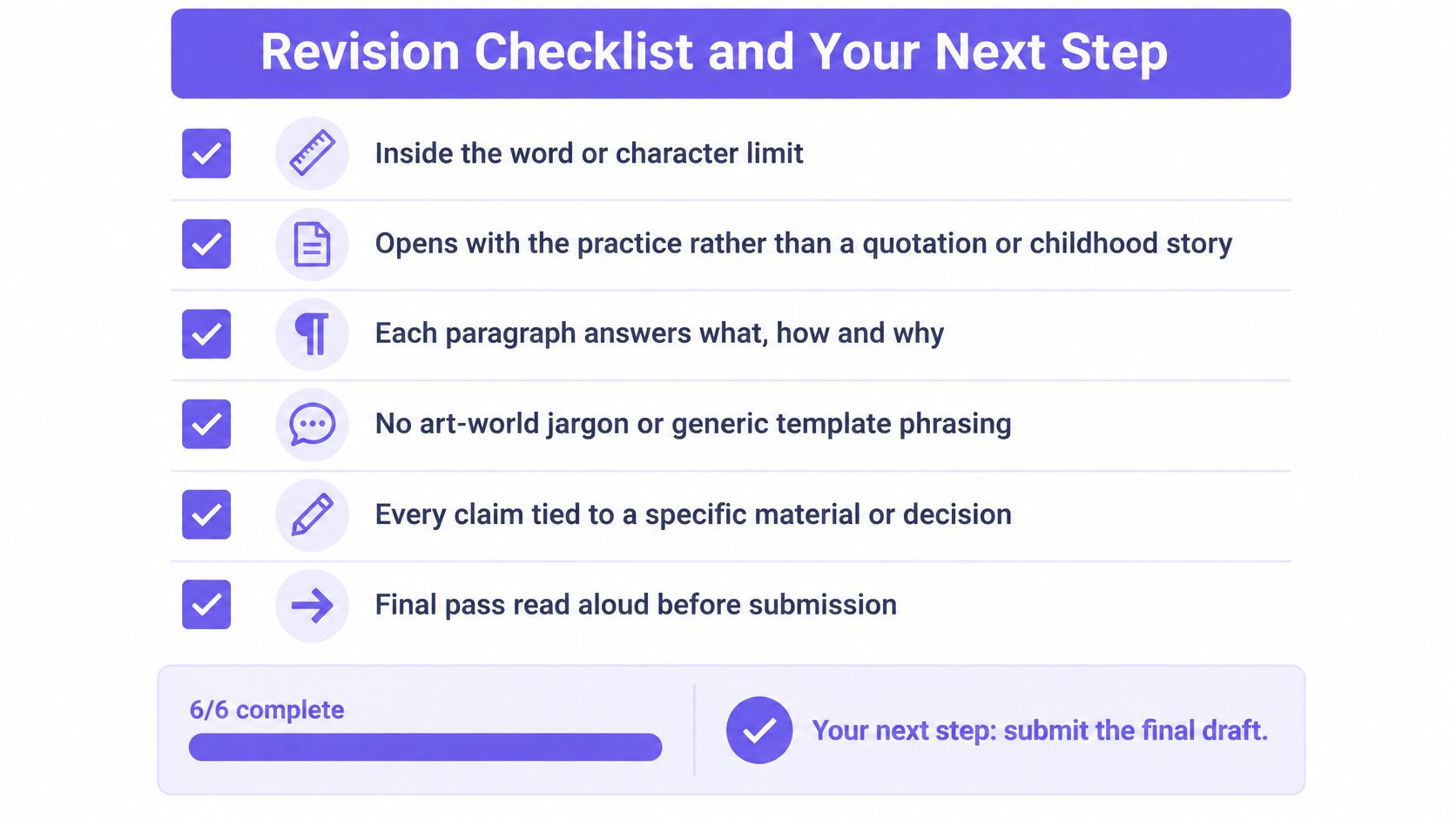
A clear statement gives a reader a route through your work: what it investigates, how you made it and why it matters now. Check that route before you submit.
- Limit: Stay within the word or character count for this submission.
- Opening: Begin with your practice, not a quotation or childhood story.
- Paragraphs: Give each one a clear job: what, how or why.
- Evidence: Support each claim with a work, material, project or exhibition.
- Language: Cut clichés, biography and marketing copy. Define specialist terms.
- Spelling: Check UK forms, including colour, realise and centre.
- Short version: Save a 100-word statement alongside the full draft.
- Fresh eyes: Ask a tutor, teacher or peer to read it.
Use the checklist as a review card, moving from the first line to the final detail.
Choose one useful action today. Ask your tutor for feedback on your statement at least two weeks before the deadline, so there is a clear day to rest between drafts and you return to the page with fresh judgement. At OCAD, tutors support students in creating and presenting assessment evidence. Students upload photographs of completed work and assignments during their course to receive feedback and build an art portfolio. This can help you develop the statement alongside the work it describes. Put the deadline, target length and a 15-minute freewrite in your calendar.
The Online College of Art & Design (OCAD) offers flexible, tutor-led online courses, including Level 2 Certificates, iGCSE, A Level and Level 3 Foundation Diplomas. Assignments are set and marked at OCAD, with constructive feedback. Students upload photographs of completed work as they progress, and tutors guide them in creating and presenting assessment evidence. Visit The Online College of Art & Design (OCAD) to explore the courses and apply using a short form.