

Practical music-making accounts for 60% of AQA A Level Music, according to the AQA scheme of assessment. That changes how you should approach the course: practising, recording and developing compositions need protected time, not whatever's left after written revision.
An A Level Music syllabus is therefore more than a list of topics. It's a plan for producing convincing musical evidence while learning to explain what you hear. Whether you're progressing from Level 2, studying at home or returning to education before university, the key is to understand what you'll submit and how you'll build it.
Table of Contents
- How the A Level Music Marks Are Split
- Listening and Appraising in the Written Exam
- Performance Requirements and the 10-Minute Minimum
- Composing a Brief Piece and a Free Piece
- How Exam Boards Vary in Weighting and Evidence
- Areas of Study and How They Link to Each Component
- How to Plan Practice Across All Three Strands
- Confirm the Board and Plan Before You Enrol
How the A Level Music Marks Are Split
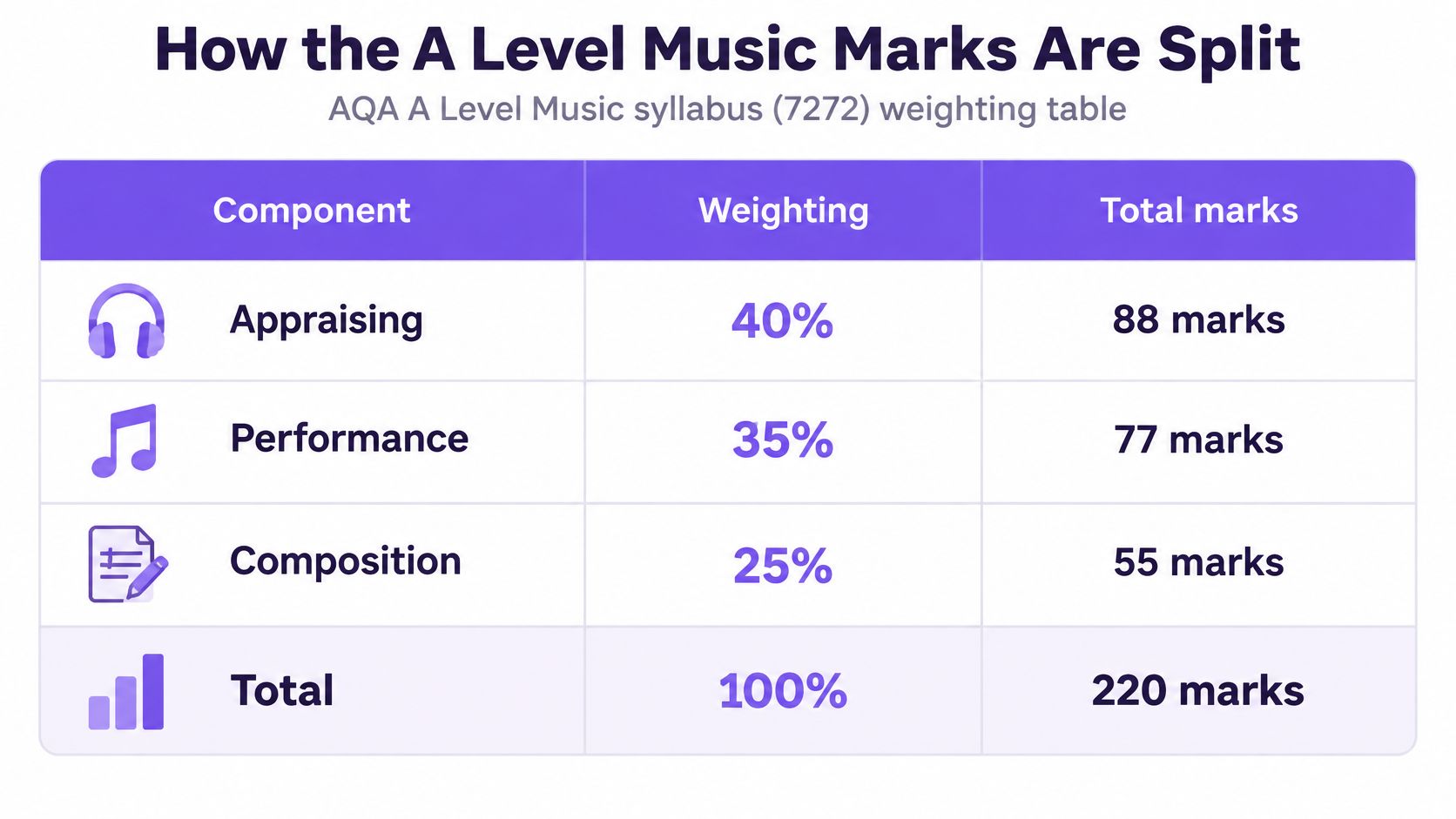
AQA A Level Music assessment weightings
| Component | Weighting | Marks | Minimum evidence |
|---|---|---|---|
| Appraising, written exam lasting 2 hours 30 minutes | 40% | 120 | Western classical tradition 1650–1910 plus selected additional areas of study |
| Performance | 35% | 50 | At least 10 minutes of music |
| Composition | 25% | 50 | Two pieces, at least 4 minutes 30 seconds in total |
| Total | 100% | 220 raw marks | 60% practical, 40% written |
These are the component requirements in AQA's scheme of assessment. Performance can involve solo playing, ensemble work or music production technology; composition combines an externally set brief with a freely composed piece.
The written paper is the largest single assessment, yet 120 raw marks still count for 40%, less than the combined practical share. A confident essay writer needs dependable recorded evidence, and a strong performer still has to build listening and analytical writing.
Raw marks are not the same as weighted contributions
Read the marks column as the raw marks available on each component: 120 for appraising, 50 for performance and 50 for composition, totalling 220. The weightings, 40%, 35% and 25%, decide how much of the final grade each component carries.
Adding raw marks treats one appraising mark as equal to one performance mark, which the weighting does not allow. Practical work works like a lever: fewer raw marks carry a large share, so missed recordings or incomplete compositions can pull down the final grade faster than their small mark totals suggest.
Planning rule: Give practical work the larger share of independent study time, while protecting regular written practice instead of leaving it for revision season.
What does this mean for your workload?
Performance grows through repeated attempts, listening back and targeted correction. Composition grows through drafting, testing and revision. Both need scheduled time across the term, with recordings and drafts saved before deadlines approach.
Set up three evidence folders in week one: appraising, performance and composition. Keep score annotations and listening notes separate from recording exports, and label composition sketches differently from files intended for submission. When the brief piece and free piece start to compete for time, move the easier draft forward rather than polishing one until the other stalls.
Build the timetable around the 60% practical and 40% written balance, then adjust to weaknesses. If playing is secure but harmonic explanation is thin, add short analysis sessions while keeping the practice routines that maintain accuracy and stamina.
Listening and Appraising in the Written Exam
The appraising paper asks you to listen accurately, analyse musical choices, understand context and build a written argument. For AQA, that includes the specified Western classical tradition and your selected additional areas.
A strong answer works like a courtroom case. Listening supplies the evidence, and extended writing builds the argument. Naming an instrument is evidence of recognition; explaining how its entry changes the texture and supports the composer's purpose is analysis.
Appraising questions reward analysis and judgement as well as recall of knowledge, so remembering terminology is not enough on its own. You need to use it to make a defensible judgement about the music in front of you.
Move from description to explanation
A descriptive answer might say that the strings repeat a rhythmic figure. An analytical answer explains how that repetition maintains momentum beneath a changing melody, then connects the observation to the passage's character.
Resist attaching a historical label to every feature automatically. Explain the relationship between what you hear and the context you have studied, using a precise score reference where possible.
This is also where the workload hides. Each exam-style answer needs a listening session, a plan and a timed draft, so weekly written practice costs more time than a single sitting suggests. Try this sequence:
- Listen with the score. Follow entries, cadences, changes of texture and important motifs.
- Build an event timeline. Write brief observations in musical order rather than collecting disconnected terms.
- Choose a question. Decide which observations support an answer.
- Write under time pressure. Practise finishing an argument, not just producing an elaborate opening.
- Review against the criteria. Highlight evidence, explanation and judgement in different colours.
Is weak theory a barrier to progression?
For a Level 2 learner considering A Level, gaps in notation or harmony are a reason to prepare rather than a reason to assume you cannot progress. Identify the exact difficulty: reading rhythms, recognising intervals, naming chords or understanding cadences.
Structured online music theory courses can support that preparation. Apply each concept to a piece you are studying so that theory stays connected to real music instead of becoming a separate vocabulary exercise.
As a readiness check, choose a short passage and identify several distinctive features. Can you explain their effect, connect them to context and justify your interpretation in a coherent paragraph? That is more useful than recognising terminology without being able to use it.
Performance Requirements and the 10-Minute Minimum
AQA requires at least 10 minutes of performance, allowing solo and/or ensemble work, performance on an instrument or voice, or music production using technology, as set out in its specification at a glance.
Treat the recording as your exam hall. The assessor can judge the performance you capture, not the more convincing version you played during practice.
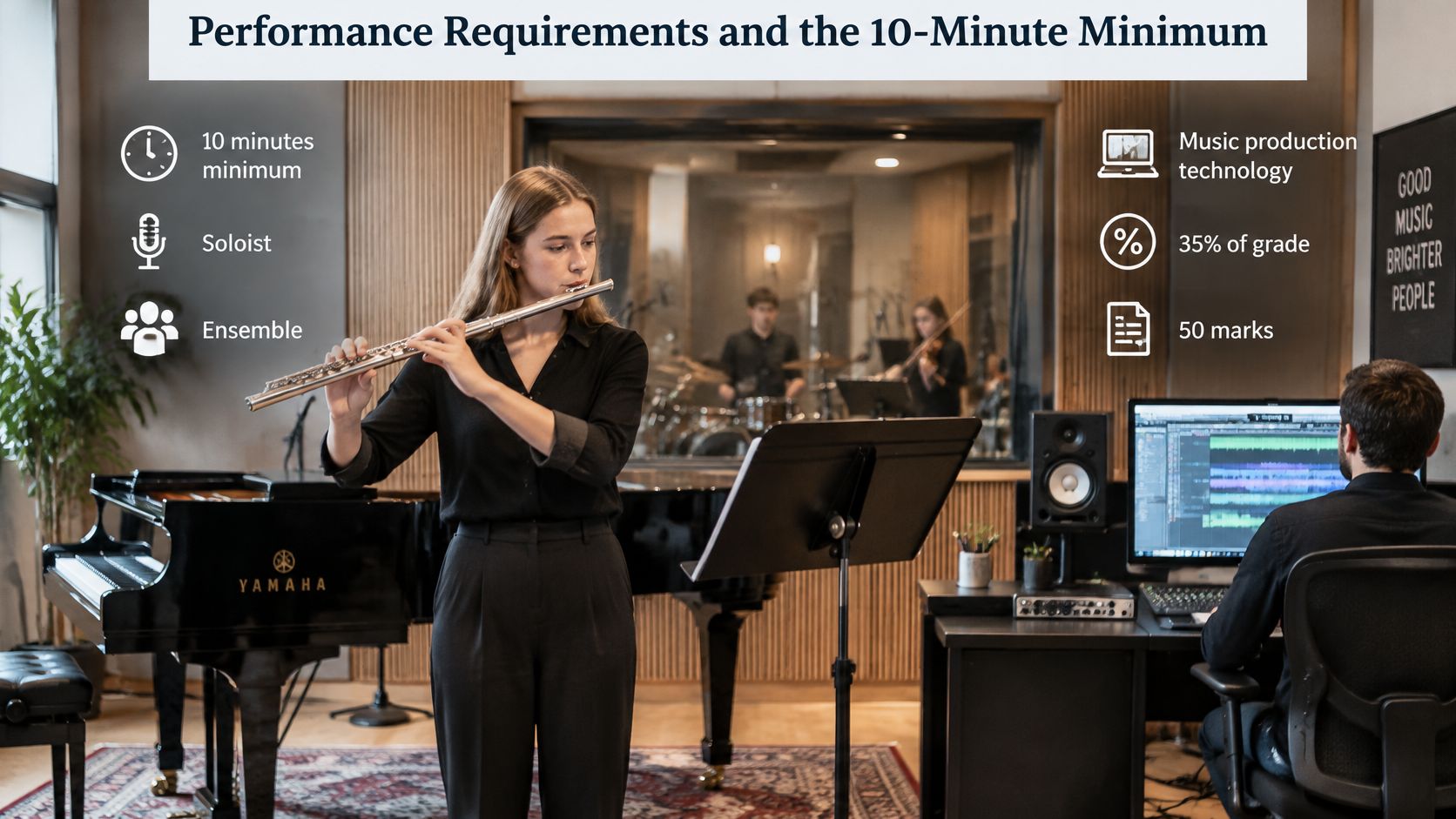
Technical control, expressive interpretation and stylistic awareness need to work together. Recording quality must allow the assessor to hear those qualities clearly, although expensive equipment isn't a substitute for musical preparation.
Schedule the performance backwards
- Approve repertoire by a fixed date. Ask whether each piece suits your technical level and provides enough musical substance.
- Capture a draft recording. Use it to test stamina, pacing, balance and the recording setup.
- Receive tutor critique. Request specific priorities rather than a general judgement that it sounds promising.
- Repair technical weak spots. Isolate unstable transitions, uneven articulation or insecure entries before returning to complete run-throughs.
- Capture final evidence. Follow your centre's rules for takes, supervision, authentication and permitted editing.
A draft recording often exposes problems that disappear during stop-start practice. A passage might be secure in isolation but unreliable after a demanding opening, for example.
A recording checkpoint should tell you what to practise next, not merely prove that you practised.
Can you study without a school ensemble?
Solo and production routes mean that an ensemble isn't the only possible starting point. However, agree your route with the provider before preparing assessment material.
If you record parts separately, keep a track sheet identifying what you performed, what was pre-existing and how the material was assembled. Ask your tutor which documentation the specification requires and which files are useful supporting evidence; don't assume any multitrack project automatically qualifies.
Build a repertoire buffer rather than aiming at the exact minimum. As a planning example, preparing eleven or twelve minutes can give you options, but check the duration of the final approved submission: removing a track may still leave you short.
Composing a Brief Piece and a Free Piece
The brief composition tests how you respond to a commission. The free composition gives you room to choose the musical direction and demonstrate personal control.
For AQA, the portfolio combines these contrasting tasks within the composition allocation shown in the assessment table. Each piece needs a clear musical purpose; freedom doesn't mean a lack of structure.
Think of it as a client commission. Before writing, identify the intended audience, performing forces, musical constraints and the desired outcome.
The free piece is closer to a portfolio project. You choose the problem, but you still need to solve it convincingly through development, pacing and coherence.
Make your decisions visible
Start a documentation habit alongside the music:
- Keep dated sketches. Save melodic fragments, harmonic experiments and structural plans, including ideas you later reject.
- Preserve project versions. Use clear filenames in Sibelius, MuseScore, Logic Pro, Cubase or your chosen software.
- Explain revisions briefly. Note why you shortened an introduction, changed a register or altered the bass movement.
- Export listening copies. Compare successive versions away from the notation screen or arrangement window.
These working files help you discuss your process and establish how the piece developed. They aren't automatically substitutes for the score, recording or other submission materials your board requires.
Can production-based work demonstrate composition?
Yes, production tools can support musical development, but distinguish composing from polishing a mix. Changing the EQ on an unchanged loop isn't the same kind of decision as developing its rhythm, harmony or formal role.
Keep session files, relevant stems and bounce versions as a working trail. Ask your tutor how to document musical ideas that aren't fully represented by conventional notation.
Avoid the late-start trap: Don't leave the free piece until the final month simply because it has no externally imposed starting point.
Begin with a manageable idea and test whether it can develop. A short motif that changes meaning across contrasting sections is often more productive than a collection of unrelated attractive sounds.
Allow extra time to interpret the brief before committing to an approach. You can explore free-composition ideas alongside that process, rather than treating the tasks as completely separate seasons of work.
How Exam Boards Vary in Weighting and Evidence
Two students can both take A Level Music and end up with noticeably different weekly workloads. The written exam holds a similar share across specifications, but the practical 60% is divided differently from board to board. One specification weights performance above composition, another treats them equally, and a third lets composition carry the larger share. The government subject-content framework sets the common ground for what the qualification covers, while each awarding body publishes its own weightings, minimum timings and evidence rules.
Typical performance and composition combinations
| Performance weighting | Minimum performance | Composition weighting | Minimum composition and pieces |
|---|---|---|---|
| 35% | 10 minutes | 25% | 4 minutes 30 seconds, two pieces |
| 30% | 8 minutes | 30% | 6 minutes, two pieces |
| 25% | 6 minutes | 35% | 8 minutes, three pieces |
Rows like these show the range of balances boards have used. Your provider teaches one specification, so the figures that govern your planning are the ones in that document, including any evidence a board asks for beyond the stated minimum.
A lower performance share still means heavy practical work
The weighting decides where your weekly hours go. A performance-heavy balance means longer rehearsal blocks and an earlier recording deadline. A composition-heavy balance means more time in the score or session file, a larger evidence folder of drafts and revisions, and sustained assessment right up to submission. Neither route lightens the practical load; it relocates it.
Check these details before comparing courses:
- Your assessment route. Confirm the actual balance offered by the provider.
- Your evidence requirements. Record durations, piece counts and the brief requirement.
- Your musical priorities. Consider whether your strengths lie in interpretation, composition or production.
If your main interest is studio practice, compare the separate A Level Music Technology route rather than assuming that Music and Music Technology assess the same skills.
Areas of Study and How They Link to Each Component
Think of areas of study as supporting pillars, not isolated revision topics. The government's music subject content requires students to study at least three areas in depth, while specifications must offer at least four overall.
That distinction is easy to miss. The breadth available in a specification isn't necessarily the number of areas each learner must study in depth.
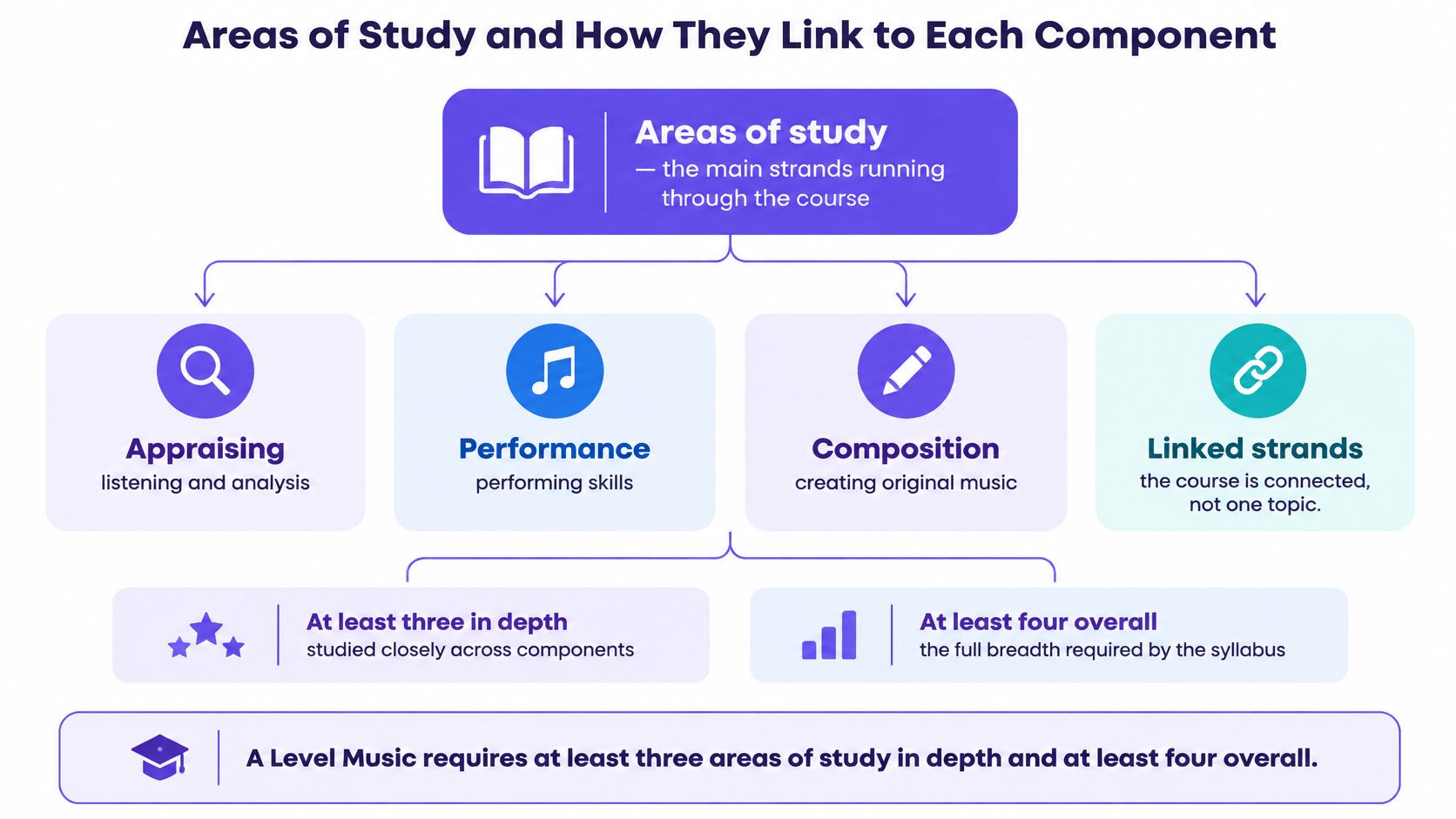
Across the course, you develop musical elements, musical contexts and musical language. You then apply that understanding through performing, composing and appraising.
Connect an area to practical tasks
Say you're studying a Classical-period movement. In performance, you might investigate phrase shaping, articulation and the balance between melody and accompaniment.
In appraising, you could examine how cadences establish structure and how the composer creates contrast. In composition, you might experiment with related phrase structures while developing your own material rather than copying the piece.
| Capability | Useful question |
|---|---|
| Performing | How should I make this musical relationship audible? |
| Composing | How could I develop a related technique in original material? |
| Appraising | What evidence supports my interpretation? |
The connection makes your study more efficient, but it doesn't mean any chosen piece satisfies every assessment requirement. Confirm repertoire suitability and area-of-study coverage separately.
What should a Level 2 student prepare?
Build the habit of moving between sound, notation and explanation. The guide to what GCSE Music involves can help you identify foundations to strengthen before progressing.
You don't need to treat historical knowledge as a detached list of composers and dates. Ask how context affects instrumentation, musical conventions and performance choices.
For university preparation, practise explaining connections clearly. Being able to discuss why you interpreted a phrase in a particular way is more revealing than saying only that you enjoyed the piece.
How to Plan Practice Across All Three Strands
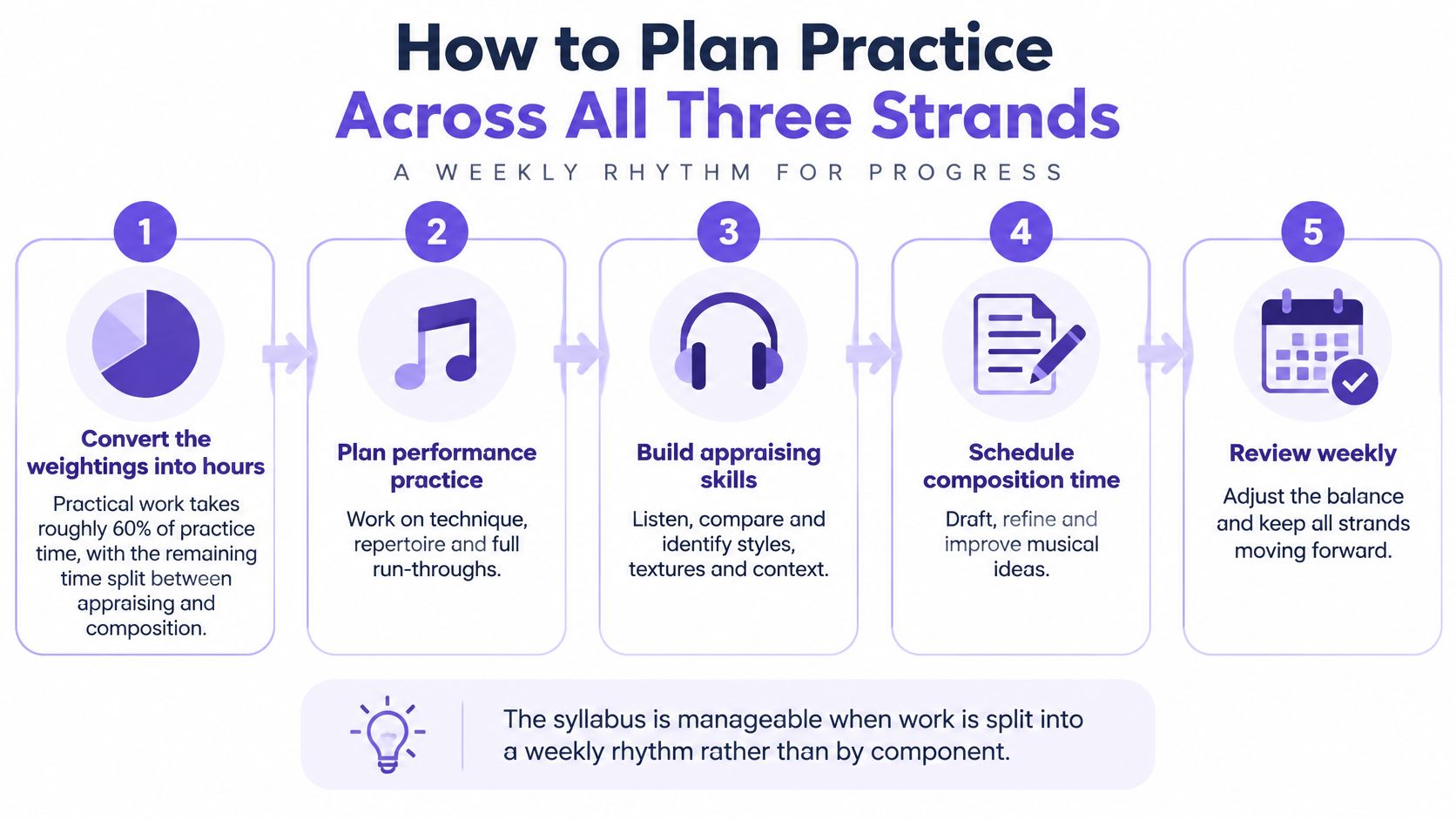
- Convert the balance into hours. In a hypothetical ten-hour independent-study week, you might reserve six hours for performance and composition together and four for appraising. Adjust that starting point with your tutor.
- Set repertoire approval early. Put an actual decision date in your calendar, not an open-ended intention to choose pieces.
- Schedule recording checkpoints. As a suggested routine, record every two to three weeks and give each recording a specific purpose.
This prevents equipment problems and unsuitable repertoire from becoming deadline emergencies. If you don't have an ensemble, agree a viable solo or production plan before booking assessment-related recording time.
Give every session a deliverable
Composition belongs inside practical work, not outside it. In your calendar, distinguish performance practice, composing and appraising so you can see whether a strand is being neglected.
- Alternate listening and writing. Follow score study with an analytical response while your observations are fresh.
- Book a feedback cycle. For example, agree fortnightly tutor reviews, with material submitted in advance and actions recorded afterwards.
- Organise evidence folders. Store dated scores, briefs, recordings and feedback under clear component names.
- Test your recording setup. Check microphone placement, input levels, room noise, file export and playback before a deadline approaches.
A useful session ends with something identifiable: an annotated passage, a revised transition, an exported draft or a recorded run-through. Time spent opening software and deciding what to do shouldn't consume the whole session.
If work or caring responsibilities interrupt your timetable, reduce the size of the task rather than dropping a strand entirely. A focused listening note or revised phrase can maintain continuity.
Make revision serve the music
For written preparation, Documind's effective study methods for final exams provide a useful starting point for organising revision. Apply revision techniques to musical tasks, such as recalling a work's structure before checking the score.
For practical work, judge progress through evidence rather than familiarity. A piece can feel comfortable because you've played it often while still containing the same unresolved weaknesses.
Keep a short review note after each feedback session: what needs changing, how you'll practise it and what you'll bring next time. That turns critique into a scheduled action.
Confirm the Board and Plan Before You Enrol
Choose your route by answering these questions: does the specification suit your goals, can you produce the evidence where you live, and can you maintain a dependable feedback cycle? A flexible course still needs firm assessment arrangements.
Use this enrolment checklist:
- Access and equipment. Confirm suitable instruments, production tools, recording space and any ensemble access you'll need.
- Current skills. Ask for an honest assessment of your playing, technology skills, notation and analytical writing.
- Available study time. Compare your realistic weekly timetable with the portfolio and examination demands.
- Teaching support. Establish whether individual tuition is needed and who will review practical drafts.
Will this route support university applications?
For Level 2 students, the immediate question is whether the course provides a realistic progression into advanced study. For Level 3 students, check the entry requirements of individual degrees, including any audition, portfolio or subject expectations.
A Level Music can develop relevant academic and practical skills, but don't assume it guarantees admission or is compulsory for every music-related degree. Compare the qualification with vocational alternatives against the courses you want to apply for.
The Online College of Art & Design (OCAD) is one online option offering tutor-led creative study, including A Level Music. Ask which specification applies to your intake and how recording feedback, tutor critique and assessment arrangements work for learners without a school music department.
Request the specification and scheme of assessment before committing. This week, put the board, minimum evidence requirements and agreed feedback date on a single page, then book your first recording checkpoint.
The Online College of Art & Design (OCAD) offers online creative courses, including A Level Music, with tutor-led study and assignment feedback. Visit The Online College of Art & Design (OCAD) to discuss the current specification, practical assessment arrangements and support for building a manageable study plan.