

Forty guided hours is the benchmark for a formal music theory foundation at SCQF Level 7. A whole GCSE Music course, which also covers performance, composition and listening, runs to 120 to 140 guided hours; A Level Music reaches about 360 guided hours. Those totals describe different qualifications.
Weekly hours turn them into calendar time. At 3 hours a week, 40 hours takes about 13 weeks; at 5 hours a week, about 8. A steady weekly slot matters more than counting months.
Table of Contents
- How Long Music Theory Takes at a Glance
- What Speeds Up or Slows Down Your Progress
- Beginner, Intermediate and Advanced Milestones
- Staged Study Plans from Foundation to University Entry
- Weekly Practice Routines That Shorten the Timeline
- Frequently Asked Questions for Level 2 and Level 3 Students
- Choose Your Target Level Before You Enrol
How Long Music Theory Takes at a Glance
At three hours a week, the Scottish Qualifications Authority's 40-hour Music Theory unit stretches to about 13 weeks. At five hours, it fits into eight. The SQA Music Theory unit has a notional design length of 40 hours at SCQF Level 7, covering notation, musical structures, harmony and analysis for learners studying HNC or HND Music. That scope matters. This is a post-beginner formal foundation for learners who already have some basics, not a universal introductory syllabus, and the SQA states that the learning centre sets the precise time allocation.
For a full school qualification, the WJEC GCSE Music specification allocates 120 to 140 guided learning hours to the whole course. Those hours include performance, composition and listening, not theory alone. The OCR A Level Music specification assigns 360 guided learning hours to the full A Level Music qualification.
Guided hours measure the length of a syllabus, not the time you will personally need, just as a recipe's oven time does not account for how quickly you chop. They are a planning benchmark.
Guided hours and calendar weeks by milestone
For an introductory vocational comparison, RSL's Music Practitioners framework lists 60 guided hours for a Level 1 Award and 120 for a Level 1 Certificate. The calendar estimates below are arithmetic conversions of these qualification benchmarks, not awarding-body completion guarantees.
| Milestone | Guided hours | At 3 hours a week | At 5 hours a week |
|---|---|---|---|
| Introductory notation and terms, RSL Level 1 Award to Certificate benchmark | 60-120 | 20-40 weeks | 12-24 weeks |
| Foundation unit benchmark, SQA SCQF Level 7 | 40 | About 13 weeks | 8 weeks |
| Full GCSE Music course (theory, performance, composition and listening), Level 2 | 120-140 | About 40-47 weeks | 24-28 weeks |
| Full A Level Music course (theory, performance, composition and listening), Level 3 | 360 | 120 weeks | 72 weeks |
To read the table, divide the target hours by the weekly time you can realistically protect. The same 120 hours becomes 40 weeks at three hours a week and 24 weeks at five hours a week. Weekly consistency matters more than the total months because missed weeks do not recover themselves. Treat the introductory RSL row as a qualification-size comparison, not a claim that those awards consist entirely of notation lessons.
What the table doesn't measure
Guided learning means structured teaching or supervised activity. Independent revision, practice, composition drafting and preparation may add to that workload. The SQA figure is a notional unit length, so it is not identical to every other measure in the table.
Planning rule: Use qualification hours to estimate your workload, then use assessment and tutor feedback to judge readiness.
Do not add every row together. These are alternative reference points with overlapping content, not consecutive blocks that everyone must complete. Find the row closest to your intended outcome, then check whether its content matches what you need to learn.
What Speeds Up or Slows Down Your Progress
A fixed number of months tells you little without knowing what happens during those months. Prior musical knowledge, reading fluency, ear training, weekly hours, study frequency, instrument access and a defined goal all affect your starting point.
A pianist may already recognise key signatures and chord shapes but struggle to explain them in writing. A producer may hear harmonic relationships confidently while needing explicit teaching in stave notation. Neither learner is starting from nothing, but they need different exercises.
The ABRSM Making Music 2025 survey reports that 6% of people study music theory, while 23% have taken a music exam. Among learners who play an instrument, average practice frequency falls from 10 days per month in primary-age children to 3.5 days per month in older adulthood. Those findings describe participation and routines, not how quickly an individual can learn.
Diagnose the obstacle before adding hours
Use a short passage of music to identify what's slowing you down:
- Reading difficulty: Name the notes, then clap the rhythm separately before combining them.
- Uncertain harmony: Build the chord on a keyboard and label its notes.
- Weak aural recognition: Sing the interval, play it and compare the sound with its written form.
- Unclear purpose: Decide whether you're preparing for an exam, composing or improving score reading.
Short, regular sessions give you repeated opportunities to retrieve information. An occasional marathon can feel productive while leaving long gaps in which you don't use what you've learned.
For SEND learners, avoid treating standard notation speed as the only evidence of progress. Adapted notation, spoken explanations, aural demonstrations and tutor-supported tasks can help reveal musical understanding without confusing access difficulties with lack of ability.
Estimate your available hours from sessions you've kept recently, not from an ideal diary. A sustainable routine is more useful than an ambitious timetable you abandon.
Beginner, Intermediate and Advanced Milestones
A milestone is a task you can complete without help, not a page you have finished reading. You might know exactly what a cadence is and still miss one when it passes in the middle of a piece. Milestones test whether the knowledge is usable yet.
Practical music grades are often compared loosely with qualification levels, and that comparison is useful mainly as a rough guide to demand. Grades sitting at Level 1, Level 2 and Level 3 suggest increasing depth, but no grade maps neatly onto school or exam-board content. Treat the levels as a ladder of expectation, not three versions of the same workload.
Beginner understanding
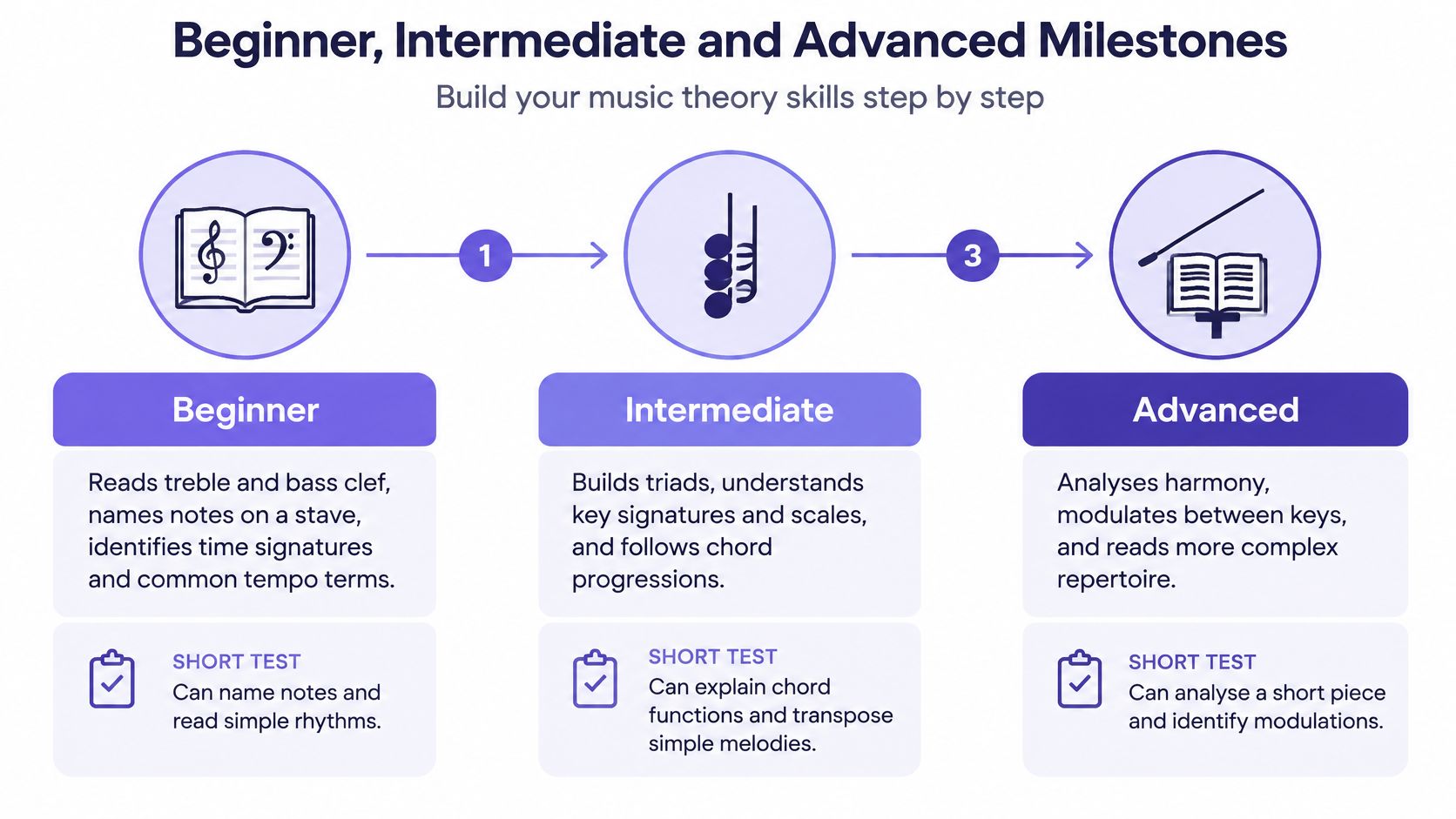
A useful beginner target is reading treble and bass clef, naming notes on a stave, recognising time signatures and understanding common tempo terms. Add major scales and key signatures up to two sharps or flats as a manageable teaching checkpoint, rather than treating this as a complete exam syllabus.
Try it: Name the notes in an unfamiliar melody and clap its rhythm without a recording. Having to count every stave line each time is normal at this stage; reading fluency arrives through repetition, not through studying the rules harder.
Weekly consistency moves this stage along faster than the calendar does. Fifteen hours of study at three hours a week takes five weeks. The same fifteen hours at five hours a week takes three. Same work, different timetable.
Intermediate and advanced understanding
At intermediate level, build major, minor and diminished triads, recognise seventh chords and simple cadences, and identify a melody's likely key. A key signature narrows the possibilities; the melody and its points of rest settle the tonal centre.
Advanced work asks you to analyse harmony, recognise modulation, write in a specified style and explain musical decisions. Correct chord labels are only part of the task. You also explain how a composer creates tension, contrast or resolution.
| Stage | A useful independent test |
|---|---|
| Intermediate | Build chords in a given key and explain a short progression |
| Advanced | Analyse a short score and justify your interpretation with musical evidence |
The difference between the two stages shows up as depth of explanation rather than a longer list of definitions. An intermediate student names the chord; an advanced student says why it belongs there and what it does to the listener.
Surrey County Council's music service identifies Grade 5 theory as the checkpoint for progressing beyond Grade 5 in ABRSM examinations. Confirm the current eligibility arrangements for your intended exam before booking, because boards revise their requirements.
For a broader school qualification, compare the content and demands of GCSE Music with your existing skills. This week, attempt an unfamiliar reading task, a chord-building exercise and a short analysis. Your least secure task gives you a sensible starting point.
Staged Study Plans from Foundation to University Entry
Plan towards an assessable endpoint, rather than completing resources for their own sake. Your route should connect written understanding with listening, performing and creating.
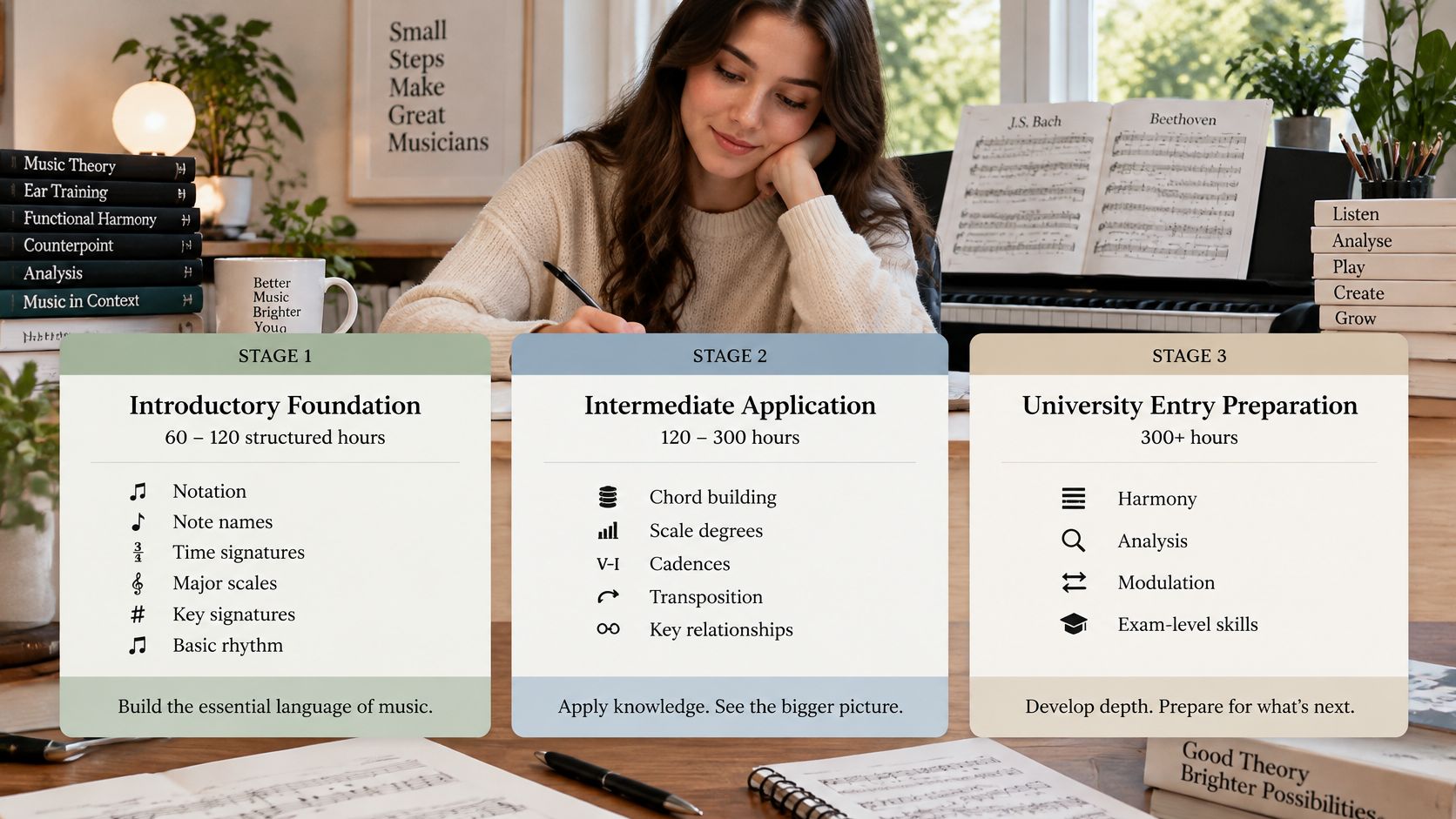
Use this roadmap to distinguish foundation study from university preparation.
Build the foundation, then broaden it
An introductory foundation should cover note names, rhythmic values, time signatures, major scales, key signatures and basic triads. Use the introductory qualification range as a planning allowance, then ask a tutor to check your reading and written work. If notation is your main obstacle, you can learn music notation with Isolate Audio alongside practical exercises.
GCSE-level competence adds applied listening, composition and performance. Practise recognising cadences, identifying keys and explaining simple harmony within actual music, rather than studying those topics only as isolated worksheets.
A Level Music requires more sustained analytical and creative independence. The government's A-level Music subject content requires performance, composition and understanding of musical style and context. Compare the A Level Music syllabus with your strengths before choosing your next qualification.
Nathalie describes the commitment involved in her family's study: “Our son just completed an A Level music and I wanted to acknowledge the great dedication of the teachers over the past 2 years.” That's an individual testimonial, not a guaranteed completion time.
For a supplementary music-learning resource, the following video can sit alongside your written and practical work.
Prepare for the degree you actually want
The National Careers Service's classical musician guidance says many classical degree or conservatoire routes usually require two or three A levels including Music, or equivalent qualifications, Grade 8 on your main instrument and a successful audition. It also notes that some music degrees emphasise theory more than performance.
Run audition preparation alongside academic study, rather than postponing it until theory feels finished. For production, composition or other creative degrees, investigate the specific portfolio, interview and qualification requirements directly with each university.
Weekly Practice Routines That Shorten the Timeline
Practise producing answers, not just recognising explanations. A video can make a chord progression look obvious; writing and playing your own progression reveals whether you can choose the notes independently.
The following is a suggested 30-minute session, not a researched minimum or a qualification requirement. Adjust the balance when a particular weakness needs attention.
A repeatable session
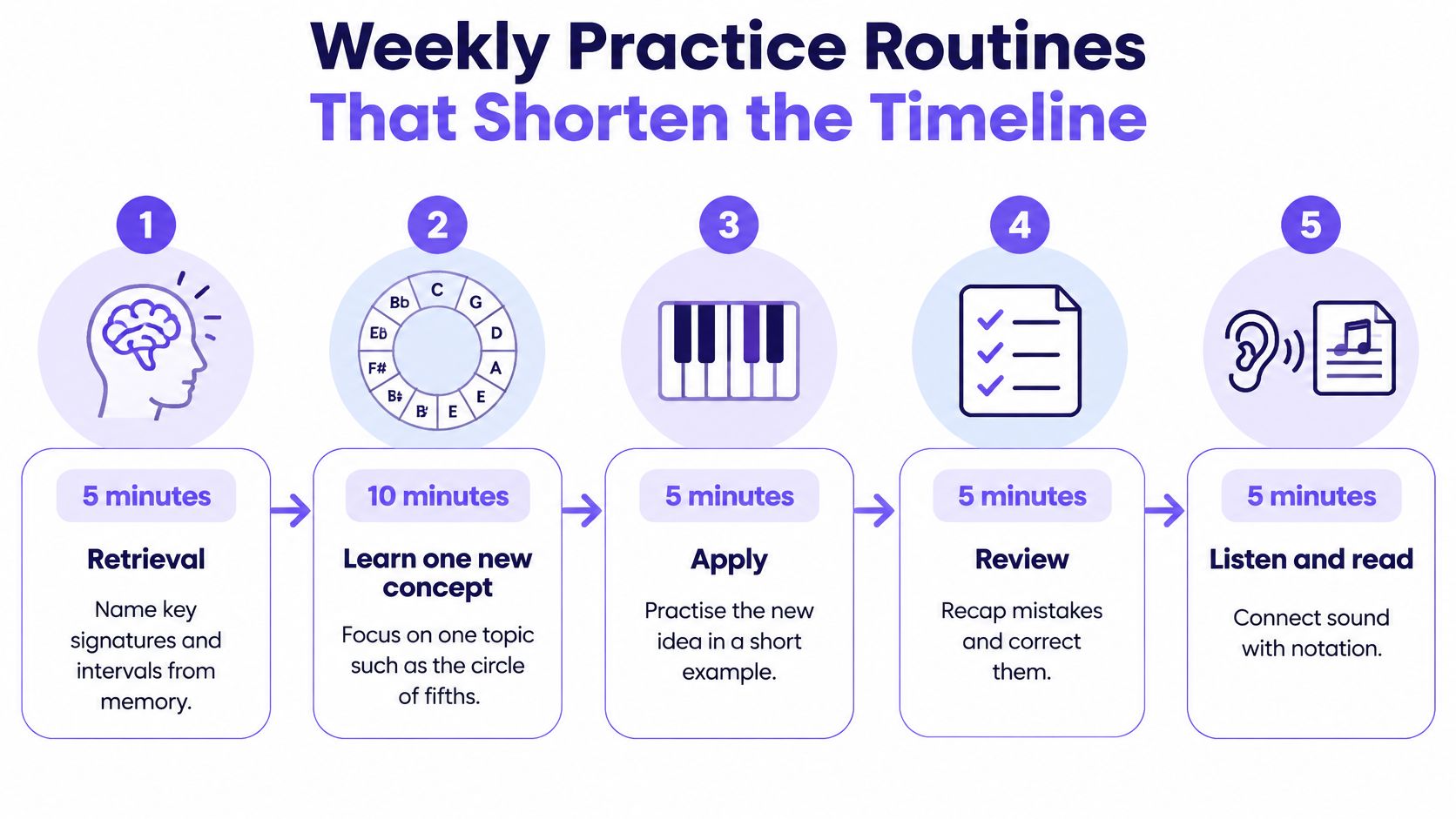
- Retrieve for five minutes. Name key signatures and intervals from memory before checking your answers.
- Study one concept for ten minutes. For example, use the circle of fifths to explain the relationship between neighbouring keys.
- Train your ear for five minutes. Sing a major third and a perfect fifth, then check them on an instrument.
- Write or analyse for eight minutes. Build a short progression, annotate a melody or correct a harmony exercise.
- Log mistakes for two minutes. Record the error, its cause and the corrected answer.
The visual below offers an alternative allocation, with separate application, review and listening stages. Choose one arrangement that fits your task rather than trying to complete both.
Turn weekly time into a workable calendar
Consider a hypothetical adult learner, Maya. With four half-hour sessions each week, she allocates two weekly hours, so the GCSE guided-hour benchmark translates arithmetically into about 60 to 70 weeks; allocating five weekly hours changes that comparison to about 24 to 28 weeks.
This doesn't mean independent practice automatically counts as guided learning, or that Maya will be assessment-ready on that date. It shows why a calendar estimate needs a weekly workload attached.
Keep an error notebook that tells you what to practise next, not merely what went wrong.
Revisit your previous topic before introducing another. Schedule a longer weekly review to combine reading, listening and writing in the same task. Choose a routine you can sustain for a twelve-week trial, then adjust it using completed work and feedback.
Frequently Asked Questions for Level 2 and Level 3 Students
Can I start music theory before GCSE?
Yes. You don't need to wait for a GCSE course. Begin with notation, rhythm, scales and basic chords, using the introductory qualification benchmark as a planning guide rather than an entry requirement.
Is GCSE Music theory enough for a music degree?
Usually not on its own for classical degree or conservatoire entry. GCSE provides a foundation, while those routes commonly expect further academic study, advanced performance and an audition. Other music degrees may assess a different combination of qualifications and portfolio work.
How many hours a week does A Level Music take over two years?
About 3.5 guided hours weekly is the arithmetic average when the qualification's guided hours are spread across approximately 104 calendar weeks. That's not the full weekly workload: holidays, independent study, rehearsal and composition preparation make an actual timetable different.
Is Grade 5 theory the same as GCSE?
No. They share a broad qualification level, not an identical syllabus. A theory grade assesses specified theoretical knowledge; GCSE Music also assesses practical and creative musical work.
Does my instrument grade matter?
Yes, particularly for performance-led applications. Check both the expected playing standard and audition repertoire early. A strong theory result doesn't replace the ability to perform at the level a course requires.
What if I can only study two or three times a week?
Use focused half-hour sessions, then calculate your actual weekly total. Two or three such sessions aren't the same as two hours, so don't choose a completion estimate based on time you haven't allocated.
- Protect continuity: Revisit your last exercise before starting something new.
- Request targeted feedback: Bring a specific uncertainty, such as an incorrectly identified cadence, to your tutor.
Choose Your Target Level Before You Enrol
Choose the outcome before choosing the timetable. Being able to follow chord symbols, pass a theory examination and prepare for a music degree are different goals. A course should match the one you're pursuing.
Use this decision checklist before committing:
- Name your target. Write a grade or qualification, such as Grade 5 theory, GCSE-level competence or A Level Music.
- Check your starting point. Complete unfamiliar reading, rhythm and harmony tasks, rather than relying on material you've memorised.
- Calculate a realistic pace. Divide the relevant benchmark by weekly hours you can consistently protect, allowing separately for independent work.
- Check progression requirements. Read the intended university's current entry page, including audition or portfolio expectations.
- Match the course to the gap. Compare the assessment demands with the skills you still need to develop.
We offer an Online GCSE Music Course and online A-Level Art, A-Level Design and A Level Music courses. For learners considering a vocational option, our RSL Level 2 Certificate For Music Practitioners costs between £1,249 and £3,250, depending on the option chosen. Choose by curriculum and progression purpose, not by qualification level alone.
Review the available online music theory courses with your target and weekly availability written down. Contact us to confirm which entry point matches your current understanding, and begin a short reading-and-rhythm session this week.
The Online College of Art & Design (OCAD) offers flexible, tutor-led online music study, including GCSE Music and A Level Music. Visit The Online College of Art & Design (OCAD) to discuss your current skills, available weekly hours and university ambitions, so you can choose a suitable starting point.