

Type how many i into a search bar and an answer arrives in under a second. It's almost never the one you needed.
You wanted to know whether two iGCSEs count towards a university application, or how many GCSEs that course page is assuming. You got a spelling puzzle about Mississippi.
A three-word search can't tell the difference between four separate questions: a letter-counting question, an admissions question, a course-entry question and a national statistics question. Getting the wrong version costs something concrete, whether that's a missed subject, an extra year, or a portfolio built to the wrong specification.
Table of Contents
- Quick Answers to the Most Common Versions of This Search
- How to Count the Letter I in Any Word
- How Many GCSEs and A Levels Universities Expect
- Portfolio and Application Steps for Each Course
- Special Cases for Home-Educated and SEND Learners
- Why Published iGCSE and GCSE Counts Disagree
- Confirm Your Count Before You Apply
Quick Answers to the Most Common Versions of This Search
The only version with a single exact answer is the letter count. Count every i in the word, including repeats, so Mississippi holds four and initial holds three. There's no interpretation to make and nobody to consult.
| Search meaning | Short answer | Where to check |
|---|---|---|
| How many i's are in a word | Count every letter i, including repeats | Word-by-word method in the next section |
| How many iGCSEs or GCSEs for university | Typically five GCSEs at grade C or above, plus at least two A levels or equivalent | Course page for each institution on UCAS |
| How many qualifications for a Level 3 foundation | No universal number; each provider sets its own entry rules | Entry requirements on the provider's course page |
| How many students take iGCSE or GCSE | Depends on whether you count entries, candidates or certificates | Cambridge and Ofqual published statistics |
The admissions version is the one that shapes a Level 2 timetable. Creative degrees generally want a core of GCSEs at grade C or above that includes English and maths, plus A levels or a recognised Level 3 equivalent such as a BTEC or a foundation diploma. UCAS publishes typical offer ranges by subject area, but the binding version always sits on the individual course page.
The Level 3 entry version has no national answer at all. A foundation diploma provider sets its own criteria, and those can include a portfolio review, a prior qualification or an interview. The entry requirements section of the specific course is the only thing that settles it.
The national totals version is where most confusion starts. Entries, candidates and certificates produce three different numbers from the same summer, so identify the unit before you quote the figure.
Separate the two kinds of number. A requirement tells you what to do next. A population total tells you how many other people are doing it. Only one of them changes your application.
Find the row above that matches what you typed, and you'll know which answer you need and where to confirm it.
How to Count the Letter I in Any Word
Counting the letter i is a mechanical job, and mechanical jobs go wrong when the method changes halfway through. Use the same routine every time and the count becomes reliable.
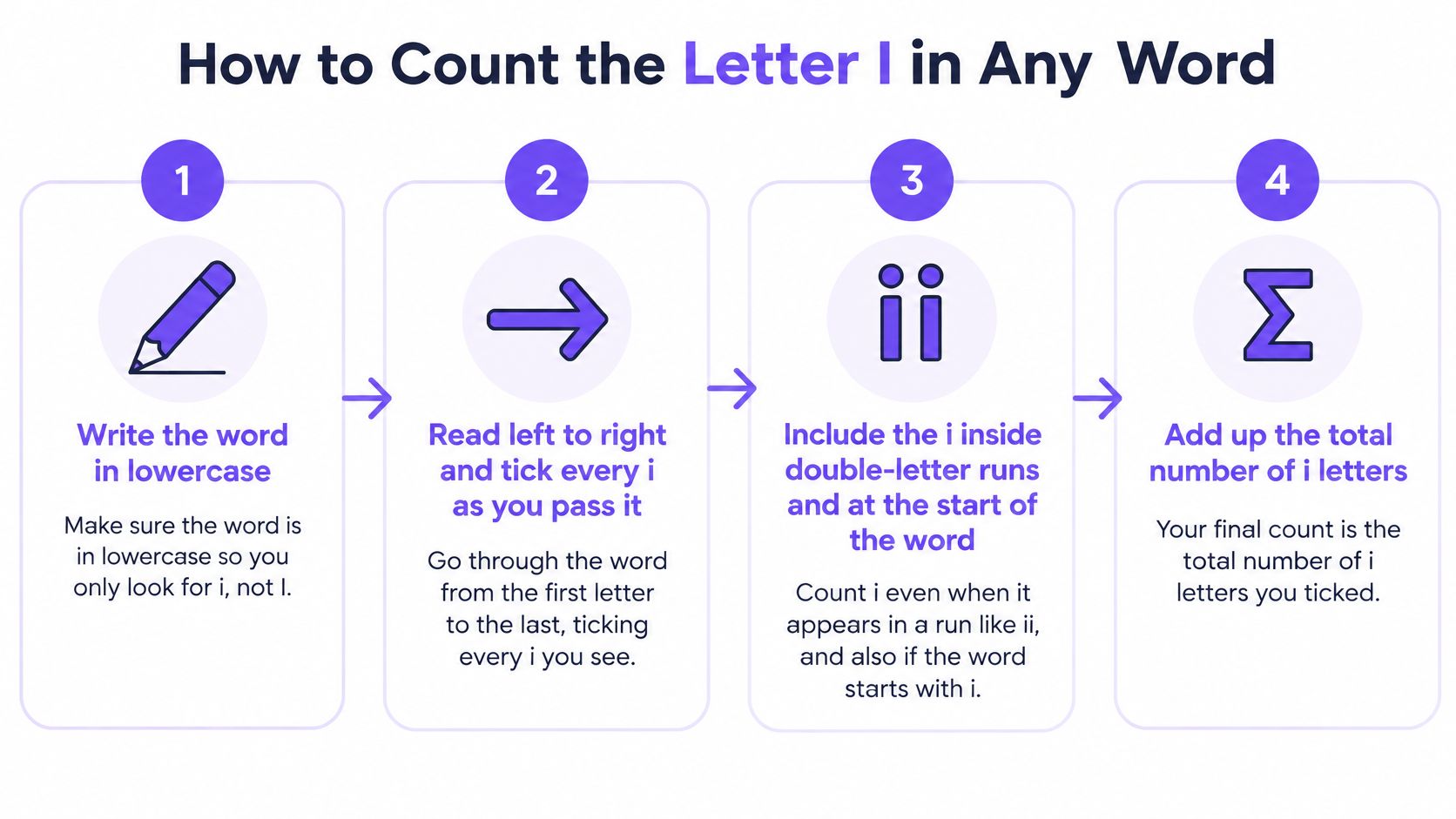
- Write the word in lowercase. A capital I and a lowercase i are the same letter, but they read differently enough for a quick eye to mistake one for an l or a 1.
- Read left to right and tick each i as you pass it. One direction only. Jumping around the word is how people count the same letter twice.
- Include the i inside double-letter runs and at the start of the word. Two adjacent letters are still two letters, and a word beginning with i gives you one before you reach anything else.
- Add up the ticks. The total is your answer, not an impression of how many times you heard the vowel.
- Read the word backwards and check again. A second pass in the opposite direction catches the letter you skipped, which happens most in words of four syllables or more.
| Word | Count of i | Why it trips readers |
|---|---|---|
| Initial | 3 | Three separate i's: one at the start and two mid-word |
| Individual | 3 | The i's sit at positions 1, 4 and 6, so the mid-word ones are easy to miss |
| Philippines | 3 | The i's sit at positions 3, 5 and 8, so the last one is easy to skip |
| Dictionary | 2 | The second i sits mid-word after the c and t, so it is easy to skip |
| Mississippi | 4 | The double letters hide the fourth i |
| Radio | 1 | Only one i, but readers often count the vowel sound as a second one |
| Ideal | 1 | One i at the start, so the count is one, not two |
Capitals count the same as lowercase, and in hyphenated or compound words each part carries its own letters, so you count the whole thing. A common mistake is counting sounds rather than letters: radio has one i even though the ear hears two beats, and Ideal has one because only the first letter is an i.
How Many GCSEs and A Levels Universities Expect
How many qualifications do you need for a creative degree? The answer depends on the route: universities set entry requirements for degrees, while vocational courses and foundation diplomas have their own criteria.
UCAS guidance on creative arts subjects says creative-arts degrees commonly ask for at least two A levels, with typical offers ranging from CDD to ABB and BBC the most common offer. It also says applicants normally need five GCSEs at grade C or above, including English and mathematics.
| Route | Typical requirement | Check with |
|---|---|---|
| Creative-arts degree, standard route | At least two A levels; typical offers range from CDD to ABB, with BBC the most common; five GCSEs at grade C or above, including English and maths | Each university's course page |
| BTEC route | BTEC Level 3 National Extended Diploma in Art and Design, or another relevant Level 3 or Level 6 qualification | The provider, before applying |
| Level 3 foundation diploma | Can support progression into art, design and photography degrees; entry requirements vary by course | The course entry page and tutor |
A BTEC can provide an alternative route. UCAS notes that a BTEC Level 3 National Extended Diploma in Art and Design, Performing Arts or another relevant subject may meet academic requirements, as may other relevant Level 3 or Level 6 qualifications. Check with each provider, because acceptance varies.
A foundation course in art can help students progress to art, design and photography degrees. It gives students time to build technical range, develop an independent project and assemble a coherent portfolio, particularly if they are progressing from Level 2 or have an unconventional school history.
Use the lower end of an offer range when planning. Published ranges describe the grades associated with offers, not grades you can rely on receiving.
Course titles alone are not enough for comparison. Two universities may offer the same named degree but set different grade requirements, portfolio rules and deadlines. If you have iGCSE results, ask each admissions team whether it accepts them in place of GCSEs.
If you are still choosing school subjects, browse GCSE and A-Level subjects to see how art and design options fit alongside the rest of your timetable.
For a Level 2 student, the typical target is five GCSEs at grade C or above, including English and maths. Map the subjects you still need to each term and mock deadline, and keep a written record of grades already achieved. That record helps you check your qualifications against a Level 3 course's entry requirements.
Portfolio and Application Steps for Each Course
Course pages usually specify a number of projects, not a number of pieces. Start with that number. If a course asks for three projects, submit three projects taken through a full cycle rather than nine finished drawings with nothing behind them.
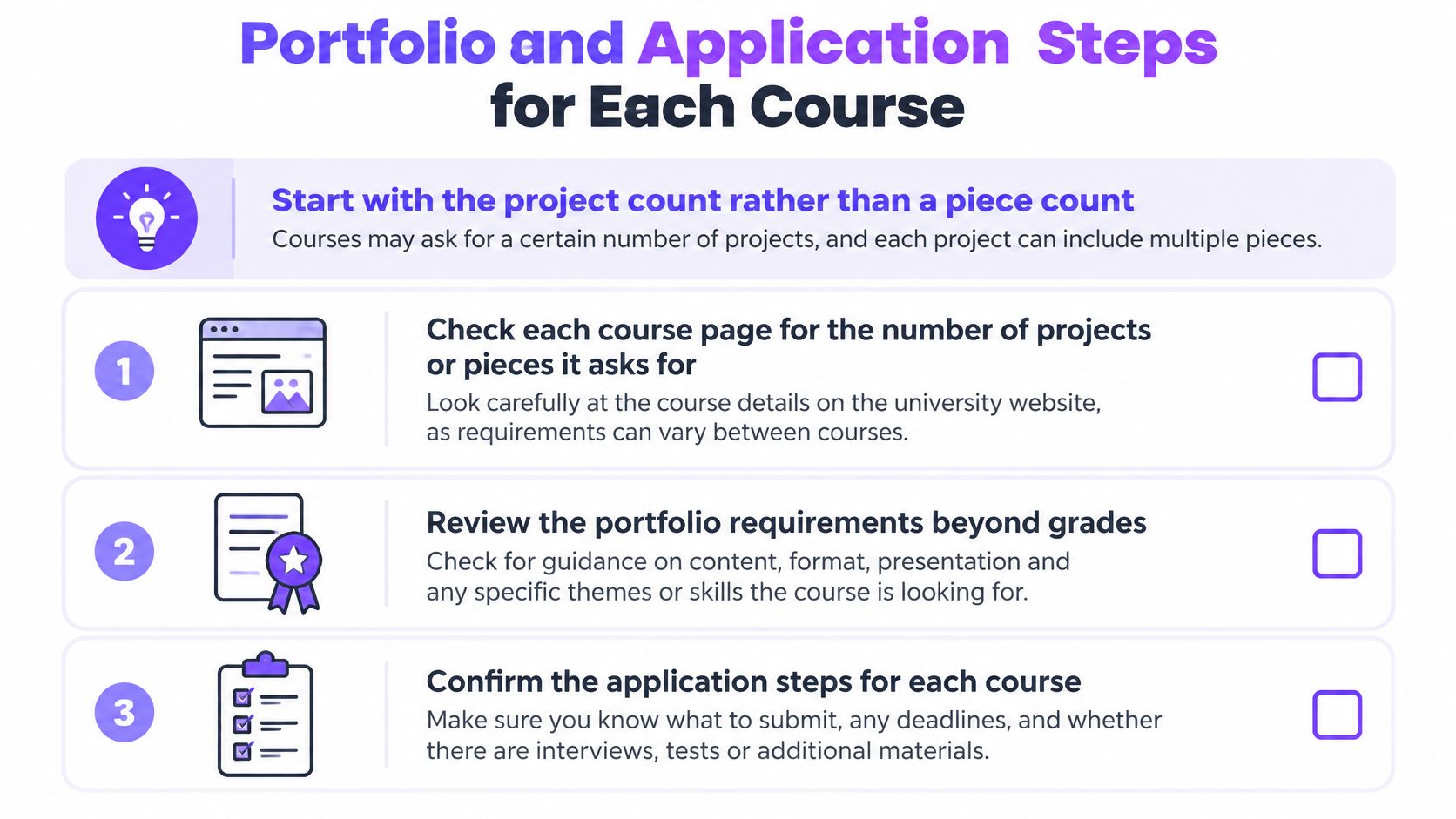
Every project in a strong portfolio shows the same three layers:
- Research. The sources, artists, photographs and visual references that started it.
- Development. Sketches, colour tests, failed experiments and refinements that show the thinking moving.
- Resolution. The final outcome, annotated so a reader can see which decisions were deliberate.
The UCAS listing for a fashion design course recommends exactly that breadth, naming colour work, mixed media, sculpture, photography, collage, idea development, observational drawing, visual research, fabric research and independent projects as the evidence applicants should bring. Keep the failures and the annotations, not only the polished final piece.
Portfolio weight goes beyond grades. UCAS states that fine art, art and design, and photography applicants are required to present a portfolio and are often asked to discuss it at interview, and that universities may relax entry requirements where the portfolio demonstrates strong creative ability.
Then the application steps themselves, set out in UCAS guidance on art and design applications: a personal statement, a portfolio submission, an interview, an audition, an entry test or relevant work experience, depending on the course.
Deadline trap: some art and design courses use 24 March rather than the standard January date. Check the deadline shown for your course and entry year before you build a plan around January.
Confirm whether work is uploaded digitally or brought to an assessment event. Home-educated, SEND and adult applicants often need portfolio reviews, references, predicted grades or evidence of prior learning arranged separately, and those tasks take weeks.
Keeping development work, annotations and tutor feedback in one place is easier with a guide to managing coursework digitally, and this explanation of what a portfolio for university actually needs covers the difference between a school sketchbook and an admissions submission.
Special Cases for Home-Educated and SEND Learners
The standard count doesn't hold for every learner, and the exceptions are large enough to plan around.
England recorded 126,000 children in elective home education on the autumn 2025 census date, about 1.5% of the population aged 5 to 16, and 175,900 were recorded as home educated at some point during 2024/25, according to the Department for Education's elective home education statistics. The gap between the two figures is the point: one measures the population on a single day, the other measures everyone who passed through it during the year.
Why support needs change the pace
Autumn 2025 reporting on England's home-educated population indicated that 16% required SEND support and 7% had an education, health and care plan, as Sky News reported on the home education figures. For those students, an adapted pattern works better than a reduced one: captioned demonstrations, chunked video, screen-reader-friendly documents, flexible deadlines and a slower submission cadence keep the qualification achievable without lowering the outcome.
Evidence beats explanation. A documented need from a previous course moves through a university's support service faster than a description of difficulty offered at enrolment.
At degree level, UCAS guidance on financial support for disabled students explains that Disabled Students' Allowance can cover disability-related study costs such as specialist equipment, and that it sits separately from ordinary student finance. Contact the university's disability service before enrolment, document the need early, and confirm the rules for the UK nation you'll study in, because student finance differs across England, Scotland, Wales and Northern Ireland.
What adult learners actually need to know
For adults the open question isn't a qualification count at all. It's weekly study hours, and no universal figure exists. Self-paced units and flexible pacing change the calculation month by month, so plan in blocks rather than in years. Learners arriving from home education often have thin formal assessment history, so a record of Key Stage 3 art projects gives a tutor something concrete to assess against.
Why Published iGCSE and GCSE Counts Disagree
The word iGCSE hides three counts, and only one of them is about people. Cambridge reported nearly 740,000 IGCSE entries worldwide in June 2025, up 5% year on year, but that total spans 139 countries and doesn't separate the UK share, according to Cambridge International's results announcement. In England, Ofqual reported 1,019,005 GCSE students in summer 2025, up from 989,880 in 2024.
| Measure | Figure | What it counts |
|---|---|---|
| Cambridge IGCSE entries, worldwide, June 2025 | Nearly 740,000 (up 5% year on year) | Subject entries across 139 countries; the UK share is not separated |
| GCSE students in England, summer 2025 | 1,019,005 (2024: 989,880) | Students in England taking GCSEs only |
| General qualification takers in England, 2025 | More than 1.3 million students across more than 6,000 centres | Unique students in England taking general qualifications |
| Certificates awarded in England, 2025 | More than 6.5 million | Certificates, one per qualification, so not unique learners |
The two sets of numbers aren't in conflict. They count different things in different places.
A global entries figure tells you how big the qualification is. It tells you nothing about how many UK candidates sat Art and Design, or where you can sit the exam.
The certificate figure is where readers go wrong most often. Ofqual's statistics on GCSE, AS and A level entries count entries separately for each component, distinguish provisional from final figures, and record more than 1.3 million students in England taking general qualifications across more than 6,000 centres in 2025, with more than 6.5 million certificates awarded. A certificate total divided by a candidate total gives a subject count, not a headcount.
Before relying on any figure, check three things: which measure it reports, which geography it covers, and whether it's provisional or final. None of the national totals change the grades a university will ask you for.
Confirm Your Count Before You Apply
Confirm the count for your own course before you apply or enrol. Work through this sequence in order, because each step narrows the one after it.
- Name the exact qualification. Not "a degree in art" but the named course, level and entry year.
- Open that course's entry requirements. The requirement for the course you plan to apply to is the only one that binds you.
- Record the count and the grades. Write down how many GCSEs, iGCSEs or Level 3 qualifications the course asks for, and at which grades.
- Add the non-academic rules. Portfolio format, deadline, interview method, and whether work is uploaded or brought in person.
- Ask how it applies to you. Home education, SEND support and adult study all change the evidence a provider will want, and only the provider can confirm what it will accept.
- Keep the answer in writing. An email from admissions settles questions that a forum thread can't.
OCAD's own catalogue runs from GCSE-equivalent Level 2 certificates and an iGCSE Art and Design course through A Level Art, Design and Music to Level 3 foundation diplomas in specialist routes, with one-to-one tuition and degree pathway guidance alongside. The entry requirement for the specific course you're considering is the number that matters, so ask for it directly before you commit a term to it.
OCAD teaches the qualifications this question keeps circling: GCSE-equivalent Level 2 certificates, iGCSE and A Level Art and Design, and Level 3 foundation diplomas in specialist routes such as fashion, fine art, photography and graphic design, all delivered online with tutor feedback and portfolio guidance. If you're still working out how many qualifications your chosen degree asks for, the course team can confirm the entry requirements for the course you have in mind and tell you which route reaches it fastest. Visit The Online College of Art & Design (OCAD) to compare the routes and put your question to the team directly.