

Two Level 2 students sit down to submit work on the same theme. The first hands over a single polished acrylic canvas with no rough studies behind it. The second submits a slightly scuffed sketchbook packed with charcoal thumbnails, tonal swatches, failed compositional grids, and a final painting that grew directly from those tests. Every experienced art tutor learns far more from the second folder.
Across England alone, students submitted 194,190 GCSE entries in art and design subjects in summer 2025, a 1.7% dip from 197,500 the year before, according to the UK Department for Education provisional entry statistics. Standing out in a pool that size doesn't come from hiding your mistakes behind one tidy painting. It comes from proving how you think on the page.
When students search for IGCSE Art coursework examples, they usually find galleries of finished pieces stripped of their working notes. That creates a dangerous blind spot for Level 2 and Level 3 learners aiming for a creative degree. Below, I break down seven common portfolio questions as real assessment cases, showing what a student produced, which assessment objectives it proves, what a tutor would challenge, and how that evidence carries into a university application.
Table of Contents
- 1. What should an IGCSE Art coursework portfolio contain if I want to apply to university?
- 2. How do Level 2 IGCSE coursework examples differ from Level 3 portfolios, and how can I progress to a university degree?
- 3. How many pieces should an IGCSE Art portfolio include, and how should it be organised?
- 4. How do universities and art schools assess an art portfolio, and what are they looking for?
- 5. Can IGCSE Art coursework be used directly for a university application, and how should it be presented?
- 6. How can online or tutor-led students get useful feedback on their IGCSE Art coursework?
- 7. What support is available for home-educated, SEND, and adult learners building an IGCSE Art coursework portfolio?
- How the seven coursework examples compare
- Turning Coursework Examples Into a Portfolio Plan for 2026
1. What should an IGCSE Art coursework portfolio contain if I want to apply to university?
Admissions tutors and exam moderators rarely judge a folder by its glossiest page. They read it as an evidence chain showing how an idea moved from first-hand observation to a resolved piece. In the Cambridge International 2023 syllabus for iGCSE Art & Design (0400), Component 1 Coursework represented 50% of the qualification and carried 100 marks, split equally at 25 marks each across four objectives: recording ideas and observations (AO1), exploring media and processes (AO2), developing ideas with critical understanding (AO3), and presenting a personal, coherent response (AO4).
That equal weighting sets a blunt trade-off. Spending weeks perfecting a final canvas while starving your research pages caps your marks before you start. The Cambridge International 2025 syllabus (0400) spells out that your portfolio must combine first-hand observation, secondary research, media trials, contextual links, and iterative refinement, curated across up to four A2 sheets. For guidance on how that structure scales up later, our guide on what makes a portfolio ready for university maps those exact habits to degree applications.
A well-documented sketchbook page makes those links obvious to an assessor at a glance.
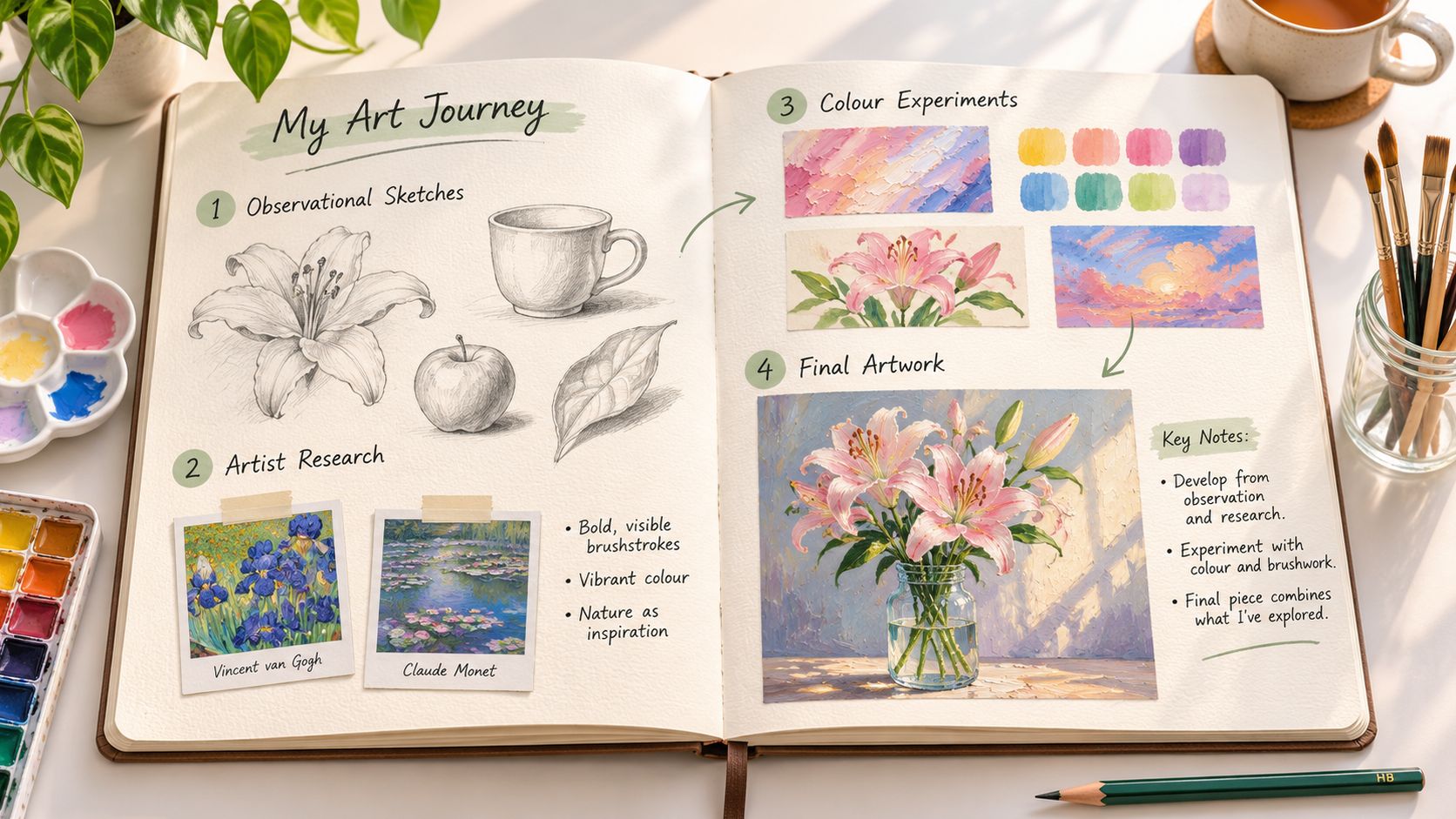
Breaking down an urban decay sketchbook
Say a Level 2 student builds a project around "urban decay". They photograph peeling paint and rusted shutters in their neighbourhood, test mixed-media texture studies using gesso, tissue paper, and ink washes, then produce three refined outcomes annotated with the reasons behind every compositional shift.
This single sequence hits all four objectives cleanly. Original photographs and observational drawings prove AO1, material tests prove AO2, deliberate changes between studies prove AO3, and the three cohesive outcomes prove AO4. A strict tutor would still challenge any page where annotation merely describes what's visible ("I painted rust with brown acrylic") instead of evaluating why a smoother wash failed to capture corroded metal. For a Level 3 or degree portfolio, those rough surface trials often carry more weight than the finished paintings because they show material curiosity.
- Date and title every sheet: Chronological labels let an examiner trace how an idea matured instead of guessing which drawing came first.
- Keep failed experiments visible: A muddy print or cramped layout adds marks when you annotate why you rejected it and what you changed next.
- Audit against all four objectives: Before mounting final sheets, mark where AO1 through AO4 appear so no single quadrant sits empty.
- Keep written notes analytical: Write short sentences explaining decisions, material reactions, and artist links rather than long biographical paragraphs.
2. How do Level 2 IGCSE coursework examples differ from Level 3 portfolios, and how can I progress to a university degree?
Say a Level 2 student completes a tight portraiture project using graphite grids and acrylic glazes to master proportion and tonal contrast. Two years later at Level 3, that same learner returns to portraiture, only now they combine fragmented self-portraits with translucent fabric projections to question digital identity. Both projects share a subject, yet they serve very different assessment jobs.
Level 2 coursework proves you can handle core technical skills and follow a structured creative sequence. Level 3 work, whether an A Level, a Level 3 Diploma, or a Foundation Diploma, demands conceptual autonomy. You're expected to write your own visual questions, test riskier formats, and sustain an investigation without step-by-step teacher prompts.
According to the UK National Careers Service fine artist profile, applicants for art courses will often need a portfolio, and building one should start as early as possible, typically progressing through a foundation diploma in art and design or two to three A levels (or equivalent) before degree study. Preserving your strongest IGCSE work gives you the "before" evidence that makes your Level 3 leap unmistakable.
Where Level 2 ends and Level 3 begins
In the portraiture progression above, the Level 2 drawings evidence strong AO1 observation and AO2 control of graphite and paint. The Level 3 installation pushes AO3 critical investigation and AO4 personal voice much further. A tutor reviewing the jump between levels would challenge any student who repeats the same photorealistic portrait technique on a larger canvas. Bigger isn't more conceptual.
Keep your best Level 2 sketchbooks intact rather than stripping out pages for display. Admissions panels love seeing where your visual habits started and how sharply you outgrew them.
When you map your route toward a BA in Fine Art, Graphic Design, or Photography, pick one or two recurring interests that can stretch across both levels. Write a brief progression note explaining how your methods shifted from guided recording to self-directed enquiry. Always verify entry expectations with your target universities early, since some degree courses prefer a Foundation Diploma while others accept direct entry from A Levels or Level 3 Diplomas.
3. How many pieces should an IGCSE Art portfolio include, and how should it be organised?
An overfilled folder can bury the drawing that explains an entire project. Select a focused, curated sequence in which research, trials and outcomes remain connected. Piece count depends on your course requirements and, later, the application format. A finished painting and a sketchbook spread serve different purposes, so counting them alone tells you little about coverage.
Cambridge Component 1 coursework represents 50% of the qualification under the Cambridge International iGCSE Art & Design (0400) framework. The AQA GCSE Art and Design specification (8205) assigns 60% of the qualification (96 marks) to its portfolio, with no fixed time limit. Accepted formats include mounted studies, sketchbooks, visual diaries, models, maquettes, prototypes, storyboards, video and digital presentations. Check your own specification before deciding what to submit.
General advice on building learner portfolios in Grades 7–12 concerns school portfolios rather than IGCSE Art submission requirements. For assessed artwork, organise each project around the evidence it contributes.
The flatlay below brings sketches, material studies and a model into view together. Keep their relationship equally clear when photographing separate pages.
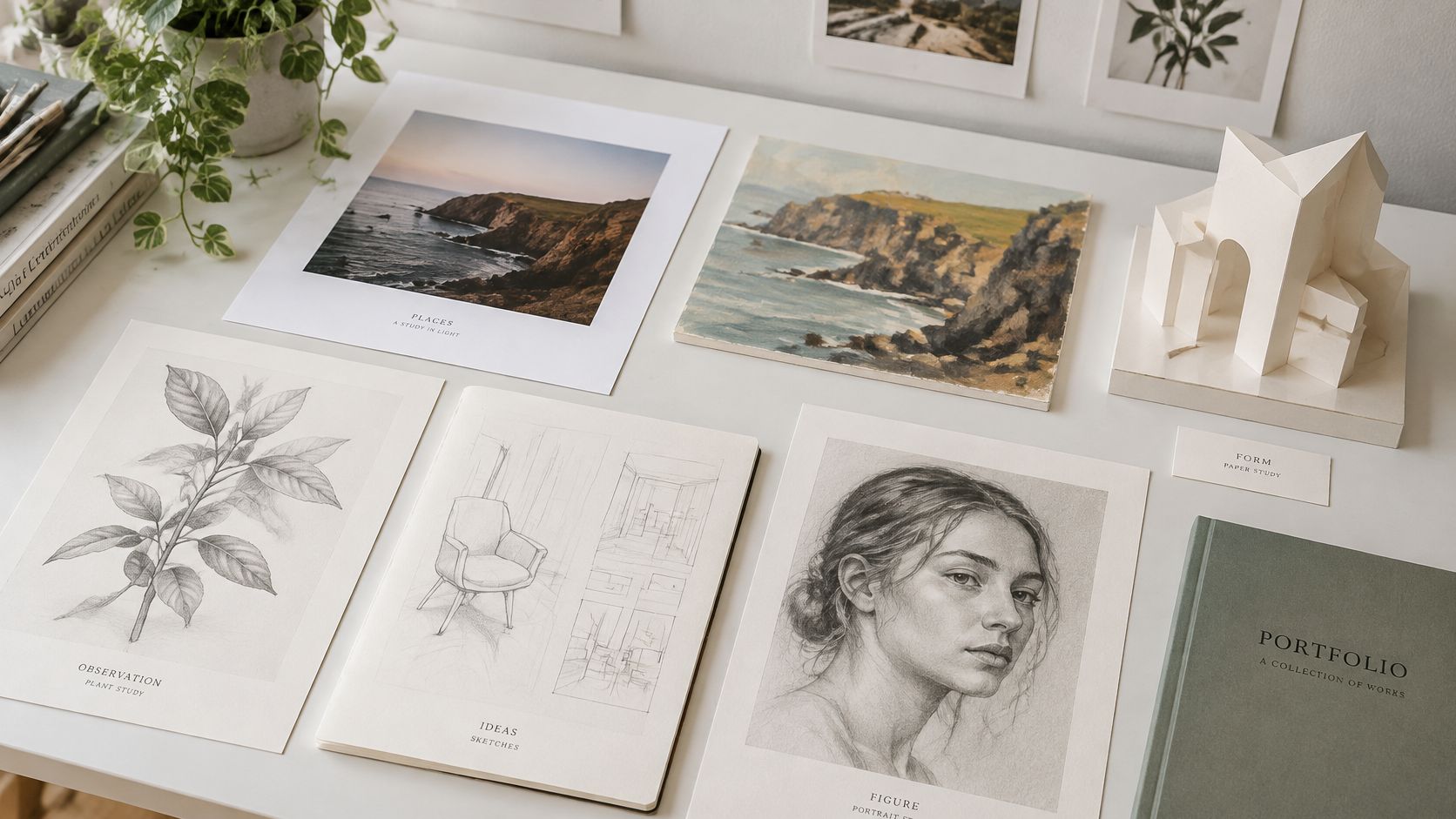
Curating a digital foundation selection
An online learner preparing a Foundation Diploma application might use a cover statement, a research sketchbook extract, development sequences and selected final outcomes. Treat this as an editing example, not a submission quota.
Pair each image with a short caption explaining its connection to primary photographs or artist studies. Research can evidence AO1; material trials show AO2; observations support AO3; the resolved response addresses AO4. A tutor would challenge a sequence that jumps from artist research to a finished painting without showing what changed. Retaining those decisions makes the same project useful as a progression record for Level 3 or a later degree application.
Presentation carries a trade-off: larger images reveal handling, while too many near-identical slides obscure development.
- Lead with impact and logic: Open with a confident, recent project, then keep its development chronological.
- Standardise your photography: Photograph flat work straight on in even daylight against a neutral grey or white surface. Crop out table edges and shadows.
- Label filenames clearly: Use sequential filenames such as
01_Research_StreetPhotos.jpgto distinguish research, process trials and outcomes. - Check exact institutional limits: Confirm the slide allowance, PDF size and requested discipline balance before exporting. Remove repetitive warm-ups before cutting evidence of a meaningful change.
4. How do universities and art schools assess an art portfolio, and what are they looking for?
In an admissions interview, a tutor skips a finished oil portrait and stops on a smudged monoprint halfway through the sketchbook. They ask why the student dropped that darker palette and switched to drypoint etching. The applicant who can name that technical turning point usually beats someone who only recounts how long a painting took.
That monoprint is the assessment case, not the portrait. The student produced a failed darker print, then a drypoint that records the decision. AO2 sits in the experiment. AO4 only holds if the later response grows out of that page. A tutor would challenge the portrait if it arrives without the rejected print. Photographed in order, the same sequence carries into a Level 3 or degree portfolio as a progression record, not a set of finished pictures.
Across England, Ofqual's published GCSE art and design assessment objectives set an equal 25% weighting across all four pillars: developing ideas through investigations (AO1), refining work through experimentation (AO2), recording observations and insights (AO3), and presenting a personal, meaningful response (AO4). Universities scan creative applicants for the same evidence under different labels: curiosity, risk-taking, technical control, and contextual awareness.
How you explain your influences matters as much as who you study. The Department for Education art and design research review highlights that learners can justify creative choices by referencing historical or contemporary artists, craftspeople, and designers alongside final outcomes. Place each reference beside the test you ran. Writers who compare eight company profile structures use the same visual discipline, guiding a reader's eye toward proof rather than fluff. In a portfolio, the proof is the annotated trial, not the artist name on its own.
Pinning works in progress across a studio wall shows the weak link before an admissions panel does.
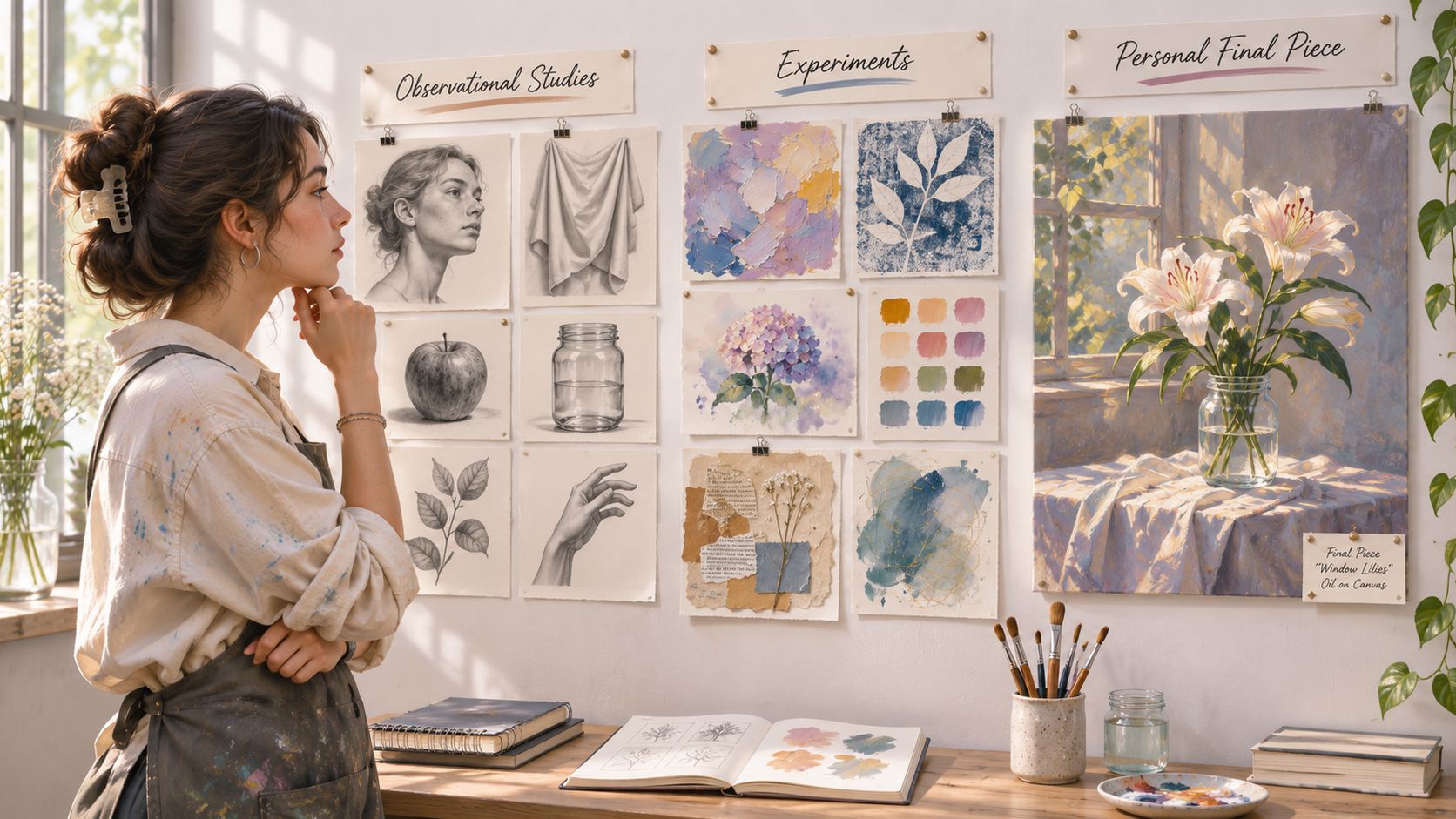
What tutors challenge during portfolio reviews
A Foundation Diploma applicant moves from tight charcoal botanical drawings to layered paper-cut sculptures based on contemporary printmakers. The drawings evidence AO3 recording. The paper-cut trials evidence AO2 refinement. The sculpture evidences AO4 only when the cuts visibly grow out of those charcoal studies.
Tutors push hardest on disconnected artist research. A copied biography of Frida Kahlo or David Hockney on page two adds nothing if your own brushwork never tests their colour, cropping, or mark-making. Test a photographer's high-contrast lighting in three of your own shoots, note what failed, and state how you changed your visual language. A degree interviewer can question that annotated set. A neat final sculpture without those three shoots cannot.
Tutor reality check: Technical polish without visible decision-making looks rehearsed. I would rather teach a curious thinker better oil technique than teach a neat copyist how to generate an idea.
Before a selection interview, practise a two-minute spoken walkthrough of your three strongest projects. State what you would change if you ran the brief again, and name which workshops or studios on the degree connect to that next step. Follow the sketchbook order so the panel hears the progression, not a tour of favourite pictures.
5. Can IGCSE Art coursework be used directly for a university application, and how should it be presented?
Sending an unedited Level 2 folder straight to a degree admissions portal rarely works in your favour. IGCSE Art and Design coursework is a centre-assessed or exam-board-moderated qualification component, not a standalone university application document. Admissions panels expect your most recent Level 3 or Foundation work to do the heavy lifting, with selected Level 2 projects acting as supporting evidence of early growth.
Authentication rules also govern how you preserve and share this material. Under Ofqual's 2022 GCSE subject-level requirements for art and design, every internally set assessment must require a portfolio completed under conditions set by the awarding organisation so the evidence can be authenticated. At OCAD, coursework submitted for assessment must clearly be the student's own work produced while enrolled on the course. Unrecorded outside help, copied stock photography, or missing process stages raise red flags for both exam moderators and university interviewers.
Understanding how different qualification structures translate is essential if you're combining international and UK credentials, which we unpack in our comparison of GCSE versus IGCSE pathways.
Pairing Level 2 evidence with Level 3 outcomes
Say a student applying for a BA in Illustration selects one standout IGCSE Art coursework example (a screen-printed folklore zine) and places it alongside three newer Level 3 narrative projects. Each slide carries a crisp label stating the level, completion year, dimensions, media, and a two-sentence summary of the brief.
This transparent curation proves sustained artistic interest (AO1/AO4) while letting recent technical maturity shine. What would a tutor challenge? Sentimental attachment. Students often cling to a favourite Level 2 painting that drags down the average quality of their folder. If your Level 3 drawing skills have visibly surpassed your IGCSE studies, swap the older piece out or reduce it to a single small progression slide.
- Label level and date accurately: Never blur Level 2 and Level 3 dates together, since tutors evaluate work relative to the stage you produced it.
- Retain dated process proof: Keep raw contact sheets, planning thumbnails, and dated sketchbook drafts to confirm clear authorship from start to finish.
- Cull outdated favourites ruthlessly: Replace any IGCSE page the moment a newer Level 3 experiment demonstrates stronger composition, control, or conceptual depth.
6. How can online or tutor-led students get useful feedback on their IGCSE Art coursework?
Working from home or an independent study space carries one predictable trap: waiting until a piece feels "finished" before showing a tutor. By then, structural flaws in composition or thin contextual research are painful to fix. Regular, staged critiques turn coursework from a lonely sprint into a manageable rhythm that mirrors university studio reviews.
Awarding bodies spell out why structured review matters. The AQA GCSE Art and Design specification requires portfolios to be selected, organised, and presented to show explicit coverage of all four assessment objectives, meaningful engagement with sources, and visible refinement. Independent learners have no classroom teacher glancing over their shoulder every Tuesday, so a formal feedback loop has to be built deliberately rather than left to chance.
Live screen reviews and video walkthroughs let tutors inspect texture, scale, and page flow in real time. Photographs flatten impasto and hide the true size of a piece; a slow camera pan does not.
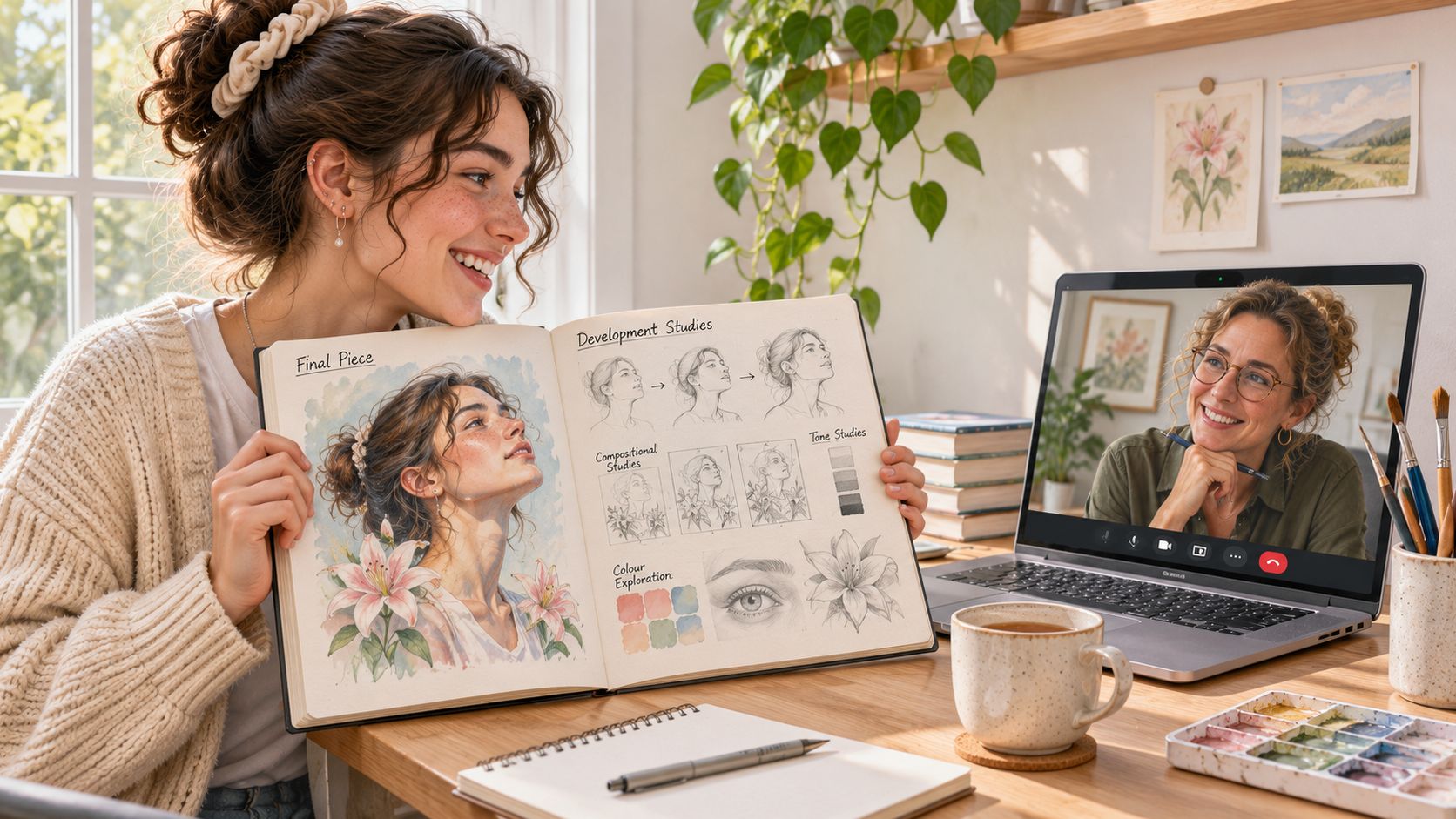
Turning live critiques into mark-band evidence
An online learner records a short, steady video panning slowly across six sketchbook spreads, then uploads sharp photographs ahead of a group tutorial on Microsoft Teams for Education. The tutor points out that the student's acrylic trials repeat the same warm palette and demonstrates a complementary underpainting technique on separate paper. The student tests two cooler colour studies, logs the critique beside them, and adjusts the final layout. Read as an assessment case, that small exchange is exactly what examiners reward: the student produced evidence, the evidence maps to specific objectives, and the next page proves the advice was absorbed rather than ignored.
The exchange directly strengthens AO2 experimentation and AO3 reflective development. It also produces a progression record that carries forward. When the same student later assembles a Level 3 or degree application portfolio, that annotated before-and-after sequence shows how they respond to direction, which admissions tutors weigh as heavily as technical finish.
A tutor will immediately challenge two common boundaries. First, tutors can demonstrate a method on scrap paper, suggest artists, and critique balance, yet they must never draw inside your sketchbook or dictate your final concept. Work submitted as assessment evidence must clearly be your own. Second, feedback only earns marks when you visibly act on it. Writing "my tutor told me to add more contrast" means nothing unless the next page shows deeper tonal range and explains how it shifted the mood.
"I tried this technique because… it worked or failed because… next I will test…"
Keep a simple feedback log inside the back cover of your sketchbook or digital folder. Book check-ins at three fixed milestones: right after initial primary research, midway through media testing, and before committing to your final outcome. At OCAD, students upload photographs of completed work and assignments throughout the course so tutors can track development before deadlines tighten. That rhythm matters more than any single critique. Three spaced reviews catch problems while they are still cheap to fix; one late review just documents them.
7. What support is available for home-educated, SEND, and adult learners building an IGCSE Art coursework portfolio?
A persistent myth holds that accessible or home-based art portfolios have to look watered down compared to school-studio work. They don't. Awarding bodies assess the depth of your investigation, refinement, recording, and personal outcome, not whether you had access to an etching press or a rigid classroom timetable.
This matters to a substantial share of learners across the UK. According to UK government elective home education statistics for autumn 2025, 16% of children in elective home education had an additional SEN requirement, and 7% held an education, health and care plan (EHCP). Add in adult career changers balancing work and family commitments, and it's clear why flexible documentation formats are essential. Younger learners building early confidence before formal Level 2 study can also explore structured Key Stage 3 art projects to establish observational habits without exam pressure.
Making accessible portfolios examiner-ready
Consider two realistic scenarios. First, a home-educated learner with dyslexia struggles with dense handwritten sketchbook essays. Instead of forcing pages of strained prose, they record short audio reflection notes, transcribe concise bullet points using dictation software, and build annotated digital spreads alongside physical charcoal studies. Second, an adult career changer working full-time uses a flexible online Level 3 Diploma route to document architectural light studies during weekend walks, assembling a digital photography portfolio for a degree application.
Both portfolios hit every assessment objective without compromise. The dyslexic learner proves AO1 and AO3 through clear visual sequencing and sharp dictated analysis; the adult learner demonstrates sustained AO2 technical control and AO4 personal voice across dated shoots. What would a tutor challenge in non-linear workflows? Missing links between formats. If an audio note or physical prototype sits unlabelled in a separate folder, an assessor can't connect it to the finished artwork. Keep dates, project titles, and short cross-references consistent across every medium.
- Flag support needs early: Talk to your provider or exams officer at the start of the course so reasonable adjustments, adapted timescales, or alternative recording formats are agreed well before moderation.
- Match tools to your working style: Use digital journals, photographed 3D maquettes, or short videos of temporary installations wherever traditional bound sketchbooks create sensory or motor barriers.
- Check university accessibility routes: Contact degree admissions teams early to confirm accepted digital formats, interview adjustments, or alternative portfolio layouts.
How the seven coursework examples compare
| Item | Main assessment focus | Best for | Typical evidence |
|---|---|---|---|
| IGCSE portfolio contents for university applications | Creative process, research, refinement, and personal response | Showing how ideas develop beyond finished work | Sketchbooks, artist research, experiments, final outcomes, and reflection |
| Progression from Level 2 to Level 3 and university | Growth in independence, depth, and conceptual ambition | Planning a pathway from IGCSE to creative degree study | Linked projects, increasing refinement, portfolio, and personal statement |
| Portfolio size and organisation | Focused selection, coherent sequence, and range of media | Preparing a clear, curated portfolio | Selected artwork, research and development pages, captions, and theme overview |
| How universities and art schools assess portfolios | Creative thinking, technical skill, context, and personal voice | Understanding admissions expectations and preparing to discuss work | Portfolio showing decisions and development, plus interview discussion |
| Using IGCSE coursework in a university application | Selection, relevance, and clear identification of work | Building an application portfolio from coursework and later study | Labelled coursework examples alongside newer Level 3 or Foundation work |
| Feedback for online or tutor-led coursework | Applying feedback and documenting revisions | Improving work through structured remote or tutor support | Tutor comments, feedback log, revised sketchbook pages, and group reviews |
| Support for home-educated, SEND, and adult learners | Accessible ways to show process, skills, and individual voice | Learners needing flexible pacing or adapted support | Digital or audio journals, dated work, adapted resources, and specialist guidance |
Turning Coursework Examples Into a Portfolio Plan for 2026
Treat the seven IGCSE Art coursework examples in this article as a diagnostic checklist rather than templates to copy. Each one works as an assessment case: what the student produced, which assessment objective it evidences, and what a tutor would still challenge. Copy the thinking, not the imagery. No examiner wants forty identical sketchbooks on urban decay. They want proof that you looked closely at the world, tested materials, listened to critique, and pushed an idea until a personal outcome emerged.
Start this week with a fifteen-minute audit of your current project. Lay your pages out in chronological order and score yourself against AO1, AO2, AO3, and AO4. Find the single weakest link, whether that is thin primary photography, unannotated colour tests, or artist research disconnected from your own experiments. Fix that gap before starting another final piece.
Test small before committing. Structured creative hobbies follow the same logic. Even beginner-friendly quilting lessons teach students to trial fabric swatches before cutting final cloth. Your exam portfolio deserves the same discipline: paint small colour studies, print test strips, and annotate what failed before you scale up.
Keep every step legible. Date your sheets. Photograph work in clean daylight. Log how you responded to each piece of tutor feedback, because that record is what turns coursework into a progression document. Admissions tutors reading a Level 3 or degree application want to see decisions and revisions, not just finished pictures, so hold on to your strongest Level 2 evidence as you step up.
For home-educated students, adult learners, or families needing SEND-friendly pacing, The Online College of Art & Design (OCAD) offers Ofqual-regulated pathways from Key Stage 3 and International GCSE Art and Design through Level 2 Certificates, A Levels, and Level 3 Foundation Diplomas. Courses run fully online with tuition via Microsoft Teams for Education, and students upload photographs of completed work throughout the course to receive feedback and build a portfolio. The Level 3 Diploma in Illustration with SEND Support Package earns up to 112 UCAS points, enough to reach university without other A Levels. Adults can also enter A Level study without a GCSE in art if they hold an equivalent qualification such as a Level 2 Certificate, BTEC, or Arts Award, or if they have worked in a creative career. To map a route from IGCSE coursework to degree preparation, contact the team at enquiries@artcoursework.com.
Ready to turn raw sketchbook pages into an examiner-ready portfolio? Visit The Online College of Art & Design (OCAD) to explore flexible, tutor-led IGCSE, A Level, SEND, and Level 3 Foundation Diploma courses built around iterative feedback and accredited creative progression.